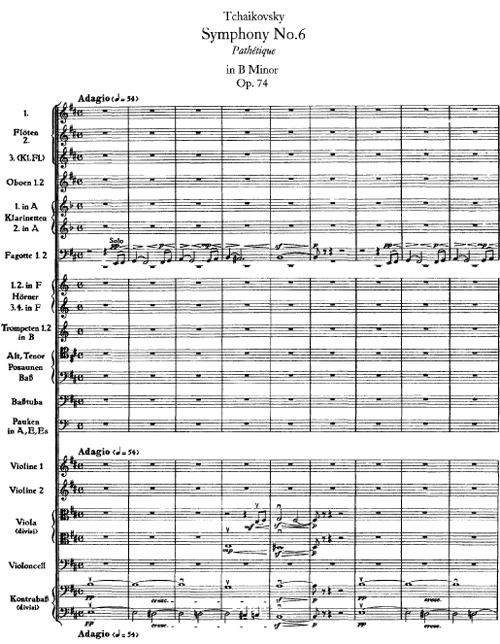
Tales of Despair: The Tragedy of the Symphony “Pathétique”

Foreword:

This is the first post of what I hope will become an ongoing series on the nature of despair. What I envisage is to introduce a work of art – be it imagery, poetry, music, film or novel – that was created from the darkest places of the soul. Darkness and despair have been a part of my life since my early teens, and as I have grown accustomed to it, and rediscovered joy in the midst of it, I have become inextricably marked by depression, and to this day there is nothing in the world so comforting as a warm, dark corner where no one can see me, My Dying Bride playing in the background, and a glass of wine reflecting the candlelight.

Being a musician and composer by training, many of these tales are likely to revolve around songs, symphonies and albums. However, I hope to reach out to further art forms, and discover among the canon of literature, film and imagery endless tales of despair.

The Tragedy of the Symphony Pathétique

There is in my mind no more fitting work of art more wrought with despair than Pyotr Illyich Tchaikovsky’s sixth symphony, popularly known as the Pathétique (in Russian, Patetičeskaja). This is a piece of music that passes through a sea of emotions of an intensity beyond anything I have heard or seen in my life. From the moodiness of the opening to the fury of the first movement’s climax, the calm sadness of the lilted waltz to the dizzying madness of the third movement, and ultimately the chilling, profoundly bleak finale, in fifty minutes this symphony takes the listener through a world of thought and a lifetime of tragedy.

The symphony’s name derives from the Russian word for passion, not pity, and it is a just name. The deep and overwhelming sadness of this music, however, is how closely it ties to Tchaikovsky’s turbulent personal life. Six days after its world première, Tchaikovsky died. He claimed to his brother that the symphony was steeped in meaning, but he would not reveal the music’s subject to anyone. Some have since said that it was his final death letter.

Tchaikovsky’s own life was a mirror for this tragedy. His sorrows began with the death of his mother at the age of fourteen, and from that day onwards he succumbed to a cloud of depression that even the recognition he eventually garnered could not completely break him free of. His life was a tale of abandonment, despair and frustration; Though homosexual, the social convictions of Victorian Russia prevented him not only from being open about this, but even from acknowledging it in his own mind. He suffered two affairs, both of which ended with the woman he cared for leaving him. He did eventually marry, but they lived together for less than two months, and she eventually bore children from another man.

Even the one light of hope – his patron, Nadezhda, with whom he corresponded for thirteen years in over a thousand letters – ceased communication with him in 1890, and he remained hurt, bitter and bewildered over this for the remaining three years of his life.

Tchaikovsky died in 1983 by his own hand. Perhaps he had become overwhelmed by the depth of despair into which his life had sunk; perhaps he could no longer bear the terrible conflict of his sexuality, which culminated in an attempted affair with his own nephew. On the night of the première of the sixth symphony, Tchaikovsky drank a glass of unboiled water, contracted cholera, and died six days later.

The terrible pain, sadness and despair is overwhelmingly prevalent in this symphony. Before his death, Tchaikovsky confided to his brother that the symphony was full of a deeper meaning, but would not say what it was. After he died, his brother realized he had been speaking of his own death – his final symphony, a monument to tragedy, was his suicide note. A parallel for his own life – childhood sadness, angst and fear at odds with the fervor and passion of creativity. Tchaikovsky destroyed more manuscripts than he completed – the artist’s madness refusing to allow him to ever be content with his own music.

This symphony, even out of context, is a tragic and moving musical journey; always a master of emotion, the composer filled his final work with every skill he possessed, and left us thus with his greatest work being his last. When considered as the final cry of a doomed man, a testament to despair, the final, terrible notes of the finale take on the reek of death, and speak of the utter finality of the grave. Tchaikovsky knew as he wrote that this symphony would be his last, and killed himself upon its completion.

For Seven Days, I Turned Off the Internet…And the World Didn’t End

Last week I got to do something very cool, and it was something I’ve never done before. I turned off the internet.

I suppose I can’t really claim that the entirety of the internet went down entirely, although if it had I wouldn’t have noticed, because I experienced a week of digital abstinence. The worst part is, I meant to.

Wow. What an admission that is. Imagine choosing not to receive emails, or text messages, or RSS feeds, or (horror!) WordPress hits. Imagine that, if you wanted to write something down, you had to use an archaic instrument known as a pen. Imagine not knowing whether you had new Facebook friends!

Such a world I lived in for an entire week. To give a bit of context, for most of the time between 12:00 PM one Saturday and 2:00 PM the following Saturday, I was in the middle of the ocean somewhere between Port Canaveral and Nassau in the Bahamas. I didn’t get wet, though, because I was on a boat. The boat was big, and in the end we had to share it with a few other people as well, but the captain was from Sweden and so I didn’t really mind.

I suppose I can’t actually claim to have shunned all technology entirely; I did bring a digital camera with me, as well as my iPhone (just for recording video, I swear). Between them, I captured 1,200 photos and two hours of video. I don’t want to look at them, because if I do I won’t ever stop. These pixellated memories are so numerous because my plethora of iDevices weren’t dinging and pinging and swishing every few minutes with something I decided was really important to know about. I didn’t receive an email. I didn’t get a text. I didn’t read a tweet, or update a feed. In fact, I ended up with such an awful lot of time on my hands that I had to look at the ocean sometimes, which was nice because there were quite a few sunsets to be had.

Another thing I had time for was thinking. After all, when you don’t have Wikipedia, you have to come up with your own answers to things. An astronaut told us that the body’s immune system doesn’t work in space, and gosh – we had to dig deep into our own poor wisdom to try to figure out why. My wife and I felt like scientists, trying to answer a question no one knows the answer to.

Above all, I was inevitably forced to spend time with my family. Man alive, the distraction of the internet is certainly a blessing for those who want nothing to do with their loved ones! I’ve been trying to keep a few chapters ahead of where my son and I are in the Redemption of Erâth, just in case one week I don’t write something, but I used them all up because he really, really wanted to know what happened next. At the end of chapter 12, I had to tell him that there actually wasn’t any more yet, and he nearly beat me. As for my wife, I had to share a jacuzzi with her, be sympathetic when she got seasick, eat a dozen chocolate-covered strawberries with her, sing karaoke with her, kiss her, and simply just be with her for seven days straight. Can you imagine?

At first, I was very worried. What was happening at home? What if someone at work really need to get in touch with me, even though I’m not really in charge of anything at all? What if my mom called? What if someone read my blog? What if a groundhog made a nest under the house? What if something really, really unimportant happened somewhere in the world? I wouldn’t be able to answer calls, say thank you to blog likes, take goofy pictures or read all about it on my iPad. I felt lost. But then, an odd thing began to happen. I slowly came to the following realization:

None of it matters.

Nope. Not one bit. Not one single thing in the imaginable universe was more important than spending seven entirely uninterrupted days with my wife and son in the Caribbean. Because you know what? I could always find out when I got back. And if I missed something in the meantime? Well, if it was something so ephemeral it only lasted a week, it probably wasn’t important enough to know about in the first place. If my schedule changed, I’d find out when I got back. If scientists discovered life on Mars, I’d find out when I got back. Hell, if my mother died, I’d find out when I got back.

In the end, of course, I got back. I came back to 101 emails, 91 tweets, 8 Facebook notifications, 66 RSS updates, 3 voice mails and 30 app updates. And you know what?

None of it really mattered.

I feel really happy right now. I don’t think I can live without connection in my working, every day life, but never again will I go on a holiday without turning off, leaving behind or utterly disabling my many devices. It is beyond worth it.

To the Oddest Person I’ve Ever Met

Can you believe it’s already been eight years since we first met? It’s surprising, when you think about it; neither of us knew each other at all all the way back then, and it was coincidence, really – a one in a hundred million chance – that we should even meet. In fact, probably shouldn’t have even happened. Amazing, then, that eight years later, we should still be in touch with each other.

Of course, you didn’t really speak to me much back then. No matter how much I tried to engage you in conversation, all I’d get were monosyllabic responses. I thought this was pretty odd behavior at the time, but I understand now that you were teaching me how to speak clearly, and slowly. How was I to know you had difficulty understanding me? I’ve worked hard at this, you know – everyone comments now on my clarity when I’m delivering a speech or presentation.

Despite that, even today there are times when I don’t really feel you’ve heard what I tried to say. But then, I’ll admit there are plenty of times when I don’t understand you, either. In fact, there are times when I don’t even listen to you.

Please don’t take me to task too much for this; despite the time we’ve spent together, our interests only partially overlap. We do both like reading, we like the same movies, and we both get a good laugh out of toilet humor, but our taste in music couldn’t be more different. Perhaps I’m just being narrow-minded, but honestly – to try and teach me the words to “Dynamite?” I’ll have you know I bought tickets to Iron Maiden last week, and you aren’t invited.

Our relationship hasn’t always been on the best of terms, either. We both get pretty angry with each other sometimes, and then we both sulk and won’t speak to each other for hours. Still, it all comes out in the end, and somehow you always find it in you to forgive me, no matter what I do. In fact, I’m kind of taken aback by just how much you tolerate of my poor behavior. It’s almost like you made some kind of subconscious decision that you’d stay with me no matter what happens. I just hope that lasts another eight years!

You do get jealous, sometimes; I remember the time you freaked out when you saw me kiss my wife. I know you don’t like the thought of us sharing a bed, but you understand: I’ve really made a commitment there, so I’m pretty much stuck with it. On the flip side, you don’t mind my long hair nearly as much, although you did tell me my beard is scratchy. I’m sorry – it’s not coming off for you, or anyone.

Through it all, though, I have to say – and I mean this, really – that knowing you has changed me for the better. You taught me things I never even considered before, and opened my eyes to a wider world. You taught me I could love more than one person, and that it was right to do so. You helped me to stop drinking so much, and got me on the meds I needed after so many years. You got me writing again, when I had all but abandoned it.

The only thing, I think, that really stands in the way is the age difference. Perhaps that’s the root of some of our differences in tastes – you’re more in touch with today’s youth. Still, I wouldn’t give it up for anything, even if people do stare at us holding hands as we walk down the street. What do they know? Things have changed, even compared to when we met. Eight years ago, I was a lifetime younger…and today, you are only eight.