The Devil’s Details: The Tragedy of a Wasted Imagination

Imagination is an exceptionally powerful thing. It is how we decide; how we play; how we learn. Even those of us who would claim to suffer from a poor imagination nonetheless exercise it on a daily basis: if you’re trying to decide which way to go home, you are essentially imagining which way is going to be best.

But sadly, the imagination often stops at these limited, practical uses. As children, our imaginations were with us. Our companion, our best friend, our life outside of life, imagination was the key that unlocked doors to a world more real and infinite than our own.* And as we grow older, and our lives become overwhelmed by those practical things, our imagination dwindles. We can console ourselves that we still read, that we watch thoughtful and engaging television, but that is really a poor substitute.

This is not to say that we have to act like children (well Einstein did, but look where he got us). All it really takes is a willingness to stop, to think, and to look beyond the surface.

I’m as guilty of this as anybody. I recently shared some photos of gravestones I took. This was one of my favorites:
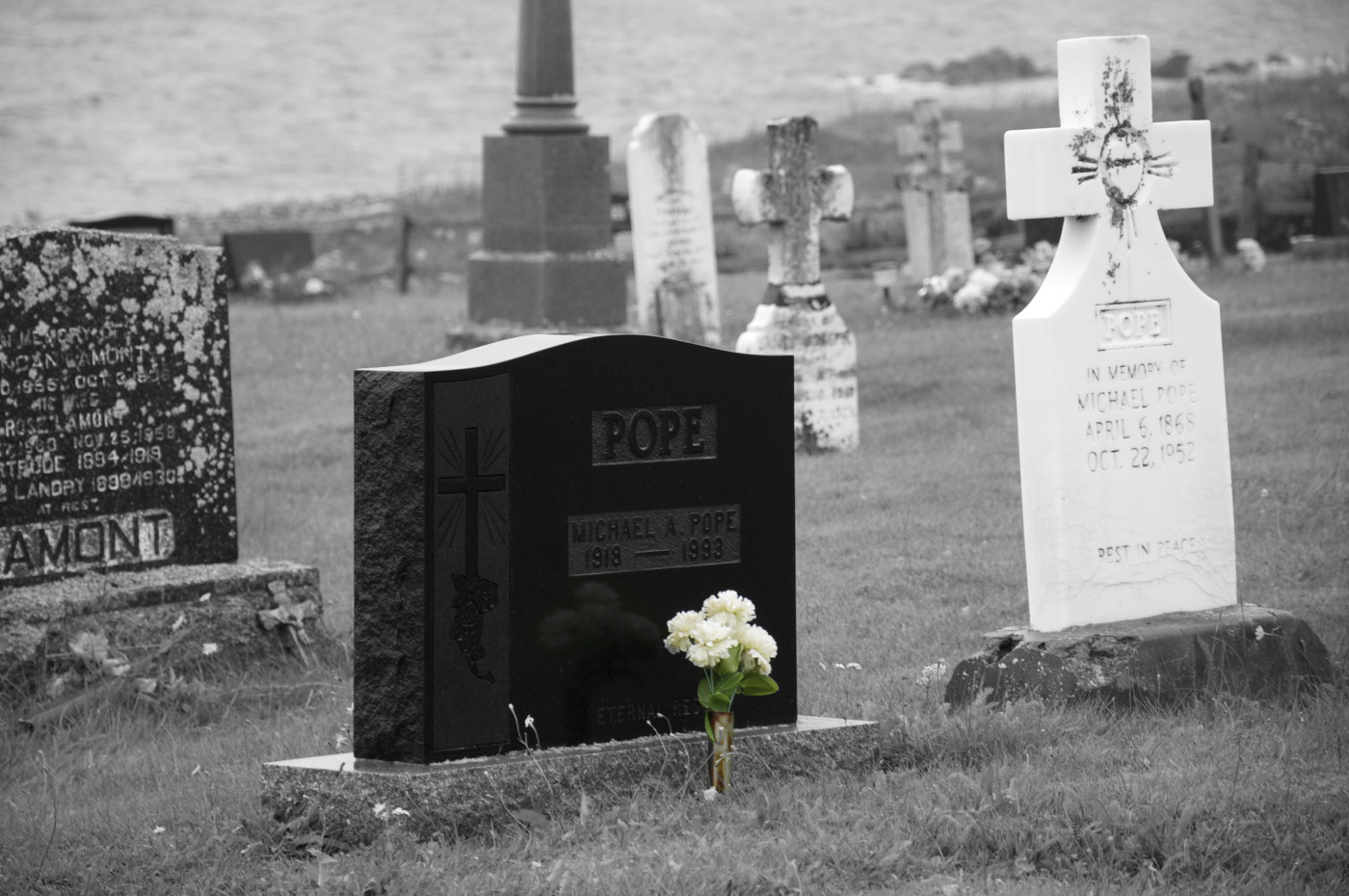
grave-of-michael-popeI took the picture because I thought the gravestone looked interesting. I was caught by the flowers, and so I took the snap. For a while, it was my favorite simply because of the composition, the way that the image lent itself to colorized black and white, and the hint of further graves behind.

And then, after I’d been working on this picture for some time, I actually stopped to read the epitaph. It reads:

POPE

MICHAEL A. POPE

1918 — 1993

ETERNAL REST

And then I started thinking about what this meant. The remains of a man lay beneath this stone. That man’s name was Michael; perhaps he went by Mike. Mike was a boy, once; his childhood might have been good, or it might have been terrible: he was eleven when the stock market crashed and threw the world into one of the worst economic depressions the world has ever seen.

Mike was twenty-one when World War II began; it’s likely he was drafted to fight. There is quite the possibility that Mike has killed people. How did that affect him for the rest of his life?

Mike knew someone else in his family; another Michael Pope – perhaps his father. Mike was thirty-four when this Michael died. This Michael himself was an astonishing ninety-four when he died. Think how incredible that is; when Michael Pope Sr. was ten, there was no such thing as radio. When he died, there was color TV, rock music, two wars whose tragic repercussions lasted long beyond his own life; there were even prototypical computers, though he might never have heard of them.

Our Mike was only seventy-five when he died in 1993. That’s not young, but it’s not old. Why didn’t he live as long as his father? Did he contract pneumonia? Did he suffer from dementia, or alzheimer’s disease? Perhaps he simply fell of a ladder. At some point, Mike took a final breath, and never breathed again. Who was with him when that happened? Maybe he knew his death was coming; maybe he never got to say goodbye to his family.

Of course, Mike might never have had any further family; there are no other Popes interred here. But there is one thing that feels certain: someone loved him very, very much. Someone loved him enough to commemorate him with a black marble gravestone. Someone who, twenty years later, still visits his grave to leave flowers.


* Children these days suffer from a world that stifles the growth of their own imagination. For your children’s sakes, don’t let them while away their childhood with video games and television; from time to time, send them outside with a stick.

The Devil’s Details: The Whale with a P***s in its Mouth

Bowhead-Zimmer
Warning: This post contains the word “penis” – several times. Rest assured that it is not, in fact, about penises.

You can read the full article here, but I just found this too bizarre and amazing not to share it with you.

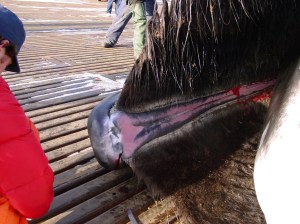
A team of scientists have discovered what is, for all intents and purposes, a penis attached to a bowhead whale’s palate. Fortunately it turns out it’s not the baby-making kind, so that’s at least one awkwardness out of the way.

Dr. Alexander Werth and his colleagues were observing an Inuit whale hunt (in the interests of science, naturally). Apparently this is the best way to get access to fresh whale tissue, which I was not aware was a commonly sought-after thing.

In any case, as they were observing the dissection, they noticed a very large ridge running along the roof of the whale’s mouth. It was nearly twelve feet long, which begs the natural question: how did they not know about this before? After all, surely these whale anatomists must spend a lot of time inside whales’ mouths, no?

What was astonishing to learn was that, when the hunters cut into this organ, it bled – massively. Sort of like if, you know, the same thing happened to a penis (don’t linger too long on that thought).

The bowhead whale's second "penis".

The bowhead whale’s second “penis”.

When they did further studies, they found that the interior structure of this odd organ did indeed function in a very similar way to the reproductive penis: it contained a mass of spongy tissue that could easily fill with blood, expanding the organ. When they discovered that this enormous pseudo-penis extended directly to the base of the brain, they started to have an inkling. The bowhead whale, out of all the species there are, is one of the most insulated, which makes sense for its arctic environment. In fact, it’s so well insulated that it can’t get rid of its own body heat efficiently. They suspected that in swelling this organ (effectively getting an erection in their mouth), they could put a large amount of their blood in contact with a vast quantity of freezing water. This would then flow back into the whale’s body, thus cooling it.

Where it gets really weird, though, is that they also discovered the surface of this organ contained a large number of extremely sensitive nerve endings – also rather like a penis. Presumably this wasn’t for the sake of having a good time, and indeed it appears to be related to the whale’s method of feeding. It takes a huge amount of energy for a whale to allow its mouth to fill with water, and then compress it so that it flows back out through their baleen. So much energy, in fact, that the whale probably wouldn’t want to waste it unless there was also a substantial quantity of food in the water. By sensing when the water contains a sufficient amount of food, it can ensure that no excess energy is wasted.

So anatomically, the bowhead whale has a fully functional penis in its mouth (sans the baby-making part). Which makes it one of the slightly weirder animals in the world.

The Devil’s Details: F-ing Handwriting

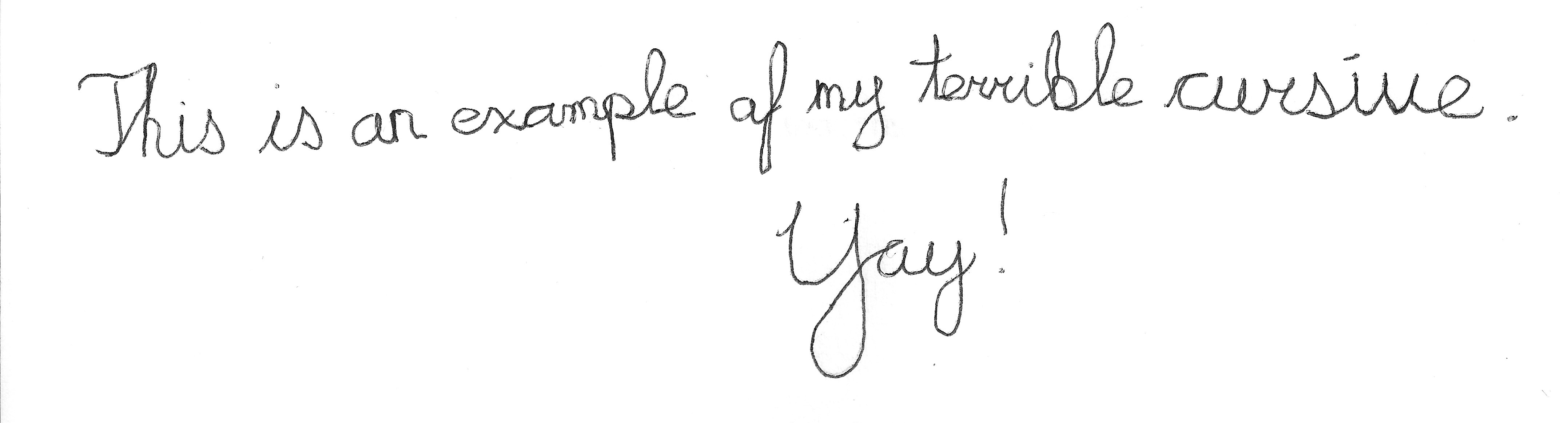
It’s so easy these days to create legible writing using a computer keyboard that it’s easy to let legible handwriting fall by the wayside. I have become such a typist that I can’t actually remember how to write in cursive:

I haven't written in cursive since the fourth grade.

I haven’t written in cursive since the fourth grade.

I did need to write by hand of course throughout school, and when push came to shove I found I could print faster than I could write (cursive). It’s still not anything I’m terribly proud of, but at least I can (mostly) keep it in a straight line:

"This is an example of my handwriting at its neatest." For those who still can't read it.

“This is an example of my handwriting at its neatest.” For those who still can’t read it.

My history exams came out looking a bit like that bottom line. There was a kid in that class who could write ten pages in the time I wrote two…he got an A.

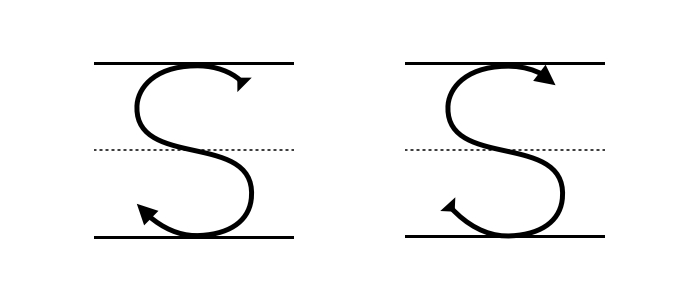
Now Little Satis has been having quite some difficulty forming letters, and his handwriting is difficult to read at its best. If he’s patient and takes his time he can actually write quite well, but he’s eight. The odd thing is how he has learned (or taught himself) to write:

Left: Standard writing direction. Right: Little Satis' writing direction.

Left: Standard writing direction. Right: Little Satis’ writing direction.

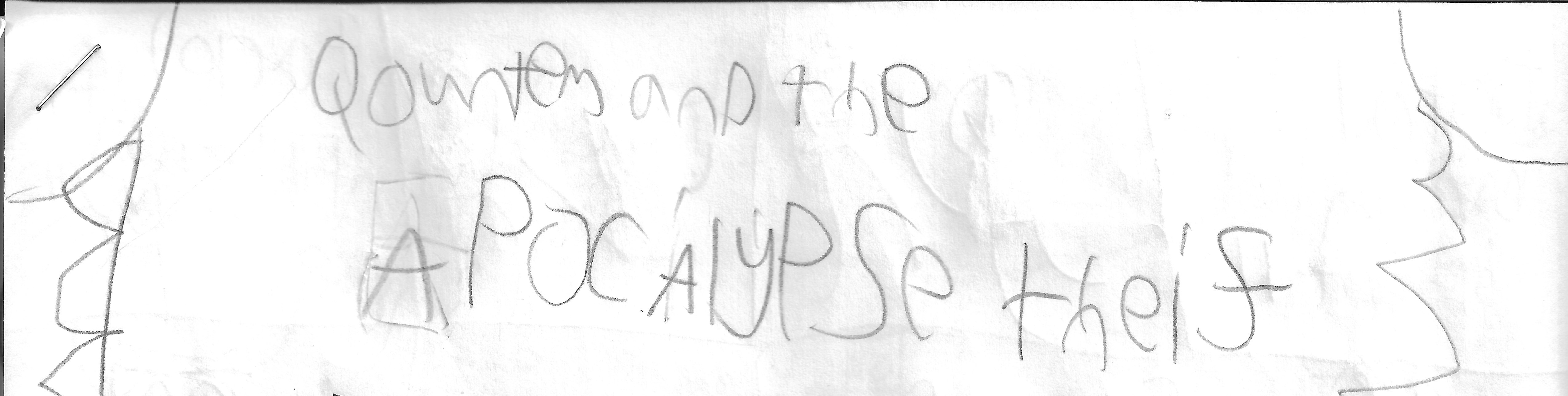
Rather than starting at the top, he starts every letter at the bottom, and traces it up from there. This particularly causes problems with descenders, since they too start on the line, and not below it:

"Qountem and the Apocalypse Theif", for those who are struggling.

“Qountem and the Apocalypse Theif”, for those who are struggling. Don’t ask.

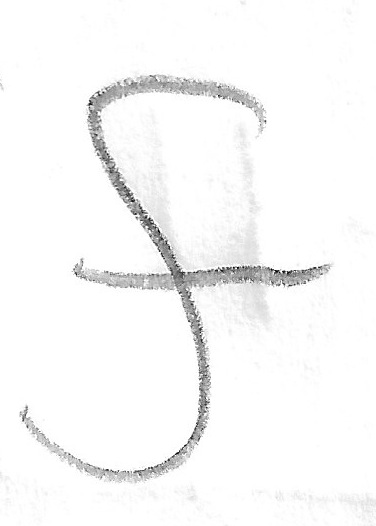
However, although his handwriting is in dire need of attention, check out the F:

What a lovely F!

What a lovely F!

Isn’t it pretty? How did that come out of…well, that?