For Seven Days, I Turned Off the Internet…And the World Didn’t End

Last week I got to do something very cool, and it was something I’ve never done before. I turned off the internet.

I suppose I can’t really claim that the entirety of the internet went down entirely, although if it had I wouldn’t have noticed, because I experienced a week of digital abstinence. The worst part is, I meant to.

Wow. What an admission that is. Imagine choosing not to receive emails, or text messages, or RSS feeds, or (horror!) WordPress hits. Imagine that, if you wanted to write something down, you had to use an archaic instrument known as a pen. Imagine not knowing whether you had new Facebook friends!

Such a world I lived in for an entire week. To give a bit of context, for most of the time between 12:00 PM one Saturday and 2:00 PM the following Saturday, I was in the middle of the ocean somewhere between Port Canaveral and Nassau in the Bahamas. I didn’t get wet, though, because I was on a boat. The boat was big, and in the end we had to share it with a few other people as well, but the captain was from Sweden and so I didn’t really mind.

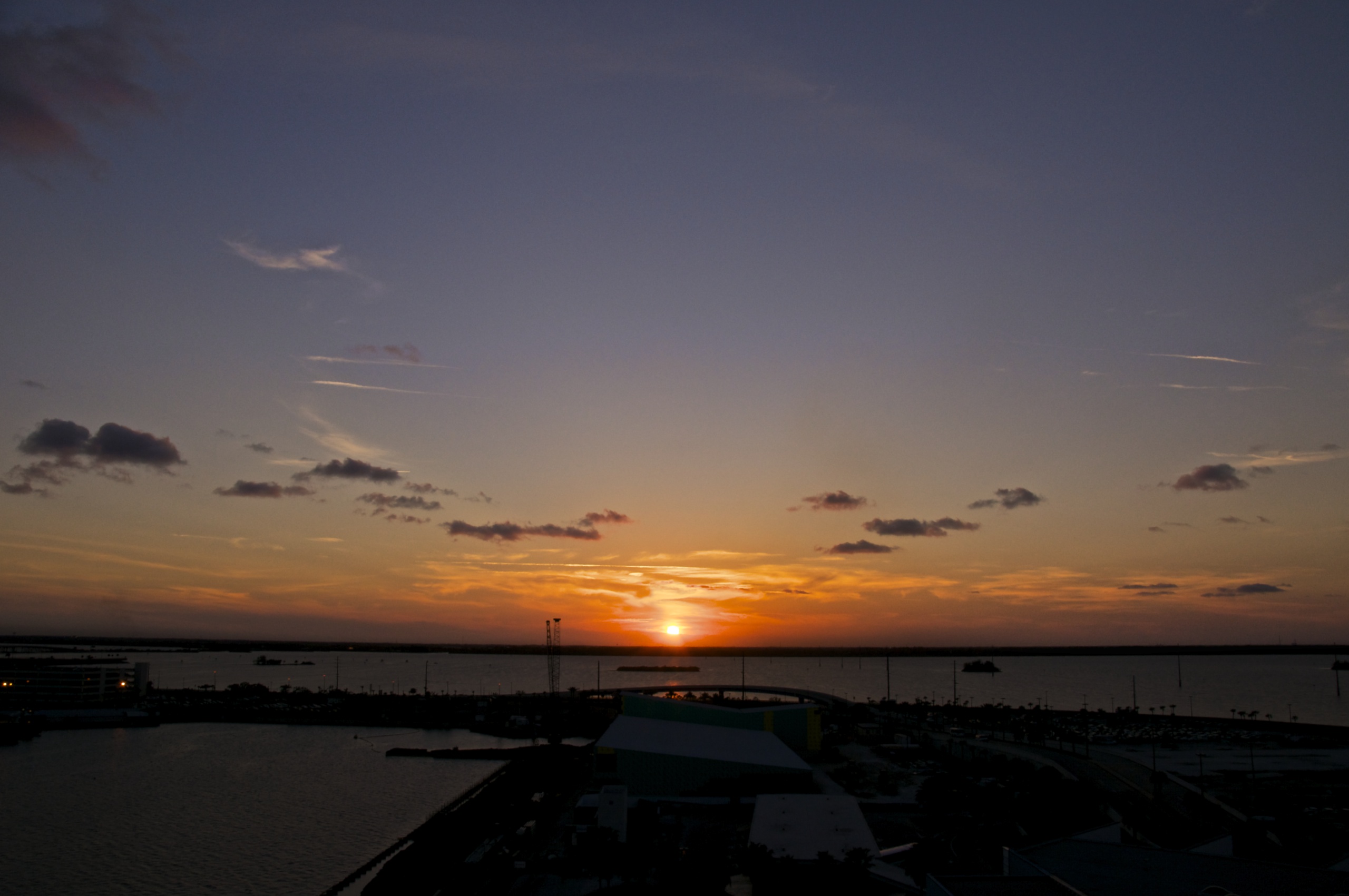
I suppose I can’t actually claim to have shunned all technology entirely; I did bring a digital camera with me, as well as my iPhone (just for recording video, I swear). Between them, I captured 1,200 photos and two hours of video. I don’t want to look at them, because if I do I won’t ever stop. These pixellated memories are so numerous because my plethora of iDevices weren’t dinging and pinging and swishing every few minutes with something I decided was really important to know about. I didn’t receive an email. I didn’t get a text. I didn’t read a tweet, or update a feed. In fact, I ended up with such an awful lot of time on my hands that I had to look at the ocean sometimes, which was nice because there were quite a few sunsets to be had.
Another thing I had time for was thinking. After all, when you don’t have Wikipedia, you have to come up with your own answers to things. An astronaut told us that the body’s immune system doesn’t work in space, and gosh – we had to dig deep into our own poor wisdom to try to figure out why. My wife and I felt like scientists, trying to answer a question no one knows the answer to.

Above all, I was inevitably forced to spend time with my family. Man alive, the distraction of the internet is certainly a blessing for those who want nothing to do with their loved ones! I’ve been trying to keep a few chapters ahead of where my son and I are in the Redemption of Erâth, just in case one week I don’t write something, but I used them all up because he really, really wanted to know what happened next. At the end of chapter 12, I had to tell him that there actually wasn’t any more yet, and he nearly beat me. As for my wife, I had to share a jacuzzi with her, be sympathetic when she got seasick, eat a dozen chocolate-covered strawberries with her, sing karaoke with her, kiss her, and simply just be with her for seven days straight. Can you imagine?

At first, I was very worried. What was happening at home? What if someone at work really need to get in touch with me, even though I’m not really in charge of anything at all? What if my mom called? What if someone read my blog? What if a groundhog made a nest under the house? What if something really, really unimportant happened somewhere in the world? I wouldn’t be able to answer calls, say thank you to blog likes, take goofy pictures or read all about it on my iPad. I felt lost. But then, an odd thing began to happen. I slowly came to the following realization:

None of it matters.

Nope. Not one bit. Not one single thing in the imaginable universe was more important than spending seven entirely uninterrupted days with my wife and son in the Caribbean. Because you know what? I could always find out when I got back. And if I missed something in the meantime? Well, if it was something so ephemeral it only lasted a week, it probably wasn’t important enough to know about in the first place. If my schedule changed, I’d find out when I got back. If scientists discovered life on Mars, I’d find out when I got back. Hell, if my mother died, I’d find out when I got back.

In the end, of course, I got back. I came back to 101 emails, 91 tweets, 8 Facebook notifications, 66 RSS updates, 3 voice mails and 30 app updates. And you know what?

None of it really mattered.

I feel really happy right now. I don’t think I can live without connection in my working, every day life, but never again will I go on a holiday without turning off, leaving behind or utterly disabling my many devices. It is beyond worth it.

Where I Am with the Redemption of Erâth

So.

I feel I’ve reached a small milestone with The Redemption of Erâth, and thought I’d share a few stats to let you know where things stand. The tale itself, of course, is planned at the moment to span over seven books, and so by that measure I really haven’t even begun yet. But, by my drafts and outlines, I have just touched the halfway mark for Book One, and I’m sort of kind of proud of that, not least because I’ve never committed to anything and seen it through this far before.

Ever.

So, what did it take to get here? Let’s start by ignoring the 50,000-word history of the world of Erâth that I raced through during NaNoWriMo last year. That provided a huge impetus into getting this story out of my head and onto (digital) paper, and allowed me to flesh out the world in which my characters live, and how this world got to where it is now, in the time of my tale. I learned so much about the world of Erâth throughout this process, I feel I have lived there. I was astonished to discover the world was flat, and that ephemeral beings called the Duithèn were responsible for the downfall of the world and its casting into Darkness. I learned of the fall of Goroth, and the role Dragons played in his defeat. I even learned that the king Daevàr of Erârün deceived the king of Kiriün into joining him in battle against the forces of Darkness.

Still, all of that is a prelude to the tale I have to tell of Brandyé Dui-Erâth and his exile from the lands of Consolation. This is the story I have committed to, and this is what my commitment has taken me to so far:

• Chapters: 12/25

• Words: 52,416/100,000

• Pages: 166/300 (I’m not sure why this matters in an eBook)

• Weeks: 10/25 (at one chapter each week)

• Cups of coffee: 150/400

• Brain farts: 23/4

• View on WordPress: 450/1,000,000 (!)

• Korn songs listened to: 1/1

• Sonata Arctica songs listened to: 43/43

• Number of times I’ve annoyed my wife: 103/0

So that’s where I am! I’m feeling pretty good with myself. I hammered out three chapters this week and last, because I will be away for the next ten days and wanted to still share the ongoing tale without pause. These will auto-post each Saturday evening (this seems a popular time – let me know when you read your blogs!).

Hopefully you’ve enjoyed the tale so far, and I can’t wait to find out what happens next. All I can say is, it only gets better from here!


Satis

On Creativity, Credit, and the Popular Idol

My wife is watching American Idol. As you can tell, I am not. I don’t strictly loathe the program; I just really, really don’t like it.

I’m aware it’s a very popular little show. Not just my wife watches it, apparently; there’s a guy at work who mentioned in passing as well. And, as long I’m being honest with you all, I don’t actually mind the talent on display, even if it does seem like a grossly overblown, shameless televised debutante ball for people with a little more lung than the rest of us.

The key thing for me is, what talent exactly is on display? There is something indeed unique and special about the contestants on American Idol (at least, those that make it through the first few rounds). Whether they’ve got a Dave Grohl grin or don’t care two whits about their audience, most of the people up on that stage share a common talent: their voice. They are, for the most part, good singers. Some are great, and would be at home on Broadway, or at the opera.

And I am a huge fan of musical talent. Alfred Brendel, Yo-Yo Ma and Isaac Stern are unparalleled to this day (and I am quite fortunate to have a recording of Brahms’ chamber music with most of these fellows playing). Joe Satriani and Eddie Van Halen can shred like none other. Mike Portnoy is an astonishing drummer, and hey – love him or hate him Axel Rose can sing. These are all exceptionally talented musicians, performers who rank in the top 1% of their art. But – and here is the argument’s focus – how far does their credit and fame extend?

As much as I enjoy consuming media (books, music, movies, etc.), I also create it as well. I am by training a musician and a composer. I am by my own hand a writer. And I have made a couple of terrible home movies. And whether it is in poring over the score of Beethoven’s sixth symphony, or marveling at the poetry of Dickens’ words, or admiring the artistry of Coppola’s Dracula, it is always driven home to me the intense passion, the sweat and tears, the frustration and the determination, that these artists have invested in their work.

Think, for a moment, about the song you’re listening to. Is it three, four, five minutes long? How long did it take to write, rehearse, perform and record that music? Chances are, several months. Production began last year on The Hobbit, which is due for release this Christmas. And the script was in the works ten years ago. Stephen King began work on his Dark Tower series in 1975 and is still working on it today. These are creations of human imagination, and while many of us have wild fantasies, stories and songs that run through our hears, these few are the ones with the bravery, the foolishness, and the love of self-immolation to commit those fantasies to permanence.

Yet in all of this, music – and specifically popular music – stands alone in several ways from all others. I won’t comment on the idea that pop songs are created for money; all art is, in one form or another. Nor will I say anything about the formulaic characteristic that defines most pop music; how many Agatha Christie clones are out there in the literary world?

No, the one thing that I can’t help but notice – the one thing that frustrates me to no end, and drives to to tears to think of it – is the credit given to the creators of these works. What springs to mind when I say The Hobbit, Vertigo, Titanic, Alien, Dune, or The Pit and the Pendulum? More likely than not, J.R.R. Tolkien, Alfred Hitchcock, James Cameron, Ridley Scott, Frank Herbert and Edgar Allen Poe. Yet if I ask you who wrote any one of Britney Spears’ eleven Top 10 songs, how many of you would be able to answer, Max Martin?

Turns out, Max Martin wrote chart-topping songs for The Backstreet Boys, NSYNC, Kelly Clarkson, Pink, Katy Perry, and even Usher. Now I don’t typically listen boy bands, pop rock or hip hop. Not out of any sense of pride – it just doesn’t speak to me. My tastes do vary – anything from The Cure and The Sisters of Mercy to Iron Maiden and Napalm Death, along with more or less the entire canon of western classical music from the 1600s on. It wasn’t until recently, however, that I started to wonder why I was attracted to these styles of music in particular. The answer that came to me, ultimately, was art. These musical styles represent art in its highest form. Like looking at a Picasso or reading Jules Verne, through the art you are in touch with the artist, and you have the chance, if you slow down, to marvel at every brush stroke, or wonder how the writer chose their words, and why they hold such magic.

When I listen to Porcupine Tree (one of my favorite bands), I don’t just hear the music. I hear Steven Wilson, writer, producer, singer, performer, making sure every single sound I hear is there on purpose, for me to recognize and revel in. I imagine him sitting in a studio, expensive headphones on, changing the reverb from 5 milliseconds to 6 milliseconds, smiling, and thinking – that’s perfect.

I wonder if Britney Spears ever does that.

In classical music, the composer is prized above all else, even the performer. “Simon Rattle conducts Beethoven’s Ninth Symphony” – the work of art belongs to the composer.

In film, it is the director, though the producer, screenwriter, and composer are all credited as well; “Stanley Kubrick’s 2001: A Space Odyssey.”

In literature – surprise – the author.

And even in contemporary popular music – rock, rap, jazz, punk, metal, house and hip-hop – it is rarely questioned that the artist and songwriter are not the same. We assume that Kurt Cobain had some hand in writing the music and lyrics to Smells Like Teen Spirit. Even Flo Rida wrote “Good Feeling” (under his real name of Tramar Dillard). So what happened to generic-brand pop? When did the performers begin to overshadow the creators?

So I won’t cry shame on American Idol; after all, showcasing talent is (ostensibly) what the show is all about. I have no problem with a nobody from Arkansas being given a shot at fame. But spare a thought for the songwriters who gave their lives to make this happen. Continue to give them credit as you sing.

And who knows? Maybe one day we’ll have a talent show for songwriters and composers. Admittedly, it would be a lot less fun to watch. But it would certainly be more interesting.