Thought of the Week: The Stubbornness of Children

Don’t forget – you can claim your free copy of The Redemption of Erâth: Consolation just by emailing satiswrites@icloud.com and telling me which digital format you’d prefer (ePub, Kindle, PDF, etc.)!

***

Our family moved house recently, and the other day I took Little Satis to the new local library for the first time. (Actually, I’m ashamed to admit that it was one of the first times he’s been in a library at all, other than at school; we get most of our books from Amazon.) I had ulterior motives, of course – I wanted to see if they’d stock The Redemption of Erâth: Consolation! But aside from that, we signed ourselves up and started to browse.

It turns out that at ten, Little Satis is far beyond the children’s section, and so we moved upstairs to the young adult/teen section, where he looked for some more books by Rick Riordan, being utterly obsessed with the Percy Jackson series. (We watched the first Percy Jackson movie the other day, incidentally; I wasn’t terribly impressed.) Being the open-minded adult that I am (and not caring what I chose for him, since he’s the one who’d be reading it), I started looking through various titles to see if there was anything new I could interest him in.


“Have I ever steered you wrong (except that one time)?”
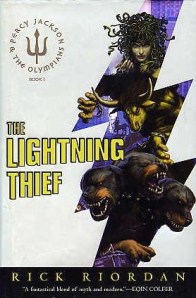
 

The Lightning Thief, by Rick Riordan

The Lightning Thief, by Rick Riordan

This has proven to be a difficult endeavor indeed. As long as I can remember, Little Satis has been bullishly obstinate about refusing to try new literature. He’s the same with movies, too. Every Friday night (more or less), we sit down to watch a movie – ideally one he, and perhaps myself, hasn’t seen yet. Every single time, he balks and whinges at every choice I make, insisting he just wants to watch The Lord of the Rings or Star Wars for the fiftieth time. So far, I’ve made precisely one bad choice: the utterly appalling, not even so-bad-it’s-funny bad, Pirates of Treasure Island. That one was a stinker. Other than that, he has supremely enjoyed every movie we’ve ever watched together, from obvious choices like the Harry Potter series to off-the-wall adventures like Time Bandits and old, dreadfully-dubbed Jackie Chan movies. It’s become a catchphrase in our house: “Have I ever steered you wrong (except that one time)?”

So I was less than surprised when he professed little enthusiasm for the book I picked out for him, Witch & Wizard by James Patterson. Personally I was surprised to find James Patterson, of Alex Cross fame, had written young adult/children’s stories, but despite having never read any of his other works I presumed that, given his enormous popularity, they would be reasonably good. Little Satis thought differently.

He pulled a huff, right there in the middle of the library, and refused to use his own, brand-new library card to check out the book. He flat-out told me he absolutely would not ever read the book. I had to bribe him – I’d buy cookies for dessert if he promised to read at least he first fifty pages. He stalled, saying that he wanted to finish reading Percy Jackson and the Sea of Monsters…for the twelfth time. In the end, I had to threaten not to read any more of Harry Potter and the Deathly Hallows with him at bed time until he tried the book.

Charles Dickens – doesn't this guy look stuffy and boring?

Charles Dickens – doesn’t this guy look stuffy and boring?

It’s funny, because of course looking back at myself as a child, I was exactly the same. I suspect many of us were; there’s a great comfort in familiarity. I remember re-reading books immediately upon finishing them, over and over again. I remember looking at the title of a new book and screwing up my nose at it. I remember being forced to read Charles Dickens, thinking it must be the most boring literature in the world (Dickens is now my primary literary hero). The thing is, I don’t consciously recall a turning point – a point where I suddenly had a desire to try new things. I feel that it was a struggle, though; something that didn’t necessarily come naturally. And nor will it for Little Satis, and I don’t expect it to. I suppose that’s what our parents are there for: to tell us, “Just try this one – trust me. When have I ever steered you wrong (except that one time)?”

In the end, of course, Little Satis did pick up Witch & Wizard one weekend while I was at work. When I got home, the first thing out of his mouth was something that had happened on page sixty-seven. “What happened to only reading to page fifty?” I asked.

“Dad…” he said with his head down, “Maybe – just maybe – you might have, well, um…been right about this book.”

I guess that’s one thing that’s no easier to say as a child than as an adult.


Featured image taken from http://www.pdgm.com/resource-library/paradigm-tv-channel/virtual-lecture-series-2014/.


Satis Logo 2014

Movie Night: The Lord of the Rings – The Fellowship of the Ring (Part 2)

Part two leads off from the Council of Elrond, through the passage over Caradhras and the mines of Moria, the stay with the elves in Lothlorien, and ultimately the sacrifice of Boromir and the breaking of the fellowship.

Frodo carries on the journey begun in the Shire, and more than ever, we see him begin to realize the danger and power of the ring. Even after Gandalf utters the ring’s inscription in the tongue of Mordor, Boromir of Gondor still tries to convince the council to allow his country to use it as a weapon. Gimli attempts to destroy it to no avail, and even when, through the tension, the council agrees that it must be destroyed at Mount Doom, a bitter argument breaks out over who is to be responsible for its destruction. We see Frodo, watching from the background, witness the mounting enmity through flames reflected in the ring itself. It is in the midst of this that he realizes his fate: he is to carry the ring to its final destruction, or his.

One Ring to rule them all,
One Ring to find them,
One Ring to bring them all
and in the darkness bind them.

This is a thought that is reinforced throughout the remainder of the film; the fear Frodo has in allowing others to touch the ring (first seen when Boromir retrieves the fallen ring in the snow of Caradhras) bears witness to this, and it is reinforced when he talks with the Lady Galadriel in Lothlorien. Having witnessed the loss of Gandalf in Moria, and bearing the guilt of that loss with him, he realizes he can no longer bring peril to the remainder of the Fellowship: his decision is made.

You are a Ring-bearer, Frodo. To bear a Ring of Power is to be alone.

It is of course not until the end of the film that Frodo finds the courage to do so; it takes the betrayal of Boromir, and the evidence of the ring’s maddening effect on those around him, to finally convince him. We see him leave; see Boromir find his redemption, and accept his king; we see Merry and Pippin captured by the uruk-hai. The stage is set for the following two films.

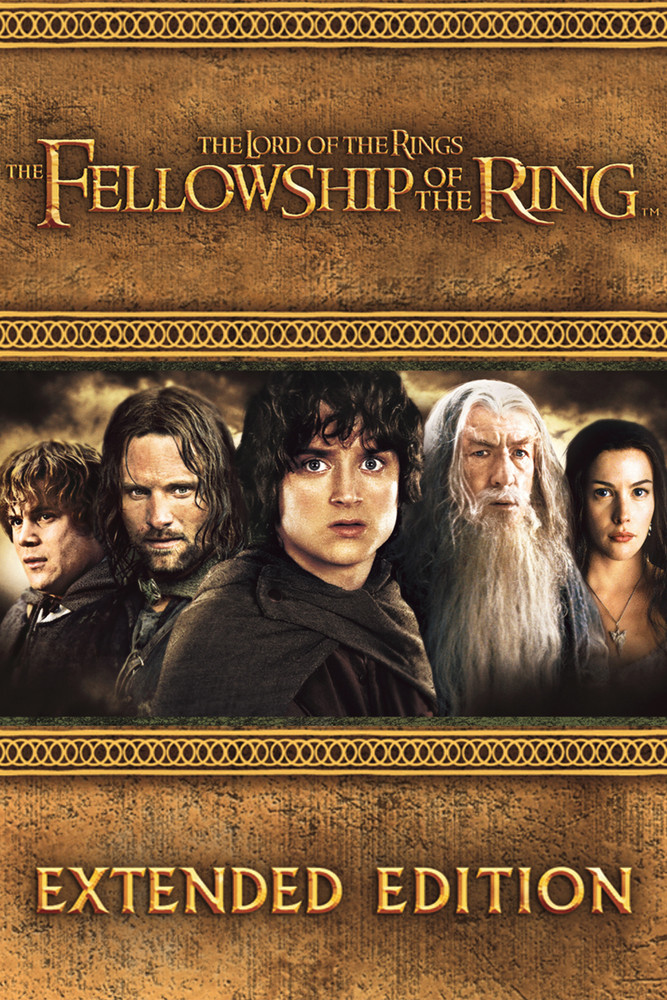
It is not the first time Little Satis and I have watched The Lord of the Rings (not even the extended edition), but each time he observes further details, and now is pointing out things I had not seen myself, or at least had not noticed. He made the distinction tonight between the goblins of Moria, the orcs of Mordor, and the uruk-hai of Saruman. Apparently the uruk-hai are seen only in the first two films; the assault on Minas Tirith is made by a combined army of orcs and men, but there are no uruk-hai. He thought perhaps this was the failing of Sauron; the uruk-hai were fewer, but were stronger. Had he had an army of ten thousand uruk-hai to storm the white city, the outcome might have been quite different.

I can’t wait to see what other things he notices as we continue with The Two Towers; watching with an eight-year-old is certainly a rewarding experience!

Movie Night: The Lord of the Rings – The Fellowship of the Ring (Part 1)

After last week’s fiasco, Little Satis and I decided we were in need of a known-good film (KGF). As we discussed it, we realized that we both had quite the hankering to revisit The Lord of the Rings.

Now as you know, this isn’t exactly a one-night endeavor, and so this will be the main focus for the next few weeks. Particularly since we are watching the extended editions (which in my mind are superior – yes they are), this is going to take us some time. Tonight, we watched The Fellowship of the Ring up to the Council of Elrond. (Fun fact – my computer’s spell-check recognizes the world Elrond.)

There’s not a lot to be said about this epic set of films that hasn’t already been discussed ad nauseum. For me, Peter Jackson’s three films represent one of the finest, most perfect filmic storytelling masterpieces of our time, alongside Ben Hur and Spartacus and Dr. Zhivago and Lawrence of Arabia (and more). I’ve discussed the music at length, and there is little more to be said about that, but there are always new things I notice in terms of the film itself.

In the area of cinematography, Peter Jackson has shown himself to be a genius. Beyond the basic settings of his native New Zealand, the direction is subtle, ingenious and masterful. Tasked with the hideous job of making a 5’6″ actor appear half the size of a 5’11” actor, Peter turned to some innovative effects. While multiple shots against green screen were used when possible, there are moments in the film when such things are simply impossible. A fantastic example of this is in the early scenes when Frodo is riding side-by-side with Gandalf in a cart; both actors – not doubles – are sitting next to each other, and the illusion is perfect. It’s only on extremely close inspection that it appears the cart was specifically built with one side of the seat further away from the camera than the other, thus placing Elijah Wood further away than Ian McKellen.

Peter’s faithfulness to the book is also commendable. I’m aware this is somewhat of a contentious issue, as there are indeed areas where Peter and his wife Fran Walsh took considerable liberties, but there are in each case a wonderfully good reason. The most common reason for changes is Hollywood dramatics; no one is interested in a character called Tom Bombadil. One of the things that impresses me continuously, however, is Peter’s respect for the pace of Tolkien’s books. The Fellowship of the Ring, like the two that follow it, is not a fast-paced film (their 4-hour running times is ample evidence of that). The fact that the opening half hour of the movie revolves around the Shire showcases this, but it serves an important job: it retains the gradual building of tension and the destroying of Frodo that is so incredibly important in the books. Take a moment and look at Frodo in the earliest moments of The Fellowship of the Ring, and compare it to the final moments before the destruction of the ring in The Return of the King. It hardly seems to be the same person.

This insidiousness is, ultimately, what draws me and Little Satis into the movie so deeply. The turning points are many, but subtle. The way Frodo looks at the ring after barely escaping the Nazgûl shows clearly that the deadly seriousness of their plight has only just dawned on him. Later, on Weathertop, the three other hobbits are cooking in the night, and only Frodo has the presence of mind to realize their fire could give them away. These are further things that change as each character experiences their own life-altering experiences.

Perhaps the most compelling scenes in the first half of this film are those at the very beginning, where Bilbo Baggins is musing on the story to write in his home under the hill. He says that a Baggins has always lived there, and always will. In these few words, we see both the beginning and the end of the tale, and are set up for all the bitterness that is to follow.

More to come next week!