Thought of the Week: The Real Final Frontier

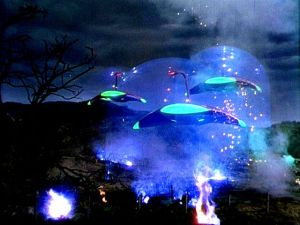
Shot from 1953's The War of the Worlds.

Shot from 1953’s The War of the Worlds.

Having recently watched Star Trek Into Darkness (and thoroughly enjoyed it), it nonetheless brought to mind the nature of the universe at large, and how stunningly wrong science fiction gets it all the time. I’m not talking about warp drives and ion engines, but some of the less obvious, background kind of stuff. Lately (actually, for some time, come to think of it) science fiction movies have been bombarding us with spectacular visual effects. The War of the Worlds from 1953 showed us groundbreaking special effects, combining matt painting, models and live action footage. Independence Day marked one of the first mass uses of CGI to create the majority of the movie’s special effects. Green Lantern was essentially computer animation with a face in it.

But in striving to wow us with ever more impressive visual effects, the writers and filmmakers have had to take liberties with the truths of the universe. In Star Trek II: The Wrath of Khan (still of the best Star Trek movies in my opinion), the Enterprise manages to ambush Khan by entering a nebula, whose gaseous particles block all of their sensors. Nebulae, of course, are real. Here’s one:

The Crab Nebula, about 6,500 light years away.

The Crab Nebula, about 6,500 light years away.

And Star Trek‘s:

The Mutara Nebula from Star Trek II: The Wrath of Khan

The Mutara Nebula from Star Trek II: The Wrath of Khan

The ships enter the nebula as though it’s a kind of cloud in space. Here’s the problem: the individual particles in a nebula are kind of far apart: about 100 or so in each cubic centimeter (air, by contrast, has around 1,000,000,000,000,000,000 particles per cubic centimeter). A nebula wouldn’t really look like a nebula; it would look sort of…empty. They’re also somewhat large for a spaceship to ‘duck’ into; the Crab Nebula above is about 11 lightyears across.

What strikes me about these images, however, is their visual impressiveness. For all the technical wizardry of ILM and Weta and all the other companies out there, nothing quite compares to the unimaginable marvels of the natural universe. Here’s Saturn:

An incredible image of Saturn and its largest moon, Titan.

An incredible image of Saturn and its largest moon, Titan.

It is one of the most stunning and awe-inspiring images I’ve ever seen. It almost doesn’t look real, and its reality is therein. Nothing we could imagine or invent could compare. What you’re seeing is hundreds of millions of miles away from us, and thousands of miles from the camera that took the picture. Nothing can even come close to encompassing the incredible scale of these stellar objects.

Here’s a shot of Enceladus, another of Saturn’s moons:

Water geysers erupting from Enceladus's south pole.

Water geysers erupting from Enceladus’s south pole.

Those small, gassy bursts are actually jets of water (yes, water – on another freaking planet!). Each one is nearly three hundred miles high. There is significant evidence that Enceladus hosts liquid water beneath its surface, which is one of the primary, basic requirements for life. Traces of potential organic matter have also been detected, increasing the possibilities. Wouldn’t it be simply astounding if there was actually life – real life – on another planet in our solar system?

And to finish, here is one of the most spectacular sights you’ll ever see:

The stellar spire inside the Eagle Nebula. I've rotated it on its side, but would be seen vertically from Earth.

The stellar spire inside the Eagle Nebula. I’ve rotated it on its side, but would be seen vertically from Earth.

These are not paintings, or computer graphics; these are real, genuine photographs of the absolutely insane and indescribably beautiful things that fill our universe. Their size is incomprehensible, galaxies that span trillions of miles, stars whose light has travelled for a billion years to reach us, and even evidence of real, genuine plants orbiting other stars. I will continue to enjoy my Star Trek, but I will never be satisfied with their tenuous links to reality, or their inability to even come close to mimicking the wonders of the universe.

Satis Logo with ©

Thought of the Week (Late): They Ruined the Movie

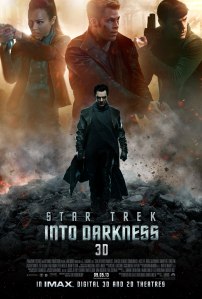
star-trek-2-into-darkness-posterI just went to see Star Trek Into Darkness today. I will say that I still don’t particularly understand the title reference unless it’s purely poetic, but it was a good movie. Full of action, laughs and tears, with a near overload of Star Trek references for the geeks (myself included).

There’s a lot about the movie that I won’t talk about because I don’t want to spoil it, but there are some scenes and things that occur that were genuinely shocking to me. And not because of their import in the world of Star Trek (although that, too, is a factor), but because I genuinely didn’t expect it. I had not been prepared beforehand; it had not been in the trailer.

And I loved it.

Take a moment to watch the trailer for Star Trek Into Darkness. It’s riveting, as of course all good trailers are. It introduces our characters: Kirk, Spock, McCoy, Scotty and the gang, and the bad guy – that guy from Sherlock. It sets the tone (dark, obviously) and features back-to-back sequences of explosions and stunts, interspersed with the slow-downs of momentary reflection. Ultimately, here’s what we know: a madman is on the loose and Kirk et al. are off to stop him. Along the way buildings get blown up, people get hurt, there’s a shot with a giant shadow-Enterprise, and a tantalizing shot of a spaceship crashing headlong into the ocean.

I can now safely tell you that you don’t know half of the movie.

Sadly, not all movies are like that these days. As we waited for the feature to begin, we quite naturally sat through some trailers for new, up-and-coming movies. Among them were World War ZAnchorman: The Legend ContinuesThe Lone RangerEnder’s Game (yeah, did you know they’re making a movie out of that?) and Elysium. Of those, the one I know the least about – and am therefore the most excited to see – is Anchorman.

Compare that to The Lone Ranger.

Now let me tell you about it. A city man returns to his home in the West, where his brother is a sheriff. He’s soon deputized, only to be ambushed by bad guys and witness his brother’s death. Rescued by a very odd native american, he learns to hide his identity to seek revenge for his brother’s murder, only to find the bad guys aren’t quite what they seem. It turns out it wasn’t a random ambush, but the very lawmakers themselves that killed his brother, in a conspiracy to smuggle some kind of valuable ore (coal, maybe?) and make a fortune out of it.

All of that, from the trailer. I didn’t look at IMDb, honest. I’ll ignore that it’s based on a previous premise, because I haven’t seen that either.

The days of the trailer as a medium of art is nigh at an end. Once, movie trailers were like this:

What a masterpiece. Every element of the story is in there, from the characters to the plot and the inevitable deaths to the tone and style set by the dark lighting and high, atonal strings. But it’s structured in a seemingly random sequence so that so one part can be associated with another. It’s not linear. It hints at a story, without actually telling it.

Here’s another fantastic trailer from the past:

What do I know? Nothing, except it’s about aliens and I’m going to crap my pants.

I’m well aware of the dangers of cross-comparison. The Lone Ranger isn’t Alien. It isn’t Psycho. It isn’t even Wild Wild West (actually, it is, but at least …Wild West‘s trailer didn’t give the entire story away). It isn’t a horror movie. It isn’t sci-fi. To be honest, it probably isn’t even a western. From the trailer, it pretty much looks like another excuse for Johnny Depp to do his thing (though I will admit that I find his thing rather enjoyable).

Here’s the thing. Every movie – every story, for that matter – needs to have a ‘reveal’: a moment in the plot where you say, “Wow – I wasn’t expecting that!” I got that with Star Trek Into Darkness. Several times. I got that with Psycho when I first watched it. Hell, I even got it with Star Trek II: The Wrath of Khan. But I very much doubt I’m going to get it with The Lone Ranger. Much like I didn’t get it with the plethora of sequels to Pirates of the Caribbean. Nor did I with Captain America: The First Avenger. Or with (I hate to admit it ’cause I really liked the movie) Juno. And a score of others.

It’s in the nature of storytelling: you don’t give it all away, or no one will come to watch the damn thing in the first place! Actually they probably will, but that’s just even worse.

Sigh. Here’s to movies I don’t know everything about before I go to see it.

Oh, and don’t even get me started on movies that are based on absolutely anything but original ideas. Can you believe they made a movie out of rock ’em sock ’em robots?

Satis Logo with ©

Movie Night: Doctor Who – The Aztecs (1964)

Year: 1964

Director: John Crockett

Production Company: BBC

Leads: William Hartnell, Carole Ann Ford

Screen Shot 2013-03-29 at 7.33.14 PMI’m a firm believer in entireties. I need to watch movies from the very beginning. I listen to entire albums. I have to read book series from the very beginning, and authors’ books in general in chronological order.

And of course, I absolutely must watch TV series from episode #1. I don’t have OCD, promise.

And so, naturally, when it came time to introduce Little Satis to Doctor Who, there really was nowhere else to start. We might end up getting on to the rather good “New” Doctor Who, but for now, it’s time to revisit the past.

Sadly, Netflix has a Doctor Who deficiency, and The Aztecs is the only episode(s) from the very first season. It meant that we really missed any introduction to the Doctor, his purpose and his shenanigans, and were expected to know quite a bit of background. As you can imagine, this bugged me, but alas, there is nothing to be done.

In brief, the Doctor and his companions – Susan, Barbara and Ian – arrive among the Aztecs prior to their invasion by the Spanish, and their eventual extinction. Emerging from a sacred tomb, the Aztecs take Barbara to be the reincarnation of a god. Sadly, Tlotoxil, the High Priest of Sacrifice, takes exception to Barbara’s insistence that human sacrifices are not necessary to bring on the rains. He denounces her as a false god, and goes to extremes to expose her for what she really is. Meanwhile, the High Priest of Knowledge, Autloc, begins to believe Barbara’s predictions of doom, and defends her against his own kind.

Ultimately the Doctor persuades Barbara to admit she’s not a real god; in shame, Autloc leaves the Aztec villages, and Tlotoxil gains control over all. Despite all that Barbara tried to do, he completes the sacrifice of the “Perfect Victim”, ending the eclipse that of course showed up at just the right time. The Doctor and his companions escape, sending the Tardis off into who knows where.

The Aztecs 7

Jacqueline Hill as the reincarnated Yetaxa.

It was difficult to come at this from the point of view of a child in the 1960s. By comparison to today’s media, or even to later episodes, the production quality, editing and acting was generally pretty poor, with wooden swords and shields and costume jewelry very obvious. However – there was nonetheless a sense of excitement, of something new and different about the show, and as the episodes progressed (it’s split into four parts) Little Satis and I were drawn in, and found ourselves very much immersed in the fabricated world of the Aztecs, cheesy though it might be.

Knowing what was to come, and the glory of the future doctors, it felt like a very suitable beginning. I wish we had been able to watch the very first episode, but until Netflix increases its canon of Doctor Who, that will have to wait.

Have any of you ever seen classic Doctor Who, and if so, what was it like that first time?

★ ★ ★ ★ ☆