Tales of Despair: My Dying Bride and the Destroyer of Hope

Weeping with you. Arms around them
Flowing with you. Without your men
Keeping with you. Feeling their shiver
Drowning with you. Deep in this river

Tired and lonely. Sitting and staring
Weak and filthy. No longer caring
Wasting to nothing. The rubble of you
Hoping for something. Poison where love grew

People. Feel her mind
She is broken
People. Fill your eyes
Her body is broken

Leave me be, with my memories
I can still see all the lovers of me
I still know those feelings

You’re still mine, my lover
I watch over you
Goodbye my lover
No sorrow. Please, no tears

Holy and fallen. Watch yourself die
Fade and wither. Long lost the fight
Tremble to sleep. Her man long gone
Years, and still weeps. Never forgotten

My Hope, the Destroyer

© 2001 My Dying Bride

It would be impossible for me to write of despair without at least mentioning the beautiful and doom-laden music of British band My Dying Bride. From a musical point of view, there is little else in all the canon of recorded music that is so inspiring of – and inspired by – despair and misery. Over the past twenty years, My Dying Bride have filled the world with misery, in a series of beautifully recorded and artfully written albums and songs. The mastery of these albums is, as much as the musical style itself (slow, morose, often heavy, with achingly tragic vocals), the imagery dredged up by their dark and evocative lyrics. Though they rarely tell a story (The Light at the end of the World is a wonderful exception), the visions painted by these terrible words have endured in my mind for years, and it is these I would share with you.

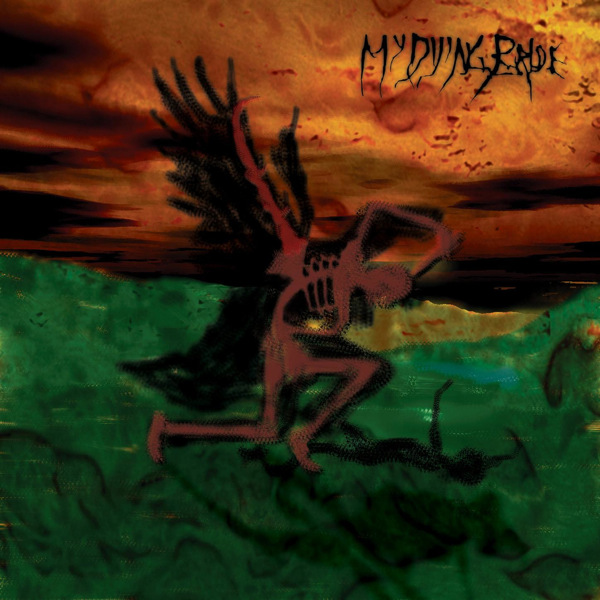
“My Hope, the Destroyer” is a part of their 2001 album The Dreadful Hours, and is the culmination of an hour-long soundscape of doom. Metaphor and reality blend interchangeably, and from the opening strings, a scene of such utter bleakness is painted that it blackens the very world around you:

There is a man, eyes red and swollen with many tears, arms out to a soul that is not there. In a room, dimly lit, he feels himself drawn ever deeper into a corner of blackness, and the world above fades into utter nothingness. So has he been for days, and now he has not the strength to crawl of the unlit void into which he has been carried away. Voices pass around and over him, and they are distant, unheard and meaningless. Their sound is cold, and bring no comfort.

As this man is ever drawn down a stream of unconscious and black, twisted claws of despair rise from the deep, and he comes to pieces, and is undone. In this dying, he sees his woman, in white on a ground of black stone, stained in red, and the bleak faces of people and demons gather and stare. He is there, again, and in his arms she is lifeless. In the rain, the gray and the red above, the twisted faces of the past stare down, and mock him.

He is carried away on the sea of ink, and there is a stone, upon it a word, and below it a death. The tree above is leafless, and the raven does not move. Water drips on the stone, and it is not rain.

And in the fading twilight of his life, his every thought has ever been bent upon this moment, and turning back on a life of many years, all hope failed that one night, and tears have filled all the nights since.

Such are the scenes in my mind, every time I hear this song, and I am given to wonder – what tragedies inspired music of such despair?

Music I Love: “Blackwater Park”, Opeth (2001)

Blackwater Park is the fifth album by Swedish band Opeth, and represents in many ways the pinnacle of their early career. Musically, their style began to vary and diversify greatly after this album, but in many ways, it still represents the perfect place to learn their music, for it forms a bridge – both the culmination of everything they had ever done to that point, and the starting point for every album since.

Opeth began their career as a death metal band in the early 1990’s, releasing their first album, Orchid in 1995. Even here, there was evidence of their trans-genre styles; at a time when death metal was reveling in sonic brutality, Opeth presented a refreshing balance between heavy guitars and beautiful, lullaby-like jazz-inspired acoustic soundscapes. Their second album, Morningrise (1996) pushed further against the genre, including extended sections of jazz improvisation, and finishing with the beautifully sad To Bid You Farewell, a 10-minute ballad with no growls in sight.

While they continued to refine their style over the following two albums (My Arms, Your Hearse and Still Life), it was in 2001, with the release of Blackwater Park, that Opeth genuinely defined their sound. While most bands would have considered this the stopping point, for Opeth it proved merely the jumping-off point – each subsequent album has pushed the boundaries of what defines death metal (and metal in general), with their most recent album, Heritage, shedding all vestiges of their roots, and providing a stunning tribute to the bands of the seventies that had inspired them in the first place.

Blackwater Park opens with a ten-minute track, The Leper Affinity, kicking off the musical journey in a terrifying and exciting manner. Fading in from silence, a massive discord of sound builds to a swell, ever increasing until, with no warning, a shocking and harsh rhythm bursts in, thick chords and fast drumming. Over the top of this, Mikael Åkerfeldt’s guttural and devasting growls push the musical tension forwards until, if possible, the rhythm doubles in speed and moves into the secondary theme. Throughout the exposition, we are treated to a dizzying variety of rapid themes, each building organically from the previous. Then, quite suddenly, the song moves onwards into the development section, taking on the melodies and rhythm of a veritable waltz before, impossibly, giving way to a gorgeous acoustic section, and for the first time we are treated to Åkerfeldt’s stunning singing. Eventually, this leads us further into the development, the heavy guitars kick in again, building to an off-rhythm climax which culminates with a solitary scream leading back into the original opening theme. Just to push the contrast as far as possible, at the tail end of such intensity, the song finishes by petering out into a beautiful, slow jazz piano solo.

This one, single song represents in ten minutes everything there is to know about Opeth. The album progresses on beautifully from there, through a simple and serene ballad in Harvest, a stunning ballad in Dirge for November, and ending finally with the title track, a twelve-minute mammoth which, though starting and ending with heaviness, includes a six-minute acoustic jam right in the middle.

Opeth are an utterly unique band, and their music transcends genres, from metal to jazz to prog rock, and taking into consideration a hefty dose of western classical tradition. Though their subsequent albums have, in musical terms, bested even the mastery of Blackwater Park, this album remains their golden masterpiece – the defining moment in their career when everything that had led to this point was justified, and providing the foundation for everything to come.

Tales of Despair: The Tragedy of the Symphony “Pathétique”

Foreword:

This is the first post of what I hope will become an ongoing series on the nature of despair. What I envisage is to introduce a work of art – be it imagery, poetry, music, film or novel – that was created from the darkest places of the soul. Darkness and despair have been a part of my life since my early teens, and as I have grown accustomed to it, and rediscovered joy in the midst of it, I have become inextricably marked by depression, and to this day there is nothing in the world so comforting as a warm, dark corner where no one can see me, My Dying Bride playing in the background, and a glass of wine reflecting the candlelight.

Being a musician and composer by training, many of these tales are likely to revolve around songs, symphonies and albums. However, I hope to reach out to further art forms, and discover among the canon of literature, film and imagery endless tales of despair.

The Tragedy of the Symphony Pathétique

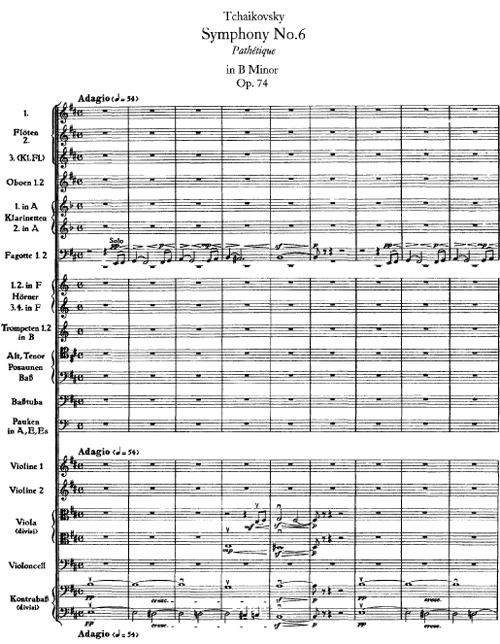
There is in my mind no more fitting work of art more wrought with despair than Pyotr Illyich Tchaikovsky’s sixth symphony, popularly known as the Pathétique (in Russian, Patetičeskaja). This is a piece of music that passes through a sea of emotions of an intensity beyond anything I have heard or seen in my life. From the moodiness of the opening to the fury of the first movement’s climax, the calm sadness of the lilted waltz to the dizzying madness of the third movement, and ultimately the chilling, profoundly bleak finale, in fifty minutes this symphony takes the listener through a world of thought and a lifetime of tragedy.

The symphony’s name derives from the Russian word for passion, not pity, and it is a just name. The deep and overwhelming sadness of this music, however, is how closely it ties to Tchaikovsky’s turbulent personal life. Six days after its world première, Tchaikovsky died. He claimed to his brother that the symphony was steeped in meaning, but he would not reveal the music’s subject to anyone. Some have since said that it was his final death letter.

Tchaikovsky’s own life was a mirror for this tragedy. His sorrows began with the death of his mother at the age of fourteen, and from that day onwards he succumbed to a cloud of depression that even the recognition he eventually garnered could not completely break him free of. His life was a tale of abandonment, despair and frustration; Though homosexual, the social convictions of Victorian Russia prevented him not only from being open about this, but even from acknowledging it in his own mind. He suffered two affairs, both of which ended with the woman he cared for leaving him. He did eventually marry, but they lived together for less than two months, and she eventually bore children from another man.

Even the one light of hope – his patron, Nadezhda, with whom he corresponded for thirteen years in over a thousand letters – ceased communication with him in 1890, and he remained hurt, bitter and bewildered over this for the remaining three years of his life.

Tchaikovsky died in 1983 by his own hand. Perhaps he had become overwhelmed by the depth of despair into which his life had sunk; perhaps he could no longer bear the terrible conflict of his sexuality, which culminated in an attempted affair with his own nephew. On the night of the première of the sixth symphony, Tchaikovsky drank a glass of unboiled water, contracted cholera, and died six days later.

The terrible pain, sadness and despair is overwhelmingly prevalent in this symphony. Before his death, Tchaikovsky confided to his brother that the symphony was full of a deeper meaning, but would not say what it was. After he died, his brother realized he had been speaking of his own death – his final symphony, a monument to tragedy, was his suicide note. A parallel for his own life – childhood sadness, angst and fear at odds with the fervor and passion of creativity. Tchaikovsky destroyed more manuscripts than he completed – the artist’s madness refusing to allow him to ever be content with his own music.

This symphony, even out of context, is a tragic and moving musical journey; always a master of emotion, the composer filled his final work with every skill he possessed, and left us thus with his greatest work being his last. When considered as the final cry of a doomed man, a testament to despair, the final, terrible notes of the finale take on the reek of death, and speak of the utter finality of the grave. Tchaikovsky knew as he wrote that this symphony would be his last, and killed himself upon its completion.