Music I Love: “Crimson”, Sentenced (2000)

Sentenced are a genre-defining band in many ways; hailing from Finland, their career has been marked by music of an intense, dark and depressing nature. Beginning as a melodic death metal band, their seminal album Down (1996) saw a departure from the guttural vocals, leaning towards a more melodic style, both vocally and musically. This was followed by Frozen in 1998, which furthered the new melodic style of the band. However, it was two years later, in January 2000, that Senteced pulled it all together, and released (to my mind) the most perfect album of their career: Crimson.

Sentenced’s themes universally revolve around depression, loss and death, though there are – every so often – rays of bitter hope that shine through. One of my favorite songs, Brief Is the Light, from their 2002 album The Cold White Light, contains the words:

Hear these words I say;

Make the most out of your day

For brief is the light on our way

On this momentary trail

Hear these words, awake:

Make the most out of your day

For brief is the time that we’re allowed to stay

However, there is little of this hope on Crimson, an album dominated by self-loathing, guilt and despair. At the time of its release, I was in a very dark place in my life, and every word on this album spoke to me, intimately. From the opening track, Bleed in my Arms, we hear of the destruction of love, for nothing but the knowledge that it is the only thing to do, the only just self-punishment. The second track, Home in Despair, is perhaps one of the most immediately identifiable songs to anyone who has suffered depression:

Again the sky has fallen down on me

Once more a world has crumbled down and over me

 [break]

And yet in some twisted way

I enjoy my misery

And in some strange way

I have grown together with my agony

 [break]

I feel home in despair for I dwell in grief

And I feel home when the air’s too thick to breathe

And I feel home anywhere human lives are going down the drain

 [break]

For as long as I remember life has been hard

I guess they have “misery” written somewhere in my stars

[break] 

For I have mourned for so damn long…

That I’ve forgotten what it was for

Everything has gone so wrong

That I really couldn’t think of anything more

[break]

I feel home in despair for I dwell in grief

And I feel home when the air’s too thick to breathe

And I feel home anywhere the light of the day is drowned in heavy rain

 [break]

Yet I know the worst is still to come

A further departure from their traditional style, the album opens to a slow-paced tempo, and in fact doesn’t pick up at all until Broken, five tracks in. The mood of the entire album, from start to finish, is morose, doomed, and dark. Halfway through, we have the anthemic Killing Me, Killing You, perhaps the best known song from the album. In some ways, this song of a torturous relationship is, if anything, the high point of the album, followed by an unstoppable descent into the black, all the way until the final, dying My Slowing Heart.

This is an incredibly strong album of frailty and despair, and its words speak a powerful message of depression. One of the most memorable, and heart-wrenching lines comes from Fragile, three songs in:

Sometimes it feels it would be easier to fall

Than to flutter in the air with these wings so weak and torn

Sentenced disbanded deliberately in 2005; a sort of pre-announced musical suicide. There could be no better end for a band so lost in despair.
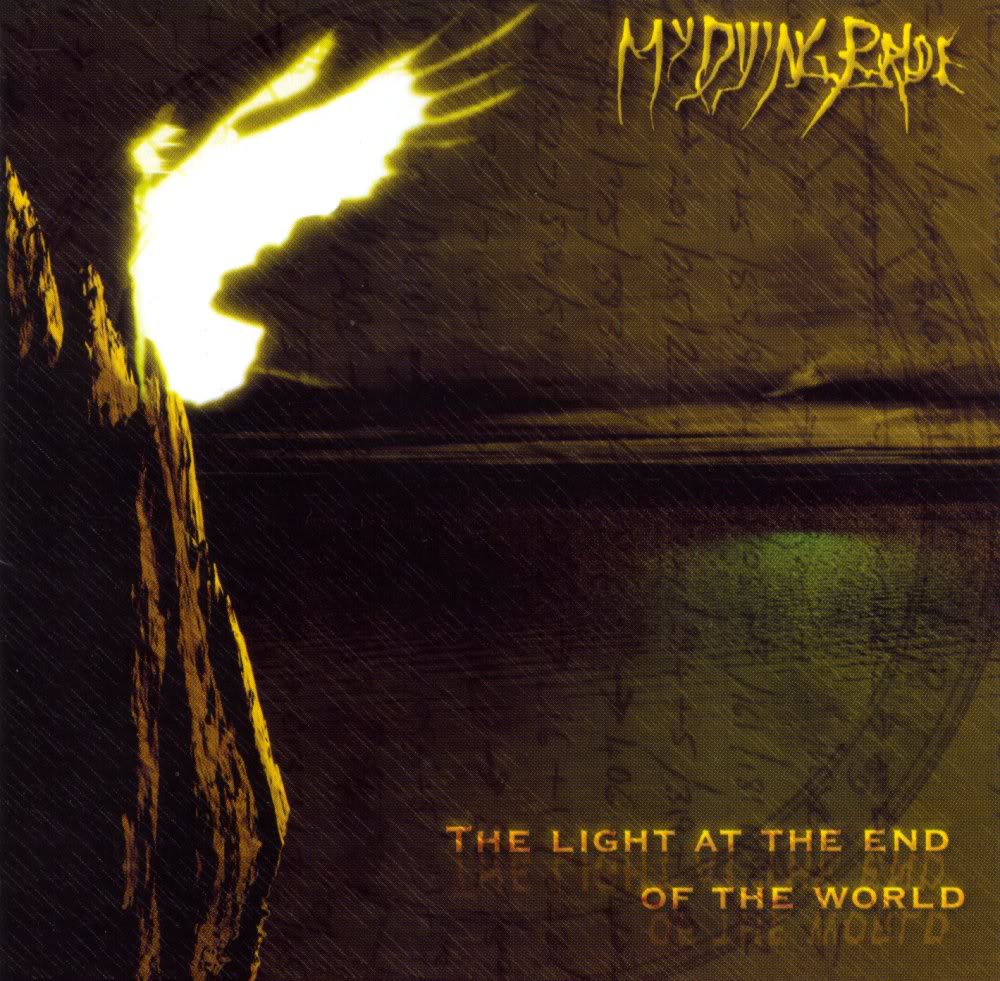
Tales of Despair: The Light at the End of the World

I have spoken of My Dying Bride before in this series, but their canon of despair is vast, and bears revisiting. Here is a tale of utter wretchedness, loneliness, bitterness and despair.

Imagine, for a moment, the abyss of complete isolation. Alone, upon an isle, lost at the end of the world. The sole companion – a light, that burns for no man.

Now consider the wretchedness of the memories of her, of the love that completed you, that made your heart whole, and the bitter knowledge that she is forever gone. Gone, to the winds, dust to the ground, and your fate is to live forever alone, never to be redeemed. Such have the gods done to you.

And the dreams, and the thoughts of madness. Sometimes, the sight of home behind closed eyes, the green trees and the laughter; sometimes, the waking to madness, the knowledge that such a past is forever gone. And sometimes, the bird visits; taunts, tells of life, and raises hope – only to dash it, like the water upon the rocks.

And then, just as the torment becomes the day and the night, to be expected forevermore – the gods bring mercy, and hope beyond hope! They make an offer: to spend one, single night with the woman, the long lost love. But oh, there is a price; this one night would seal the fate of eternity alone, until the ending of life.

Would you take it? Would you throw your hopes to the rocks, for one night with her?

The agony, the soul-crushing blackness, to wake the morning, and to find – after that one, oh-so-brief night – that she is gone. And gone, now and then, for ever, and ever. The doom, the screams, the despair.

Such is the terrible fate of the man who tends the light at the end of the world.

An isle, a bright shining isle

stands forever, alone in the sea.

Of rock and of sand and grass

and shade, the isle bereft of trees.

Small.  A speck in the wide blue sea.  ’Tis the last of all the land.  A dweller upon our lonesome isle, the last, lonely man?

By the Gods he is there to never leave, to remain all his life.  His punishment for evermore, to attend the eternal light.

The lighthouse, tall and brilliant white, which stands at the end of the world.  Protecting ships and sailors too, from rocks they could be hurled.

Yet nothing comes and nothing

goes ’cept the bright blue sea.

Which stretches near and far

away, ’tis all our man can see.

Though, one day, up high on

rock, a bird did perch and cry.

An albatross, he shot a glance.

and wondered deeply, why?

Could it be a watcher sent?

A curse sent from the gods.

who sits and cries and stares at him,

the life that they have robbed.

Each year it comes to watch

over him, the creature from above.

Not a curse but a reminder of

the woman that he loved.

On weary nights, under stars,

he’d often lay and gaze.

Up toward the moon and stars.

The sun’s dying haze.

Time and again, Orion’s light

filled our man with joy.

Within the belt, he’d see his love,

remembering her voice.

The twinkle from the stars above,

bled peace into his heart.

As long as she looks down on him,

he knows they’ll never part.

One day good, one day bad.

The madness, the heat, the sun.

Out to sea, he spies upon land.

His beloved Albion.

Cliffs of white and trees of green.

Children run and play.

“My home land,” he cries and weeps,

“why so far away?”

Eyes sore and red.  Filled with tears,

he runs toward the sea.

To risk his life, a worthy cause,

for home he would be.

Into the sea, deep and blue,

the waters wash him clean.

Awake.  He screams.  Cold with sweat.

And Albion a dream.

Such is life upon the isle,

of torment and woe.

One day good.  One day bad.

And some days even hope.

The light at the end of the world

burns bright for mile and mile and mile.

Yet tends the man, its golden glow,

in misery all the while?

For fifty years he stands and waits,

atop the light, alone.

Looking down upon his isle

the Gods have made his home.

The watcher at the end of the world

through misery does defile.

Remembers back to that single night

and allows a tiny smile.

(His sacrifice was not so great,

he insists upon the world.

Again he would crime,

Again he would pay

for one moment with the girl.)

Her hair, long and black it shone.

The dark, beauty of her eyes.

Olive skin and warm embrace,

her memory never dies.

’Twas years ago, he remembers clear

the life they once did live.

Endless love and lust for life,

they promised each would give.

Alas, such love and laughter too,

was short as panting breath.

For one dark night, her soul was kissed,

by the shade of death.

(Agony, like none before,

was suffered by our man)

who tends the light now burning bright

on the very last of land.

(Anger raged and misery too

like nothing ever before.)

He cursed the Gods and man and life,

and at his heart he tore.

A deity felt sympathy

and threw our man a light.

“Your woman you may see again

for a single night.

But think hard and well young man,

there is a price to pay:

to tend the light at the end of the world

is where you must stay.

Away from man and life and love.

Alone you will be.

On a tiny isle.  A bright shining isle

in the middle of the sea.”

“I’ll tend the light, for one more night

with the woman whom I love,”

screamed the man, with tearful eyes,

to the deity above.

And so it was that very night,

his lover did return.

To his arms and to their bed,

together they did turn.

In deepest love and lust and passion,

entwined they did fall.

Lost within each other’s arms,

they danced (in lover’s hall.)

Long was the night and filled with love.

For them the world was done.

Awoke he did to brightest light,

his woman and life had gone.

To his feet he leapt.  To the sea he looked.

To the lighthouse on the stone.

The price is paid and from now on

he lives forever alone.

Fifty years have passed since then

and not a soul has he seen.

But his woman lives with him still

in every single dream.

’Tis sad to hear how young love has died,

to know that, alone, someone has cried.

But memories are ours to keep.

To live them again, in our sleep.

My Dying Bride – The Light at the End of the World

On Creativity, Credit, and the Popular Idol

My wife is watching American Idol. As you can tell, I am not. I don’t strictly loathe the program; I just really, really don’t like it.

I’m aware it’s a very popular little show. Not just my wife watches it, apparently; there’s a guy at work who mentioned in passing as well. And, as long I’m being honest with you all, I don’t actually mind the talent on display, even if it does seem like a grossly overblown, shameless televised debutante ball for people with a little more lung than the rest of us.

The key thing for me is, what talent exactly is on display? There is something indeed unique and special about the contestants on American Idol (at least, those that make it through the first few rounds). Whether they’ve got a Dave Grohl grin or don’t care two whits about their audience, most of the people up on that stage share a common talent: their voice. They are, for the most part, good singers. Some are great, and would be at home on Broadway, or at the opera.

And I am a huge fan of musical talent. Alfred Brendel, Yo-Yo Ma and Isaac Stern are unparalleled to this day (and I am quite fortunate to have a recording of Brahms’ chamber music with most of these fellows playing). Joe Satriani and Eddie Van Halen can shred like none other. Mike Portnoy is an astonishing drummer, and hey – love him or hate him Axel Rose can sing. These are all exceptionally talented musicians, performers who rank in the top 1% of their art. But – and here is the argument’s focus – how far does their credit and fame extend?

As much as I enjoy consuming media (books, music, movies, etc.), I also create it as well. I am by training a musician and a composer. I am by my own hand a writer. And I have made a couple of terrible home movies. And whether it is in poring over the score of Beethoven’s sixth symphony, or marveling at the poetry of Dickens’ words, or admiring the artistry of Coppola’s Dracula, it is always driven home to me the intense passion, the sweat and tears, the frustration and the determination, that these artists have invested in their work.

Think, for a moment, about the song you’re listening to. Is it three, four, five minutes long? How long did it take to write, rehearse, perform and record that music? Chances are, several months. Production began last year on The Hobbit, which is due for release this Christmas. And the script was in the works ten years ago. Stephen King began work on his Dark Tower series in 1975 and is still working on it today. These are creations of human imagination, and while many of us have wild fantasies, stories and songs that run through our hears, these few are the ones with the bravery, the foolishness, and the love of self-immolation to commit those fantasies to permanence.

Yet in all of this, music – and specifically popular music – stands alone in several ways from all others. I won’t comment on the idea that pop songs are created for money; all art is, in one form or another. Nor will I say anything about the formulaic characteristic that defines most pop music; how many Agatha Christie clones are out there in the literary world?

No, the one thing that I can’t help but notice – the one thing that frustrates me to no end, and drives to to tears to think of it – is the credit given to the creators of these works. What springs to mind when I say The Hobbit, Vertigo, Titanic, Alien, Dune, or The Pit and the Pendulum? More likely than not, J.R.R. Tolkien, Alfred Hitchcock, James Cameron, Ridley Scott, Frank Herbert and Edgar Allen Poe. Yet if I ask you who wrote any one of Britney Spears’ eleven Top 10 songs, how many of you would be able to answer, Max Martin?

Turns out, Max Martin wrote chart-topping songs for The Backstreet Boys, NSYNC, Kelly Clarkson, Pink, Katy Perry, and even Usher. Now I don’t typically listen boy bands, pop rock or hip hop. Not out of any sense of pride – it just doesn’t speak to me. My tastes do vary – anything from The Cure and The Sisters of Mercy to Iron Maiden and Napalm Death, along with more or less the entire canon of western classical music from the 1600s on. It wasn’t until recently, however, that I started to wonder why I was attracted to these styles of music in particular. The answer that came to me, ultimately, was art. These musical styles represent art in its highest form. Like looking at a Picasso or reading Jules Verne, through the art you are in touch with the artist, and you have the chance, if you slow down, to marvel at every brush stroke, or wonder how the writer chose their words, and why they hold such magic.

When I listen to Porcupine Tree (one of my favorite bands), I don’t just hear the music. I hear Steven Wilson, writer, producer, singer, performer, making sure every single sound I hear is there on purpose, for me to recognize and revel in. I imagine him sitting in a studio, expensive headphones on, changing the reverb from 5 milliseconds to 6 milliseconds, smiling, and thinking – that’s perfect.

I wonder if Britney Spears ever does that.

In classical music, the composer is prized above all else, even the performer. “Simon Rattle conducts Beethoven’s Ninth Symphony” – the work of art belongs to the composer.

In film, it is the director, though the producer, screenwriter, and composer are all credited as well; “Stanley Kubrick’s 2001: A Space Odyssey.”

In literature – surprise – the author.

And even in contemporary popular music – rock, rap, jazz, punk, metal, house and hip-hop – it is rarely questioned that the artist and songwriter are not the same. We assume that Kurt Cobain had some hand in writing the music and lyrics to Smells Like Teen Spirit. Even Flo Rida wrote “Good Feeling” (under his real name of Tramar Dillard). So what happened to generic-brand pop? When did the performers begin to overshadow the creators?

So I won’t cry shame on American Idol; after all, showcasing talent is (ostensibly) what the show is all about. I have no problem with a nobody from Arkansas being given a shot at fame. But spare a thought for the songwriters who gave their lives to make this happen. Continue to give them credit as you sing.

And who knows? Maybe one day we’ll have a talent show for songwriters and composers. Admittedly, it would be a lot less fun to watch. But it would certainly be more interesting.