The Devil’s Details: The Tragedy of a Wasted Imagination

Imagination is an exceptionally powerful thing. It is how we decide; how we play; how we learn. Even those of us who would claim to suffer from a poor imagination nonetheless exercise it on a daily basis: if you’re trying to decide which way to go home, you are essentially imagining which way is going to be best.

But sadly, the imagination often stops at these limited, practical uses. As children, our imaginations were with us. Our companion, our best friend, our life outside of life, imagination was the key that unlocked doors to a world more real and infinite than our own.* And as we grow older, and our lives become overwhelmed by those practical things, our imagination dwindles. We can console ourselves that we still read, that we watch thoughtful and engaging television, but that is really a poor substitute.

This is not to say that we have to act like children (well Einstein did, but look where he got us). All it really takes is a willingness to stop, to think, and to look beyond the surface.

I’m as guilty of this as anybody. I recently shared some photos of gravestones I took. This was one of my favorites:
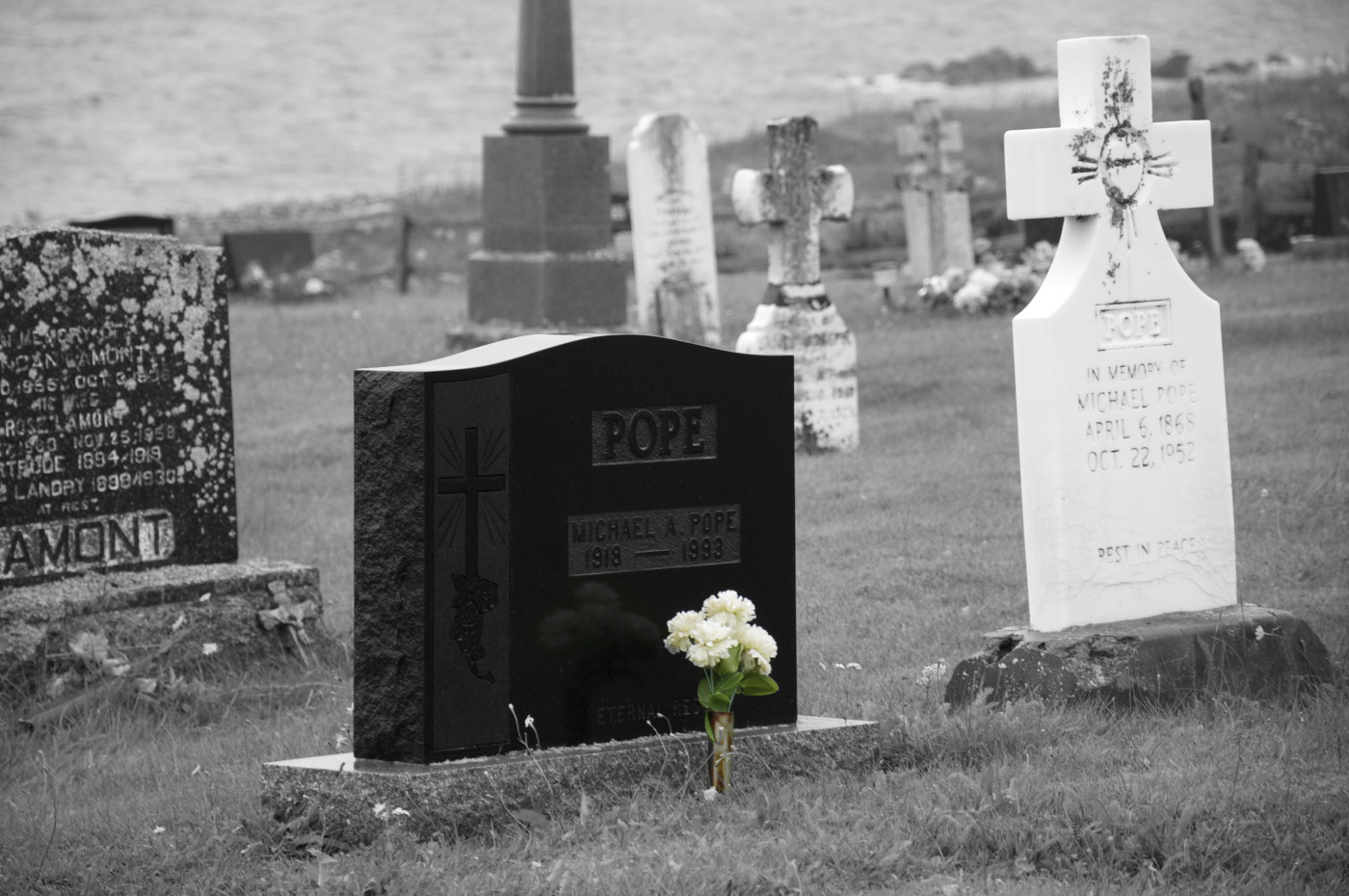
grave-of-michael-popeI took the picture because I thought the gravestone looked interesting. I was caught by the flowers, and so I took the snap. For a while, it was my favorite simply because of the composition, the way that the image lent itself to colorized black and white, and the hint of further graves behind.

And then, after I’d been working on this picture for some time, I actually stopped to read the epitaph. It reads:

POPE

MICHAEL A. POPE

1918 — 1993

ETERNAL REST

And then I started thinking about what this meant. The remains of a man lay beneath this stone. That man’s name was Michael; perhaps he went by Mike. Mike was a boy, once; his childhood might have been good, or it might have been terrible: he was eleven when the stock market crashed and threw the world into one of the worst economic depressions the world has ever seen.

Mike was twenty-one when World War II began; it’s likely he was drafted to fight. There is quite the possibility that Mike has killed people. How did that affect him for the rest of his life?

Mike knew someone else in his family; another Michael Pope – perhaps his father. Mike was thirty-four when this Michael died. This Michael himself was an astonishing ninety-four when he died. Think how incredible that is; when Michael Pope Sr. was ten, there was no such thing as radio. When he died, there was color TV, rock music, two wars whose tragic repercussions lasted long beyond his own life; there were even prototypical computers, though he might never have heard of them.

Our Mike was only seventy-five when he died in 1993. That’s not young, but it’s not old. Why didn’t he live as long as his father? Did he contract pneumonia? Did he suffer from dementia, or alzheimer’s disease? Perhaps he simply fell of a ladder. At some point, Mike took a final breath, and never breathed again. Who was with him when that happened? Maybe he knew his death was coming; maybe he never got to say goodbye to his family.

Of course, Mike might never have had any further family; there are no other Popes interred here. But there is one thing that feels certain: someone loved him very, very much. Someone loved him enough to commemorate him with a black marble gravestone. Someone who, twenty years later, still visits his grave to leave flowers.

 

* Children these days suffer from a world that stifles the growth of their own imagination. For your children’s sakes, don’t let them while away their childhood with video games and television; from time to time, send them outside with a stick.

Daily Photo: February 13, 2011

Aren't I a sweet husband? At least one day a year.

Aren’t I a sweet husband? At least one day a year.

I’m not sure how this happened to be the 13th of February, but it was that year’s Valentine’s Day breakfast. I didn’t have a mold for heart-shaped pancakes, so I made one out of paper and foil. It barely held together, and almost caught fire.

Tales of Despair: Oh, For the Dark World

The Days of Light

Once, there was a world filled with light, and love.

There was a home, whole and fine, even if it changed into different homes over the years. The home was warm in the winter and had a fire, and was cool in the summer with open windows. There were woods to explore, bikes to ride and paths to follow. There were bright toys, shades of color and paper to take them, and a pen to write down the adventures of the mind.

There were walks in the forest, great trees towering monumentally overhead, cascades pouring down through the green glens. There were great treks of many days across the mountains, soaring peaks and biting rock and shivering snow, a tent pitched by a crystal alpine lake, and the wonder of a map as it led down twisting and winding roads.

There were friends who would come to birthdays, who would bike to school and who would go rock climbing on Fridays. There were beloved teachers and caring parents, if a little overbearing. They encouraged and fostered, gave love and grew confidence. There was music, and there was writing, and there was the soar of the imagination. There was a full life, and there was joy.


The Days of Dark

And then, one day, the light and love disappeared.

The home became a prison, one that changed into other prisons over the years. The windows remained shut, and the shades were drawn. The fire became candles, lit only in the depths of the night, in a room all alone, the door locked. The woods were forgotten, the bikes gathering cobwebs. All the colors turned to black, and the toys…they turned to razors.

The trees appeared gnarled and twisted, even in the midst of summer; their towering heights now oppressed, threatening to crush and choke from above. The mountains became evil, and a jailer, a torment that prevented the comfort of a bed in a corner in the dark. The world was dim, and the sun failed to pierce both eyelid and heart.

The old friends left; new friends came, and shared the blackness of the world. They would drive to school with doom on the radio, and would go drinking on Fridays. The teachers and parents looked with sadness and despair, and all their encouragement fell on deaf ears, their love on a broken soul. There was no confidence, no hope, and the imagination saw only the ending of all life. There was an empty life, and there was misery.


The Days of Gray

And so life went on, for many years. There was no going back, no return to the days of light. The nature of the darkness changed as the homes once did, but always against a background of blackest black. There were days when life was bearable, and days when rising from bed was more effort than there was to spare.

But there was one, a single person who refused to give up. One who would not accept the lethargy, who refused to allow the darkness to thrive. She fought, and for her efforts received anger, and abuse. But in the face of this was an indomitable will, a knowledge that, free of the pits of despair, there was a soul worth saving.

And there was a child. A precious, tiny child who did’t — who couldn’t — understand the darkness. A child who did not deserve to be subjected to its despair. And that broken soul, it saw the child, and for the first time in forgotten years, knew that here was a thing to live for. The survival of this infant life was, if nothing else, the sole reason to begin to fight the darkness.

The battle is far from won. There have been great triumphs, and even greater falls. Wonderful joy when the child shows thoughtfulness and caring, and the deepest guilt and shame when it displays the same rage and obstinacy of its father. And what makes it all the harder is that, in the face of inarguable proof that the darkness must be abandoned, that broken, stained soul still longs for it with a great, empty ache. The darkness lived for too long, and is now an inseparable part of life, no easier parted with than one’s own finger.

But the struggle will continue, and it will continue because of that one, single person, and the child she gave him.


I love you, sweetie.

Satis 2012