Movie Night: Jurassic Park

Year: 1993

Director: Steven Spielberg

Production Company: Universal Pictures

Leads: Sam Neill, Laura Dern

Jurassic ParkI’ll admit to being caught up in the hype of Jurassic Park‘s recent 3D re-release, and it gave me that hankering to see it again you get with a good movie you haven’t seen in a really long time. I didn’t go to see it in the theater, though – no 3D for me, thank you very much. I bought it in HD on iTunes instead.

Oh, what a treat it was to revisit this cinematic masterpiece. And when I say cinema, I really mean visual: I don’t think anyone can claim the plot isn’t as full of holes as the dinosaur DNA it purports to use to generate real-life sauropods. Considering that the film is twenty years old now I can give it some slack; a lot of the discoveries and advances in paleontology have happened in the past decade or so (did anyone know that birds are now taxonomically considered living dinosaurs?).

But whether he can pick a good story or not, Steven Spielberg knows his visuals, and in Jurassic Park he pulled out all the stops. It’s truly telling that only now, after twenty years, does the CGI begin to show through. The effects used at the time were monumentally groundbreaking, and he used such a clever mix of miniatures, animatronics and CGI that it even today is hard to discern the truly fake stuff from the tangible, real-world models.

My biggest concern in approaching it with a nine-year-old, of course, was that Jurassic Park has some pretty intense scenes, and I remember being scared the first time I watched it – how was Little Satis going to react? Remember this scene?
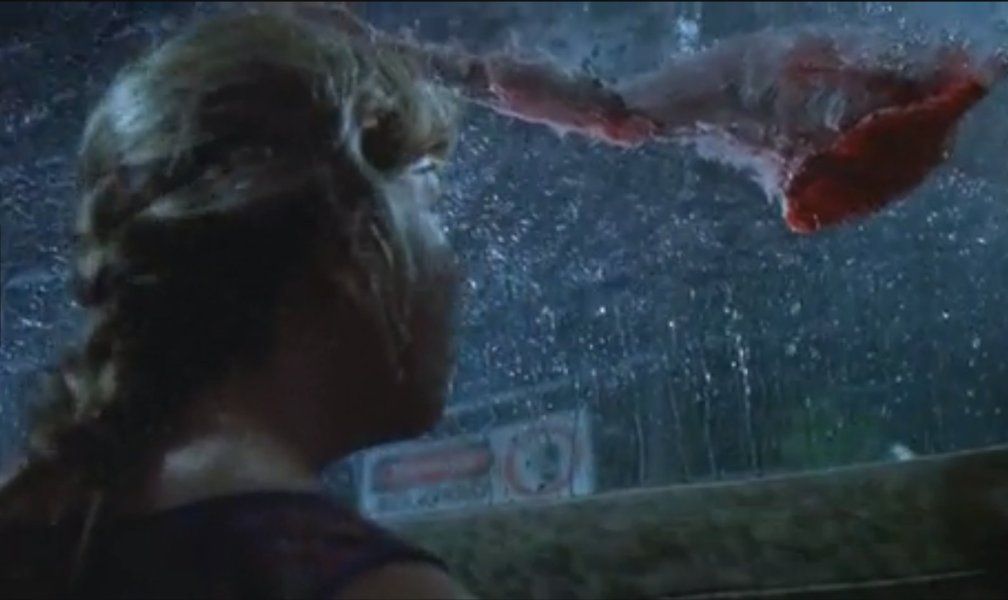
Jurassic Park - 11 - Where's the goat - the goat leg lands on the roof of the jeep

Or this one?

CaptionContest1

Steven Spielberg seems to have a thing for severed limbs.

But surprisingly, he didn’t seem too fazed. There were moments when he asked to snuggle, but at the end of it all, he stood up and said, “That was one of the best movies ever!” I thought he might have nightmares (I know I did), but he slept sound. Kids these days.

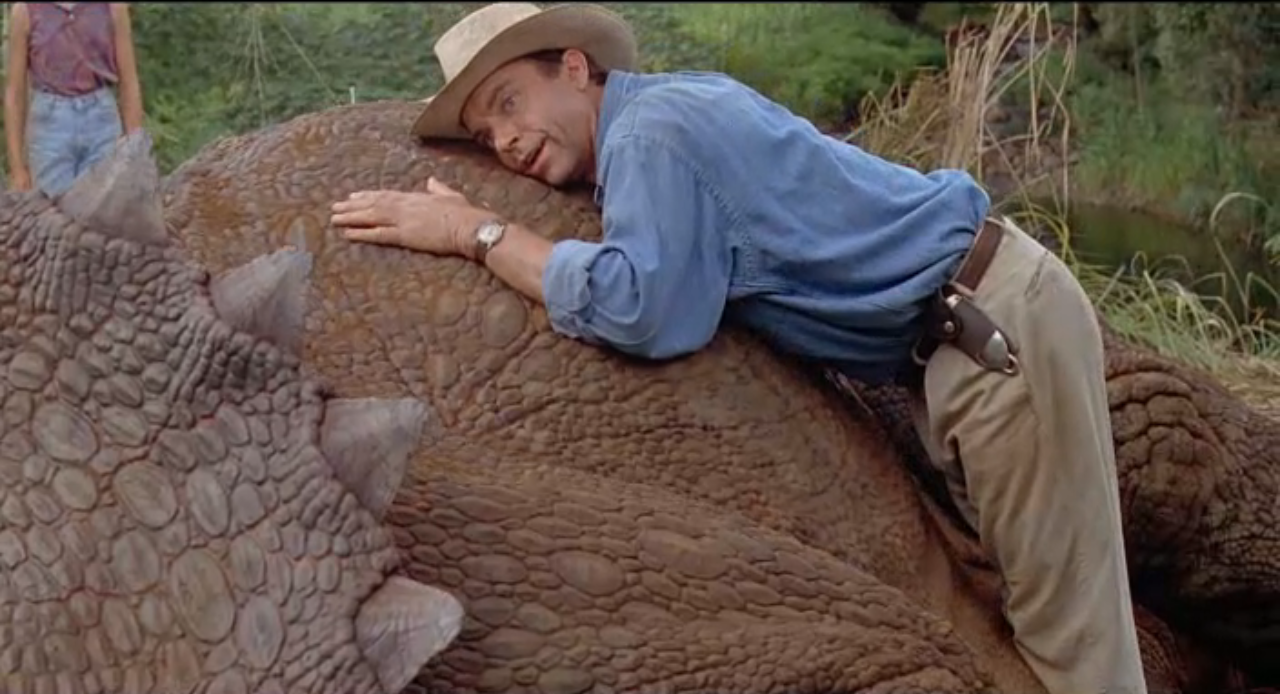
I’m glad I bought it, because it’s one of those movies that you end up wanting to watch over and over again (now I want Forrest Gump for some reason). I really didn’t expect the visuals to hold up nearly as well as they do, and even though my eye is better trained to look out for the tricks now, I could still very much sit back and enjoy the film for itself; the technology (ironically) never got in the way of the film. The scene with the breathing triceratops still blows my mind to this day.
Picture 23

★ ★ ★ ★ ★

Movie Night: Beethoven Lives Upstairs

Year: 1992

Director: David Devine

Production Company: Devine Videoworks Production

Leads: Neil Munro, Illya Wolloshyn

Beethoven_Lives_UpstairsI had forgotten about this movie for so, so long; I can’t believe it’s been over 20 years! As a young classical music snob this was one of my favorite movies, and revisiting it now I can safely say it still is.

The plot is elegant and simple; young Christoph lives in Vienna with his recently widowed mother, and in order to make a living they rent out their upstairs room. It just so happens that their new lodger happens to be a rather well-known figure: Ludwig van Beethoven.

Predictably, Christoph hates Beethoven for taking his father’s place, and for desecrating his father’s study: in his constant madness and compositional furore, Beethoven writes music on any surface he can find – including the walls and the shutters.

Ah – the shutters. Well don’t worry, after I move you can sell them. I’ve heard they demand a good price.

Eventually though, he comes to understand the source of the man’s terrible frustration – to have such beautiful music to write, and be so totally unable to hear it. Christoph’s uncle Kurt helps him to learn the passion behind the man, and the terrible sadness and humiliation Beethoven lives with every single day. Gradually the two become ever closer, culminating in the hair-raising premier of his 9th symphony (one of the most glorious pieces of music ever penned). The triumph, of course, is made bittersweet by the knowledge that he was to die only three years later.

One of the best aspects of this film is that the score is entirely comprised of music by Beethoven – even the peddler and his monkey on the street corner! So great and varied was the output of Beethoven’s life that there was more than enough material to set the atmosphere of any setting, from overwhelming sadness (Allegretto from Symphony no. 7) to fury (Allegro con brio from Symphony no. 5), reminiscence (Für Elise) and light-hearted joviality (Menuet in G).

The performances are, in hindsight, less than perfect; Illya Woloshyn, in particular, feels like a by-rote actor. Neil Munro, however, is surprisingly excellent as the tempestuous and eccentric Beethoven, passing from raving lunacy to gentle tenderness and everything in between.

Little Satis enjoyed it, although I think I enjoyed it more; he very much likes Beethoven’s music (especially the 5th and 9th symphonies), and he certainly learned quite a few things about the man that he hadn’t known before. He gave it three stars, but I’m afraid I’m going to have to give it

★ ★ ★ ★ ★

There are many princes; there is only one Beethoven!

392px-Beethoven_Signature.svgSatis Logo with ©

Movie Night: Doctor Who – The Aztecs (1964)

Year: 1964

Director: John Crockett

Production Company: BBC

Leads: William Hartnell, Carole Ann Ford

Screen Shot 2013-03-29 at 7.33.14 PMI’m a firm believer in entireties. I need to watch movies from the very beginning. I listen to entire albums. I have to read book series from the very beginning, and authors’ books in general in chronological order.

And of course, I absolutely must watch TV series from episode #1. I don’t have OCD, promise.

And so, naturally, when it came time to introduce Little Satis to Doctor Who, there really was nowhere else to start. We might end up getting on to the rather good “New” Doctor Who, but for now, it’s time to revisit the past.

Sadly, Netflix has a Doctor Who deficiency, and The Aztecs is the only episode(s) from the very first season. It meant that we really missed any introduction to the Doctor, his purpose and his shenanigans, and were expected to know quite a bit of background. As you can imagine, this bugged me, but alas, there is nothing to be done.

In brief, the Doctor and his companions – Susan, Barbara and Ian – arrive among the Aztecs prior to their invasion by the Spanish, and their eventual extinction. Emerging from a sacred tomb, the Aztecs take Barbara to be the reincarnation of a god. Sadly, Tlotoxil, the High Priest of Sacrifice, takes exception to Barbara’s insistence that human sacrifices are not necessary to bring on the rains. He denounces her as a false god, and goes to extremes to expose her for what she really is. Meanwhile, the High Priest of Knowledge, Autloc, begins to believe Barbara’s predictions of doom, and defends her against his own kind.

Ultimately the Doctor persuades Barbara to admit she’s not a real god; in shame, Autloc leaves the Aztec villages, and Tlotoxil gains control over all. Despite all that Barbara tried to do, he completes the sacrifice of the “Perfect Victim”, ending the eclipse that of course showed up at just the right time. The Doctor and his companions escape, sending the Tardis off into who knows where.

The Aztecs 7

Jacqueline Hill as the reincarnated Yetaxa.

It was difficult to come at this from the point of view of a child in the 1960s. By comparison to today’s media, or even to later episodes, the production quality, editing and acting was generally pretty poor, with wooden swords and shields and costume jewelry very obvious. However – there was nonetheless a sense of excitement, of something new and different about the show, and as the episodes progressed (it’s split into four parts) Little Satis and I were drawn in, and found ourselves very much immersed in the fabricated world of the Aztecs, cheesy though it might be.

Knowing what was to come, and the glory of the future doctors, it felt like a very suitable beginning. I wish we had been able to watch the very first episode, but until Netflix increases its canon of Doctor Who, that will have to wait.

Have any of you ever seen classic Doctor Who, and if so, what was it like that first time?

★ ★ ★ ★ ☆
