
I kind of have a thing for dragons.
You know what I mean. For as long as I can remember, these fantastic creatures have mesmerized me, awed me, and pulled me in with their frightful allure. There is a thrill in imagining the pounding of great wings overhead, of the shadow of that colossal beast as it passes over your head, of the dangerous intent in its eye as it bores its gaze into you.

Sculpture of a Chinese dragon
The history of dragons is long, and convoluted. Wikipedia has an excellent entry on them, but in a basic summary, dragons appear to have arisen in myth and folklore out of the common and widespread fear of lizards in general, and snakes in particular. Eastern and western dragons are substantially different, not only in their appearance, but in their demeanor, mythology and meaning as well. Snakelike in form, Chinese dragons are wise, long-lived, powerful and majestic. They are intelligent beyond men, and some legends hold that dragons first taught men to speak. Western dragons, with their legs and wings, are typically more brutal, representing a force of maliciousness and destruction, raining fire and poison from their throats.
I marvel at all of these, but it is admittedly the more western dragons that hold my attention (no doubt due to my upbringing). It’s likely that this was borne from my fascination as a child with dinosaurs (isn’t every young boy?); though I knew there were no longer dinosaurs, the idea that there could be, somewhere in the world, some living vestige of those incredible creatures fueled my imagination. I remember having a near obsession at one point over the Loch Ness Monster; I remember an odd movie with Ted Danson, of all people, as a scientist trying to prove the existence of the fabled creature. I loved that movie.
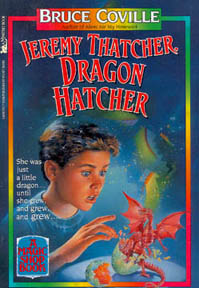
Jeremy Thatcher, Dragon Hatcher – Bruce Coville (1991)
Dinotopia, which I have already written about, bore the marvel of living dinosaurs to me, and the Skybax riders, soaring majestically on the backs of great, winged beasts, made me intensely jealous that I didn’t live on a remote, unknown island filled with saurians.
There have been numerous books and films over the years that have sustained my love of the creatures; I remember a lovely book from my childhood called Jeremy Thatcher, Dragon Hatcher. In it, the titular character comes across a mysterious object in a mysterious shop – a shop that disappears almost as soon as he steps out of it, carrying with him what he will soon discover to be a real, living dragon egg. He tends to the egg, hatches it, and begins to rear the wonderful creature as a pet. Soon, though, he discovered that the dragon – and he – have a much greater destiny, with the fate of the entire race of dragons in their hands.

Draco, from DragonHeart
Another favorite is DragonHeart, with Dennis Quaid and Sean Connery as Draco (yes – it’s a terribly imaginative name). A delightfully witty and dramatic adventure, it tells the tale of a prince, wounded in battle, who is healed by the generosity of a dragon – the creature passes to him half of his heart, so that he might live. Yet as he grows, the boy becomes ever more bitter, and his teacher – his mentor since childhood – finds himself banished from the kingdom for disagreeing with him. A dragon slayer by nature, he eventually comes across Draco (voiced so wonderfully by Sean Connery), and the two form an uneasy partnership, determined to end the prince’s tyranny once and for all.

Rendition of a Nazgûl as they appear in Peter Jackson’s The Lord of the Rings films.
There are many others – Reign of Fire, Mulan, Harry Potter, The Hobbit (and The Lord of the Rings, if you count the Nazgûl),Beowulf, and even Shrek all have dragons or dragon-like characters; some benevolent, some evil, and some simply depicted as wild creatures, bent on destruction. However, the most recent addition to the wonderful canon of dragon tales is a movie Little Satis and I watched only recently: How to Train Your Dragon. I will admit, I was worried about this movie; I have no great affection for DreamWorks, as I generally find their animation substandard compared to Pixar’s, and their stories far less compelling than Disney’s. I am glad to say this time, however, I was happily mistaken.
How to Train Your Dragon is a surprisingly heartfelt and touching tale of a young viking who, though desperate to participate in the great dragon hunts of his village, is perpetually shunned for his mild demeanor and physical weakness. Desperate to gain their approval, he in secret designs a complex dragon-killing machine – and manages to bring down a Night Fury, one of the most feared dragons in the land. When he goes to find the creature, however, he discovers not a terrifying, vicious beast, but a frightened and badly wounded animal, just as hurt and alone as he is.

Toothless, from How to Train Your Dragon
In its fall, the dragon’s tail suffers an irreparable injury, leaving it unable to fly. Overcome with guilt, the boy begins the process of constructing a prosthetic tail wing – and in doing so, learns there is far more to the race of dragons than anyone had previously thought. Through the dragon’s healing, their bond strengthens, and the two will eventually lead the fight in an epic battle whose outcome will determine the fate of the vikings – and the dragons themselves.
For those of you who have been following The Redemption of Erâth, you’ll have certainly noticed that dragons have an important role to play in this world as well. Sadly, I have yet to come across a live dragon, so this is the closest I can get to seeing, touching, and breathing in the scent of one of these beautiful beasts.
What I wouldn’t give to ride on the back of one of these great winged furies.

 Satis Writes