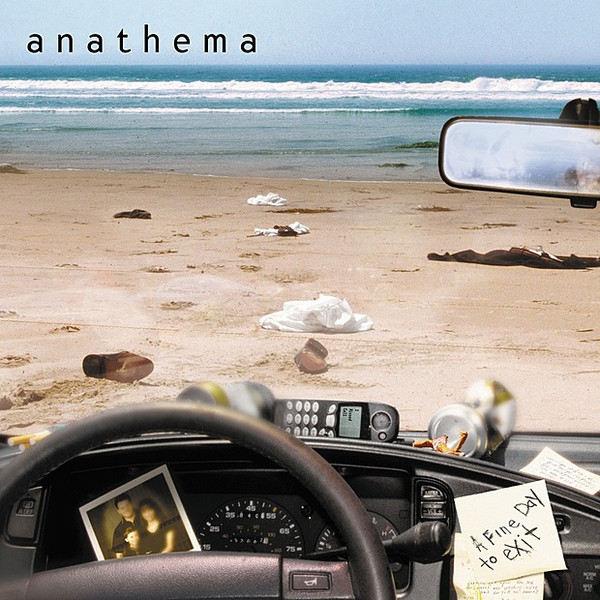
Music I Love: “A Fine Day to Exit”, Anathema (2001)

Following on the heels of our heart-to-heart about depression, it seems only fair to share what is for me possibly the most depressing album I have ever heard.

Anathema is the final piece of my ‘big four’ (the others being My Dying Bride, Opeth and Sentenced). Their roots begin right along side fellow Northeners My Dying Bride, a heavy and dirge-like Doom Metal band from Liverpool. It didn’t take them long to gain the attention of Peaceville, who signed them for a four-album deal.

The Crestfallen (EP) was their first mainstream release, a 32-minute dirge of atonal distortion and howled vocals. Even here, though, their more sensitive side, which would only become more prominent, can be heard in tracks such as Everwake. Their first full-lenth, Serenades, brought this musical style to a strong consistency, winding from leaden and moaning distress such as Lovelorn Rhapsody to haunting, acoustic interludes like J’ai Fait Une Promesse. The closer is an epic 23-minute drone; synths and soothing harmonies intertwine, changing slowly and subtly.

The following EP, Pentecost III, carried this style further, focusing on lengthy, heavy and atmospheric tracks. When The Silent Enigma came out in 1995, however, the beginnings of a marked change in style became apparent. Though still heavy and filled mainly with growled vocals, the musical style began to become less dissonant, with songs such as Cerulean Twilight and the wonderful A Dying Wish bringing a desolate and sad tone to their style.

Then, something happened that cemented the transition from Doom Metal to atmospheric, haunting and dismal rock: Darren White, the vocalist, left. Rather than hiring a new vocalist, guitarist Vincent Cavanagh took up the mic. Unable (or unwilling) to growl like Darren, 1996’s Eternity is now a classic album, an epitome of their canon. Alternative 4 carried this yet further, becoming ever more distant from their metal roots. By the time Judgement was released in 1999, the heaviness of their past was all but gone, leaving behind a deeply sad style of alternative rock.
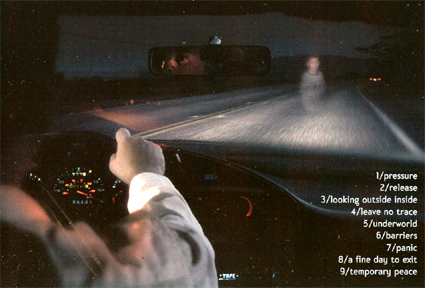
And then came A Fine Day to Exit, in 2001. This is an incredibly important—and precious—album for me. Every one of the nine tracks simply drips with depression, and this became the soundtrack to my life at the time of its release. This album is Anathema perfected; nothing before or since has quite touched its sense of absolute, utter despair.

Both musically and lyrically, A Fine Day to Exit carries the listener on an uninterrupted journey through landscapes of darkness, each song blending seamlessly into the next. The piano-driven ostinato of Pressure feels like a crushing weight on the chest, a feeling of stress that doesn’t life. As it fades, Release picks up, its striking opening guitars lulling the listener into its landscape of sadness. Release eventually peters out to the subtle sound of heating pipes in an old, run-down building, and the inescapable arpeggios of Looking Outside Inside gently ease their way into the ear. This is perhaps the best song on the album, building up slowly, gradually, from acoustic nothingness into a rage of entrapment.

As feedback leads the way into Leave No Trace, the album settles into a soothing swaying between slow and faster-paced songs, and the lyrics become noticeably more unstable. An unsettling feeling of a descent into madness begins to creep into the music, with Underworld turning out some disturbing imagery.

Climbing up the wall gonna creep between the cracks

Get out of my skull tie the rope around my neck

Destroy all emotion gonna rip my face to shreds

Cut my eyeballs open

Underworld – Anathema, 2001

(Breaking Down the) Barriers brings a sense of calm, and indeed feels like a sort of conclusion. Heart-rending, it speaks of the ever-growing disconnect between two people who realize they are utterly disconnected. Try as they might, there is no salvation.

And then, all hell breaks loose. A great pause of silence follows …Barriers, as if preparing for the storm that is to follow. Rapid, wavering guitars then break in, musically reflecting the sudden and complete unbalance of Panic‘s disturbing words.

I don’t think it’ll all end up like this

There’s spiders on the wall and they stink of piss

Dead heads lying in the corner

Staring at me making me feel bad

I put my hands up to my eyes

But the holes in my palms let me find a way

To corner you…

Panic – Anathema, 2001

Racing through at breakneck speed, Panic represents the peak of the album, the final release of the terrible tension of an unstable mind. From here it descends into the final moments of utter despair, the title track A Fine Day to Exit bringing with it a sense of absolution.

Then, finally, the perfect conclusion: Temporary Peace. Slow, quiet and bleak, it is a resting, a peace; a settlement from the madness. It speaks of finality, of the the darkness dragging you under for the last time. Its closing lines reflect this, simultaneously intimating the momentary quiet before the ending.

Beyond this beautiful horizon

Lies a dream for you and I

This tranquil scene is

Still unbroken by the rumours in the sky

But there’s a storm closing in

Voices crying on the wind

The serenade is growing colder

Breaks my soul that tries to sing

And there’s so many thoughts

When I try to go to sleep

But with you I start to feel

A sort of temporary peace

There’s a drift in and out

Temporary Peace – Anathema, 2001

And as the final notes ring out, the music dissolves into the sound of breaking waves, and the muttering nonsense of a madman.

The flow of this album so perfectly reflects my own cycle of madness that it cuts me to the very soul, unfailingly bringing tears to my eyes by the final dying sounds. The tension, the guilt, the increasing loss of control, until it finally all breaks loose—and then, when the rage is spent, dissolving into nothing but the desire to fade into absolute blackness, and never return.

This is not an easy album, but it is ultimately rewarding. Just beware: it will not put you in a happy mood.


Thought of the Week: Full Disclosure

Hello, everyone.

I’ve missed you all; it feels like I’ve been away for quite some time. I apologize in advance if this post fails to be interesting; my intention is simply to explain my absence, and lay it all open for once.

I have spent the past three weeks in the company of that great black dog, dragged away to a numb and black landscape that offers no escape. I’ve been lost in apathy, neither wanting to live or to die. A deep uncaring with no emotion. It’s been all I can do to get up in the morning and go to work. When I got home, I want nothing more than to crawl into bed. I spent my lunches sleeping on a couch at work.

The fatigue has been a key factor in the past few weeks, too. I often am tired at the end of a busy day at work, and I sometimes find it difficult to stay alert during the drive home. Recently, however, it’s been an unbearable challenge to stay awake at the wheel, not only coming home but even going to work in the morning. I came closer than I ever have before to a serious accident: I was driving down a straight stretch of road in moderate traffic, and I closed my eyes for a moment…and when I opened them, a car was crossing in front of me, pulling across traffic into a driveway. I was only feet away, and in my waking daze, didn’t even have the wherewithal to hit the brakes. What I was able to do was instinctively jerk the wheel, and passed around the car as it continued into the drive by probably three inches. Into oncoming traffic, as it happens, but that’s beside the point.

The terrible lethargy hits hardest at home, of course, where my walls collapse and I’m unable to hide it. Laundry piles up; dishes go undone; hair goes unwashed. Understandably, this puts a great strain on all of us — my wife, Little Satis and I — and the worst is the guilt of knowing that I’m responsible for all the stress.

In all of this, the effort of writing posts has been more than I’ve been able to contemplate. For this, I apologize. I feel that I’ve let you all down, as much as myself and my family.

Along with the mood stabilizer and antidepressant I’m already taken, my psychiatrist has had me start a third medication, a non-SSRI antidepressant. It’s probably too early to tell, but it surprisingly seems to be helping already. The past two days, I was able to drive to and from work without feeling like I was going to fall into a deep sleep. I’ve been able to smile and laugh again, and criticism isn’t driving me into the ground, a wailing child catatonic on the floor.

I’ve been through these cycles before, too, of course. The ups, and the downs. I don’t have manic periods, so they’ve ruled out bipolar disorder. Nonetheless, the key difference I’ve noticed since starting this new medication is the lack of perpetual drowsiness. A stated side-effect of this new medication is mild to moderate weight loss (which I need), and I have my appetite generally reduced, and I’m no longer dreadfully enticed to devour an entire box of saltine crackers in one go.

And there you have it. I’m well aware that I’ve alluded to my depression in many past posts, but I needed to just say it clearly. It is a monster, a treacherous demon that sneaks its way behind my eyelids, slackens my jaw and convinces me that there is no other way to be. That is the worst of it — the love of the depression, the aching desire to let myself be washed away with its black waters.

I am slowly returning, I believe, and I will attempt to return to this blog, as well. Up until the New Year I am focusing on the process of final edits for The Redemption of Erâth, in preparation for its publication sometime next year, which I’m terribly excited about (when I’m not drowned in depression). I will continue to post a Thought of the Week each Monday, and the Daily Photos will continue to autopost as well. I will be putting a pause on Tales of Despair, as the time and research involved each week is something I don’t feel I can commit to at the moment. We will see how things stand in the new year.

Most importantly, there will be nothing more of The Redemption of Erâth to be posted. The entirely of book one is already posted, and the extensive background written late last year as a preparation is at an end. This doesn’t, however, mean The Redemption of Erâth is finished. Oh, by no means. More details to come…

So in conclusion, my apologies once more for my absence, and my sincere gratitude for bearing with me all this while. The 300+ of you who have visited me 7,000 times in the past year have made this experience more than worthwhile, and the likes and comments have meant the world to me. I can’t make any promises, but I’ll try not to let you down again.

Satis 2012

Tales of Despair: The Color and the Key of Despair

What mood do you see?

There are certain things that ring so of despair that they are instantly recognizable. In life there are such things — death, sadness, old men crying. In art also, there exists an equal dogma of darkness (even the term darkness serves as such an example). The darker of colors — black, blue, crimson — these are colors of despair. They are the colors of things that are frightening — the black of night, the unfathomable depths of the ocean, the terrifying heat of flame, and the letting of blood.

These colors form a great part of our perception of misery and sadness. Winston Churchill famously referred to depression as his “black dog”. Yet even the shading of these colors is significant; when we describe someone as being “blue”, we rarely imagine the pale, soothing blue of a spring sky. Bright red is a color of excitement and joy; deeper tones convey heat and flame and blood.

I think this man might be useful to me – if my black dog returns. He seems quite away from me now – it is such a relief. All the colours come back into the picture.

— Winston Churchill, 1911

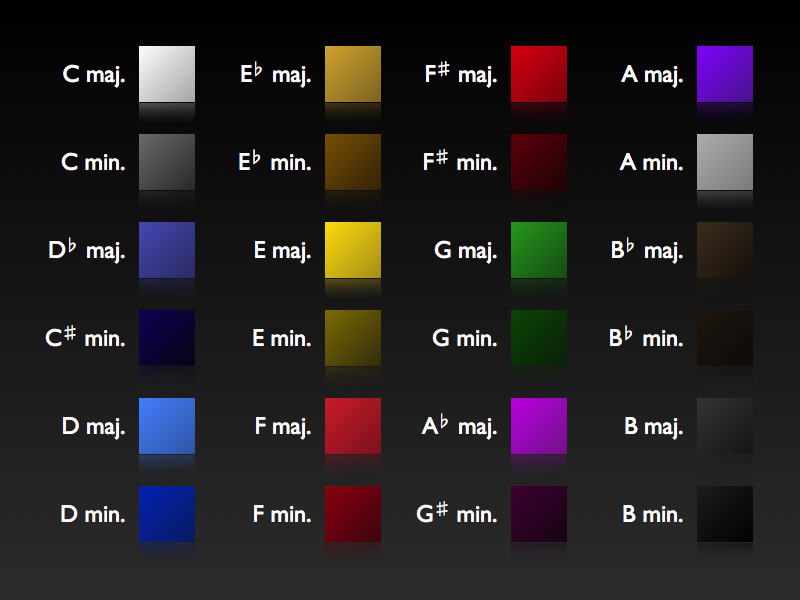
And these tones are carried through into music. Ignoring synesthesia, it isn’t uncommon to think of a song or piece as carrying a particular color. These visual representations of key vary from person to person; if you were to ask any two musicians, you would likely get two completely different descriptions.

My personal key-color relationships. Even ignoring the colors, notice that the minor keys are universally darker than the major ones.

Having said that, there are certain keys that, almost universally represent sadness, anger and despair. As a starting point, these keys are naturally minor. The bright, exuberant major keys — the clean, purity of C major or the homeliness and warmth of E-flat major — rarely suggest any aspect of darkness. The inherent sad quality of the minor key, however, is inextricable.

The falling of tears.

Part of this is in the psychological impact of the falling semitone; to turn major into minor, the third key of the scale falls by one semitone. The very nature of falling and descent is linked to death (going underground) and sadness (the falling of tears). One of the most heart-wrenching progressions is the fall from the sixth note of a minor scale to the fifth (especially if the root note remains in the bass). A wonderful example of this is the opening of Sotto Vento by Ludovico Einaudi.

However, quite apart from this inherent quality of the minor keys, there is a particular key (or closely related keys) that has throughout the history of western music been used to express the deepest pathos and despair. Countless works have been based on this key, and they are without exception some of the most beautiful, and tragic, pieces of music ever written.

I speak, of course, of B minor (the key that, for me, is represented by the deepest black). There is likely a reason for this; C major, the standard and most oft used key, is above this by one semitone. The shift, the fall from this key of happiness, represents a profound shift from light to dark.

Violin part from the first edition of Beethoven’s fifth symphony.

What’s interesting, however, is that this history of this key is not so straightforward. Though from the 1800s onwards B minor because a de facto standard for sadness, it was prior to this rarely used. Instead, the tonally slightly higher key of C minor was used instead. Mozart wrote a beautiful mass in C minor (despite rarely using minor keys in general); one of his best piano concertos is the twenty-fourth in C minor. Later, Beethoven used this key for one of the most famous and furious of compositions: the raging fifth symphony in C minor. He was attracted to this key several times further: his eighth piano sonata, the Pathétique; the third piano concerto (clearly and heavily influenced by Mozart’s own piano concerto in the same key), and the thirty-second piano sonata (one of the last pieces he ever wrote).

The tragedy of Swan Lake.

Yet something happened in the early nineteenth century that changed this, and suddenly the key of despair dropped a semitone. We began to see works such as Schubert‘s eighth symphony, Chopin‘s third piano sonata, Liszt’s only piano sonata and the wonderful Totentanz, and Brahms’ chamber works (one of the most delicate and beautiful, the first piano trio in B, is in fact half in B minor). And then there was Tchaikovsky. B minor was an epic favorite of this troubled composer, being the home key of his first piano concerto, the beautiful Swan Lake, the furious passages of the Romeo and Juliet Fantasy Overture, and of course the intensely tragic and heartbreaking sixth symphony, the Pathétique.

Though at first it might appear that there are therefore two keys of darkness, and that the choice of key is down to the individual perception of the composer, it turns out not to be so simple. In the eighteenth and nineteenth centuries, there was no set tonal standard, meaning that different countries, and indeed different orchestras, would have their own definitions of standard concert tonality. In most cases, of course, the tonalities were similar – often differing by one semitone.

And to this day, as western tonalities became standardized (a practice that was only formalized in the 1950s), the key of B minor has assumed reign as the common standard for darkness, and despair.