Music I Love: “Crimson”, Sentenced (2000)

Sentenced are a genre-defining band in many ways; hailing from Finland, their career has been marked by music of an intense, dark and depressing nature. Beginning as a melodic death metal band, their seminal album Down (1996) saw a departure from the guttural vocals, leaning towards a more melodic style, both vocally and musically. This was followed by Frozen in 1998, which furthered the new melodic style of the band. However, it was two years later, in January 2000, that Senteced pulled it all together, and released (to my mind) the most perfect album of their career: Crimson.

Sentenced’s themes universally revolve around depression, loss and death, though there are – every so often – rays of bitter hope that shine through. One of my favorite songs, Brief Is the Light, from their 2002 album The Cold White Light, contains the words:

Hear these words I say;

Make the most out of your day

For brief is the light on our way

On this momentary trail

Hear these words, awake:

Make the most out of your day

For brief is the time that we’re allowed to stay

However, there is little of this hope on Crimson, an album dominated by self-loathing, guilt and despair. At the time of its release, I was in a very dark place in my life, and every word on this album spoke to me, intimately. From the opening track, Bleed in my Arms, we hear of the destruction of love, for nothing but the knowledge that it is the only thing to do, the only just self-punishment. The second track, Home in Despair, is perhaps one of the most immediately identifiable songs to anyone who has suffered depression:

Again the sky has fallen down on me

Once more a world has crumbled down and over me

 [break]

And yet in some twisted way

I enjoy my misery

And in some strange way

I have grown together with my agony

 [break]

I feel home in despair for I dwell in grief

And I feel home when the air’s too thick to breathe

And I feel home anywhere human lives are going down the drain

 [break]

For as long as I remember life has been hard

I guess they have “misery” written somewhere in my stars

[break] 

For I have mourned for so damn long…

That I’ve forgotten what it was for

Everything has gone so wrong

That I really couldn’t think of anything more

[break]

I feel home in despair for I dwell in grief

And I feel home when the air’s too thick to breathe

And I feel home anywhere the light of the day is drowned in heavy rain

 [break]

Yet I know the worst is still to come

A further departure from their traditional style, the album opens to a slow-paced tempo, and in fact doesn’t pick up at all until Broken, five tracks in. The mood of the entire album, from start to finish, is morose, doomed, and dark. Halfway through, we have the anthemic Killing Me, Killing You, perhaps the best known song from the album. In some ways, this song of a torturous relationship is, if anything, the high point of the album, followed by an unstoppable descent into the black, all the way until the final, dying My Slowing Heart.

This is an incredibly strong album of frailty and despair, and its words speak a powerful message of depression. One of the most memorable, and heart-wrenching lines comes from Fragile, three songs in:

Sometimes it feels it would be easier to fall

Than to flutter in the air with these wings so weak and torn

Sentenced disbanded deliberately in 2005; a sort of pre-announced musical suicide. There could be no better end for a band so lost in despair.
Tales of Despair: The Light at the End of the World

I have spoken of My Dying Bride before in this series, but their canon of despair is vast, and bears revisiting. Here is a tale of utter wretchedness, loneliness, bitterness and despair.

Imagine, for a moment, the abyss of complete isolation. Alone, upon an isle, lost at the end of the world. The sole companion – a light, that burns for no man.

Now consider the wretchedness of the memories of her, of the love that completed you, that made your heart whole, and the bitter knowledge that she is forever gone. Gone, to the winds, dust to the ground, and your fate is to live forever alone, never to be redeemed. Such have the gods done to you.

And the dreams, and the thoughts of madness. Sometimes, the sight of home behind closed eyes, the green trees and the laughter; sometimes, the waking to madness, the knowledge that such a past is forever gone. And sometimes, the bird visits; taunts, tells of life, and raises hope – only to dash it, like the water upon the rocks.

And then, just as the torment becomes the day and the night, to be expected forevermore – the gods bring mercy, and hope beyond hope! They make an offer: to spend one, single night with the woman, the long lost love. But oh, there is a price; this one night would seal the fate of eternity alone, until the ending of life.

Would you take it? Would you throw your hopes to the rocks, for one night with her?

The agony, the soul-crushing blackness, to wake the morning, and to find – after that one, oh-so-brief night – that she is gone. And gone, now and then, for ever, and ever. The doom, the screams, the despair.

Such is the terrible fate of the man who tends the light at the end of the world.

An isle, a bright shining isle

stands forever, alone in the sea.

Of rock and of sand and grass

and shade, the isle bereft of trees.

Small.  A speck in the wide blue sea.  ’Tis the last of all the land.  A dweller upon our lonesome isle, the last, lonely man?

By the Gods he is there to never leave, to remain all his life.  His punishment for evermore, to attend the eternal light.

The lighthouse, tall and brilliant white, which stands at the end of the world.  Protecting ships and sailors too, from rocks they could be hurled.

Yet nothing comes and nothing

goes ’cept the bright blue sea.

Which stretches near and far

away, ’tis all our man can see.

Though, one day, up high on

rock, a bird did perch and cry.

An albatross, he shot a glance.

and wondered deeply, why?

Could it be a watcher sent?

A curse sent from the gods.

who sits and cries and stares at him,

the life that they have robbed.

Each year it comes to watch

over him, the creature from above.

Not a curse but a reminder of

the woman that he loved.

On weary nights, under stars,

he’d often lay and gaze.

Up toward the moon and stars.

The sun’s dying haze.

Time and again, Orion’s light

filled our man with joy.

Within the belt, he’d see his love,

remembering her voice.

The twinkle from the stars above,

bled peace into his heart.

As long as she looks down on him,

he knows they’ll never part.

One day good, one day bad.

The madness, the heat, the sun.

Out to sea, he spies upon land.

His beloved Albion.

Cliffs of white and trees of green.

Children run and play.

“My home land,” he cries and weeps,

“why so far away?”

Eyes sore and red.  Filled with tears,

he runs toward the sea.

To risk his life, a worthy cause,

for home he would be.

Into the sea, deep and blue,

the waters wash him clean.

Awake.  He screams.  Cold with sweat.

And Albion a dream.

Such is life upon the isle,

of torment and woe.

One day good.  One day bad.

And some days even hope.

The light at the end of the world

burns bright for mile and mile and mile.

Yet tends the man, its golden glow,

in misery all the while?

For fifty years he stands and waits,

atop the light, alone.

Looking down upon his isle

the Gods have made his home.

The watcher at the end of the world

through misery does defile.

Remembers back to that single night

and allows a tiny smile.

(His sacrifice was not so great,

he insists upon the world.

Again he would crime,

Again he would pay

for one moment with the girl.)

Her hair, long and black it shone.

The dark, beauty of her eyes.

Olive skin and warm embrace,

her memory never dies.

’Twas years ago, he remembers clear

the life they once did live.

Endless love and lust for life,

they promised each would give.

Alas, such love and laughter too,

was short as panting breath.

For one dark night, her soul was kissed,

by the shade of death.

(Agony, like none before,

was suffered by our man)

who tends the light now burning bright

on the very last of land.

(Anger raged and misery too

like nothing ever before.)

He cursed the Gods and man and life,

and at his heart he tore.

A deity felt sympathy

and threw our man a light.

“Your woman you may see again

for a single night.

But think hard and well young man,

there is a price to pay:

to tend the light at the end of the world

is where you must stay.

Away from man and life and love.

Alone you will be.

On a tiny isle.  A bright shining isle

in the middle of the sea.”

“I’ll tend the light, for one more night

with the woman whom I love,”

screamed the man, with tearful eyes,

to the deity above.

And so it was that very night,

his lover did return.

To his arms and to their bed,

together they did turn.

In deepest love and lust and passion,

entwined they did fall.

Lost within each other’s arms,

they danced (in lover’s hall.)

Long was the night and filled with love.

For them the world was done.

Awoke he did to brightest light,

his woman and life had gone.

To his feet he leapt.  To the sea he looked.

To the lighthouse on the stone.

The price is paid and from now on

he lives forever alone.

Fifty years have passed since then

and not a soul has he seen.

But his woman lives with him still

in every single dream.

’Tis sad to hear how young love has died,

to know that, alone, someone has cried.

But memories are ours to keep.

To live them again, in our sleep.

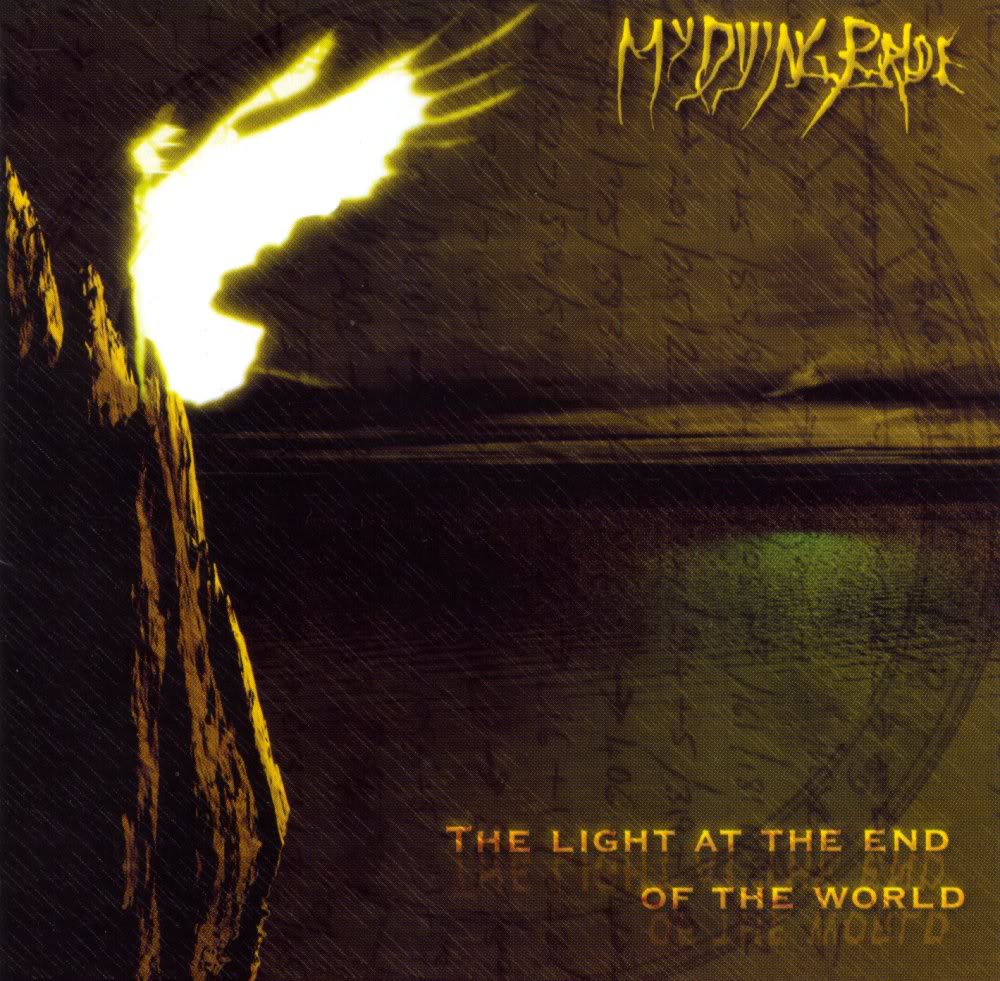
My Dying Bride – The Light at the End of the World

Tales of Despair: The Triumph of Death

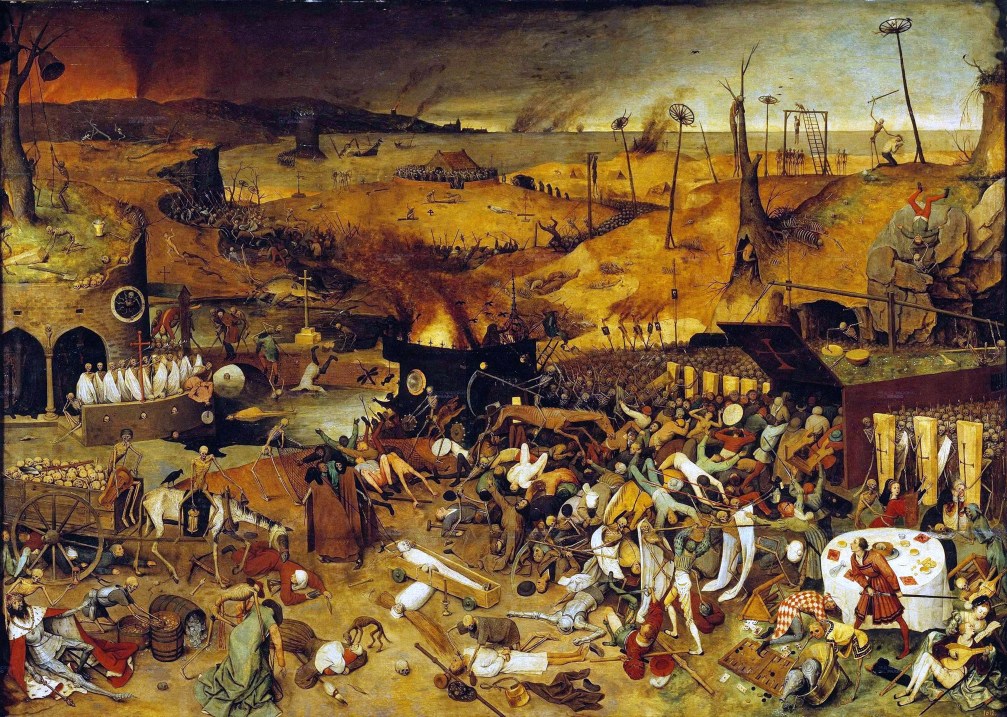
I am no student of art, and I know little of the medium and its history. However, I came across this painting some years ago, and even to my untrained eye it is exceptional for its time.

Pieter Bruegel (1525 – 1569) was a Flemish painter at the height of the Renaissance, when secular art began to be accepted in European culture, and people suddenly started painting people and fish, and not just god. Bruegel in particular has become renown for his paintings of everyday life, depicting peasants, hunters and even beggars, working hard to capture the scenes all around him (a kind of 16th-century George Bellows). In many of his works, however, he allowed fantasy to creep into the scenes, such as Landscape with the Fall of Icarus.

Detail showing a king, all his riches powerless to slow the advance of time, and the coming of his death.

Still, none of his paintings (including Dull Gret) come nearly as close to the dark and twisted nature of The Triumph of Death. This is a massive work – the original is some five feet across – and it portrays hundreds of figures, fallen upon by an army of death. There is too much here to even begin to go into, so complex is the entire painting, but there are some points within it that genuinely stand out to me.

Overall, it seems painting seems to emphasize death as the lord of all – kings and peasants as one fall victim to its clutches. In one corner, a great king, cape in ruins, cannot prevent a grinning skeleton from pillaging his gold. As a reminder of his despair, a second skeleton holds up an hourglass, driving home the fact that he will not long last in this world.

Detail showing a man and woman playing music, unaware of death mocking them behind; a moment of black humor in an otherwise bleak work.

The detail of the agony and despair in this painting is astonishing, and excruciating; every inch of canvas is covered by death. Even where there are people yet alive, death is yet hounding them. In one small detail, a man, stripped and naked, seeks refuge from the horror by hiding under the roots of a tree. It is, of course, futile – a spear protrudes from his back. In another, a man fleeing desperately, is set upon by the starved hounds of hell, while a skeleton looks on nonchalantly, waiting as they take down their prey. In particular, though, I am drawn to a small detail that shows two people – perhaps the only people in the entire painting – who seem unaware, or unaffected, by the death and torture around them. The man is playing a lute; the woman is singing from a songbook with him. The man looks worried, as though he perhaps should be thinking about something other than their music, but the woman rests a reassuring hand on his shoulder, and carries a calming expression, as though music is untouchable by death. In an inspired moment of irony, Bruegel adds a skeleton, hiding behind them, accompanying them both on the fiddle.

Church – and god – are no escape for the coming of death.

Though the Renaissance was, of course, a time of artistic awakening, religion was nonetheless and inescapable and fundamental part of culture, and every person’s life. Prayer, and the hope of an afterlife, was often the only consolation for peasants who slaved for a lord, starved, and grew ill with terrible disease. For Bruegel, however, even the church is unable to give deliverance from death; in what may have been nearly heretical at the time, he depicts the skeleton army invading the house of god, desecrating its windows, drowning people in its river, and mockingly calling the ring of silver trumpets. To the right, a very large portion of the canvas is given to showing the skeletons herding people in droves into a cross-embossed box, while their armies await on either side, holding shields bearing crucifixes. It is as though Bruegel was verily denouncing religion itself as false hope of life.

The scene is a grim twist on the artist’s nature and style. Whilst many of his works depict ordinary scenes of peasant life, here he takes a scene from almost every class imaginable, and treats them to the same horror and finality. The princes and the poor, the pious and the sinners, all succumb alike. In the distance, the fires of hell glow bright, while skeletons ring a great funeral bell. Ships burn on the horizon, and the earth is barren of all growth. The only life that seems to persist are the crows, likened as always to companions of death.

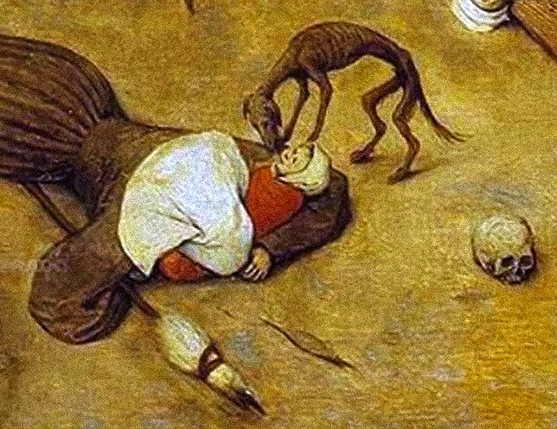
In Bruegel’s eye, death spares no one, and nothing. By the river, a large whale or dolphin lies butchered, and in the distance, skeletons hack at the few remaining trees. However, the true depth of the artist’s horror, and the epitome of death’s cruelty, is in a small detail at the bottom of the painting. Prostrate, a mother lies dying, her bundled infant dead in her arms. The true ghastliness of this scene, though, and the terrible truth of death, is the skeletal hound of hell, feasting on the dead child’s flesh.