
Chocolate smile?
Look at this guy. What are the chances that a single spilled drop of hot chocolate would form this exact pattern? This was not set up, I promise!

Chocolate smile?
Look at this guy. What are the chances that a single spilled drop of hot chocolate would form this exact pattern? This was not set up, I promise!
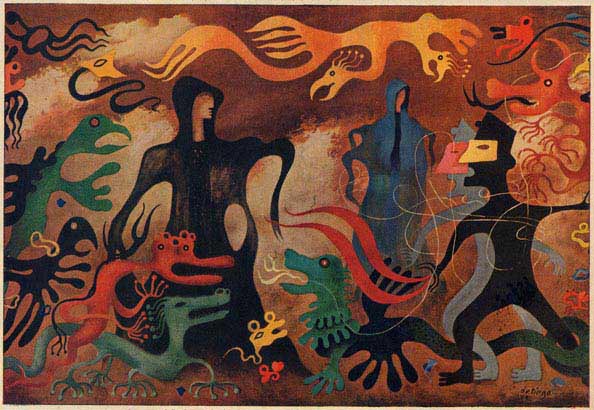

Perhaps disheartened by the difficulty of writing an actual opera, in 1804 Ludwig van Beethoven (1770 – 1827) had the bright idea to tell a musical story without the words, and so was born the programmatic symphony. His sixth orchestral masterpiece, the “Pastoral” symphony, was one of the first great musical creations to not just paint a scene or don a mood, but tell, from start to finish, a coherent and structured tale, through wordless music alone.
And it was a phenomenal achievement; through five intertwined movements, we are taken through the experience of the composer as he travels to an idyllic countryside, breathes in the beauty and serenity of the pastures and streams, and revels in the joyous dancing of the country folk. In a dark turn, we are overcome by a terrifying and violent storm, threatening to ravage the countryside, until finally it passes, and we rejoice with the shepherds. The story is, admittedly, rather naïve, but Beethoven was one of the great advocates of Goethe‘s humanism at the time, desperate for the belief that man was a better creature, and could aspire to beauty and greatness.
As the world moved forward into the romantic era, the youthful idealism became tainted with the dark reality of industrialism, war and poverty. Stories continued to be told, but they became ever darker. Composers and pianists, the rock starts of the nineteenth century, became corrupted by their popularity. Hector Berlioz (1803 – 1869), the infamous French composer, wrote many of his greatest works under the heavy influence of opium. In fact, perhaps his greatest tribute to Beethoven – a twisted retelling of his tale of beauty and serenity – is the Symphonie Fantastique, in which that very drug is the catalyst for a descent into murder and madness.
Being a child of the romantic era, Berlioz was infused with the passion and impetuosity of many of those of his generation, and he found himself infatuated with several women in his life. One of these, an Irish actress called Harriet, caught his fierce attention in Romeo and Juliet, and she became the inspiration for what is today perhaps his most enduring work.
Berlioz’s Symphonie Fantastique is, as was Beethoven’s Pastoral Symphony, a song with a tale to tell. Our young musician, in a dream of passion, discovers a woman who embodies his every ideal, and cannot rid her from his mind. He is delirious, love-struck, despairing and joyful, and sees her in his mind every waking moment. These thoughts consume him even as he passes through life – at a ball, a festive, joyous occasion, he cannot see the lights or the music. Wandering in the fields, by the brook and past the shepherds, he cannot but brood on his terrible loneliness. He wishes – hopes – that he may soon not be alone, but thoughts of betrayal of evil creep through his mind.
And then, the story takes a dark turn, and does not return. Convinced his love has forsaken him, he poisons himself with opium, and as he lays dying, he is plagued with the terrifying dream that he has murdered his only beloved. Powerless from the drug, he watches helplessly as he is captured, and led to the gallows. The crowd looks on, he cries out in despair – and, as the guillotine’s blade descends, he sees her in the crowd – alive.
And it does not end there. Dead, he finds himself transported to hell, lost in the midst of a witches’ Sabbath. Shadows, demons, sorcerers dance sickeningly around him, taunting and teasing him in his own death. And then – horror upon horror – he sees that she is a part of the diabolical gathering, that she is dancing to his death with the witches. As the bells of his death sound, the terrible creatures conspire to mock god, dancing over the ancient music of his wrath, and all is lost to perpetual darkness.
Inspired by the beautiful Harriet, Berlioz went on nonetheless to become engaged to a Camille, instead. When she spurned him, he raced to Paris, seeking to murder her, her mother and her fiancé. Eventually, when this plan failed, he returned to Harriet – and there, he discovered the painful truth behind infatuation. The two wed for a mere two years.
Berlioz would go on to produce one of the most famous renditions of the legend of Faust, who sold his soul to the devil. He separated from Harriet, and though he continued to provide for her for the rest of her life, she died not long after from severe alcohol abuse. His mistress, whom he eventually married, died eight years later. A girl for whom he had affection, only twenty-one years old, died also, and Berlioz was left with nothing but his grief.
At the age of only sixty, he began, in his despair, to wish for death, and not long after, he was stricken with violent abdominal pains. The pains soon grew and spread, and in the end, consumed him. On his death bed, he spoke these final words:
Enfin, on va jouer ma musique.

These have four legs. I think they’re called ungulates.
I was reading the “about” of a blog, recently, and they mentioned being an advocate for all the four-legged creatures of the world. I whole-heartedly agree, but it caused me to wonder: what about all the others? What about those with six legs, with eight, with a hundred, or with none?
I remember being fascinated by life, in general, from a young age (funny how I failed biology). I had these great children’s science books, and my two favorites were those on snakes and spiders. Don’t get me wrong – these creatures terrify me – but they also fascinate me, inspire me, and awe me. I try my best to never, ever kill any creature found in our house; many, many spiders have found themselves peacefully transported outside in a small glass I have just for this purpose. I will swat a few insects – flies and mosquitoes – but even then I feel a little bad (okay – not for the mosquitoes).

One of thousands, all working perfectly together to strengthen the whole. We humans could learn from these creatures.
The thing that fascinates me most, however, about these many and varied creatures is the startling intelligence displayed by these creatures. There are many, many humans I can think of that behave with far less intelligence than the smallest six-legged bug. I remember reading not too long ago that the octopus, about which so little is known, keeps as much as forty percent of its brain in its tentacles (note: not nervous system, but actual brain). In other words, each specific tentacle is a living, thinking unit, separate yet part of the whole. If amputated, the tentacle will continue to live on, moving, crawling, and will even attempt to capture food.
It is these alien intelligences that bewilder me, astound me, and give me thought for the diversity of all life. We are attuned to empathizing more directly with animals that are closest to us in appearance and behavior; we attribute many human characteristics to our dogs and cats, find it adorable when a parrot learns to say a word, or even when a mouse sniffs a piece of cheese. Certainly, our perspective of these behaviors is significantly different to the perspective and thoughts of the animals themselves, but it is nothing compared to the alienness of those creatures far, far removed from us.

So visceral, so frightening – built perfectly for this job.
I think often of the remarkable intelligence of spiders. Lone, solitary creatures, they defend their realms viciously, often killing other spiders in the process. They have an astonishing patience, to lay in wait for days. They have foresight, to capture food and store it for later consumption. They are master architects, building structures naturally and instinctively that the greatest human engineers have yet to better. They have senses beyond senses, able to feel imperceptible motions in the ground and air. Their eyes…what can it possible be like, to see the world from all directions, through eight, or ten, or a dozen eyes?

Look closely – what beautiful colors.
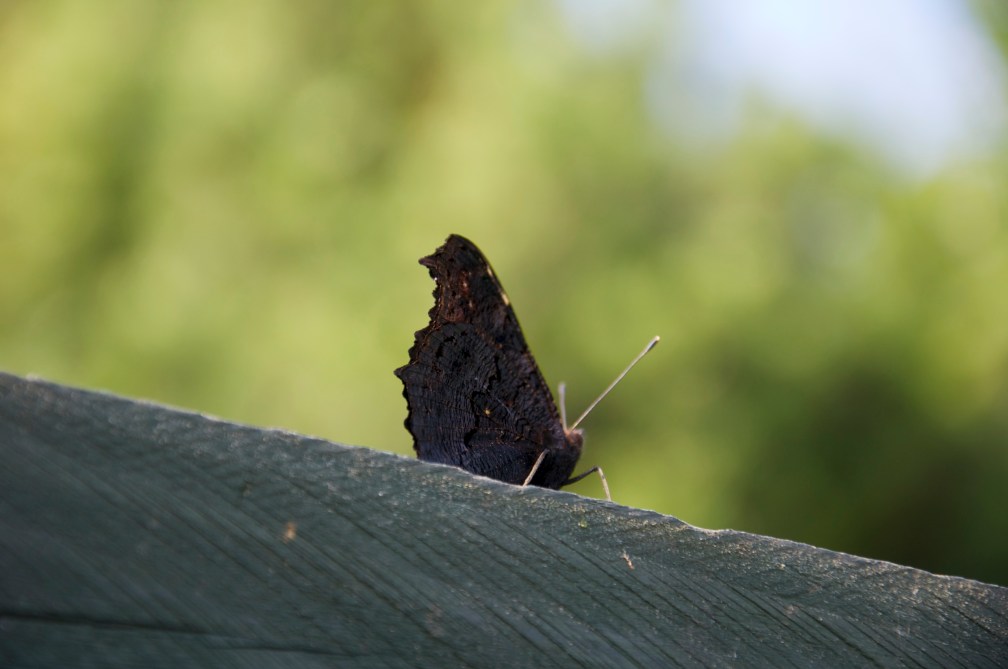
The frightening beauty of these creatures is also a thing that possesses me. Humans are nothing compared to the visual diversity of these creatures. Imagine one person having black skin with vertical stripes of white pigment, while another’s skin is burgundy, spotted with patches of green skin. The colors, textures, and dynamics of their appearance is astonishing. Even the greyest of moths has a wonderful hue, when seen close.
And then there are those with no legs, the great creatures of the sea. Sharks, so long seen as mindless death machines, know each other, recognize friend from foe, and can tell from a single taste that a human is not a fish, and not worth eating. And whales…oh, what wondrous creatures. If ever there was a creature to better the ways of the human race, it would be they. Rulers of their ocean world, they journey, they feed, they play, and their lives are perfect…except for the mindless human death machines that thoughtlessly kill all those creatures around them, ignorant of their pain, of their lives, and of the destruction they will bring upon their own world.
Douglas Adams once spoke of this intelligence of the whales’ smaller cousins, the dolphins:
Man has always assumed that he was more intelligent than dolphins because he had achieved so much…the wheel, New York, wars and so on…while all the dolphins had ever done was muck about in the water having a good time. But conversely, the dolphins had always believed that they were far more intelligent than man…for precisely the same reason.
How true this is.

