Apologies for the graphic image, but I think it’s needed. All day at work people gasped “oh my god”, and then went about their business.
There will be no other thoughts this week.

Once-weekly posts on whatever nonsense crosses my mind.

Apologies for the graphic image, but I think it’s needed. All day at work people gasped “oh my god”, and then went about their business.
There will be no other thoughts this week.


Yeah. I have a big kit.
Let me preface this by saying that I am a music snob. I require my music to have depth, meaning and thought. Though my tastes lean heavily towards metal and anything before 1900, I am not closed to other styles of music per se; I simply find that most styles of music are…how to put this tactfully…banal. (Somehow despite this, I find jazz unpalatable. Sorry.)

Britney who?
This is why I find myself disliking ‘artists’. I don’t like Britney Spears’ music. I don’t like Justin Timberlake’s music. I’m impartial to Madonna’s. Why? Because their music either isn’t theirs, or is utterly trite. Although their style isn’t aligned with my personal tastes, I do like The Black Eyed Peas; I do like Eminem. I grudgingly like Oasis. I’d like Kelly Clarkson if she stopped writing about breaking up with her boyfriends. Their music comes from a different place; it comes from passion, or from beliefs, but most importantly, from them. Marshall Mathers has written or co-written every one of his songs. The Black Eyed Peas are a self-made band, both performing and writing together. Oasis are…well, Oasis.
So what do I admire? I admire composers. This is probably because I am a composer myself. I see (and know) the sweat and the tears that go into writing a good – good – song, be it vocal, metal, orchestral or anywhere in between. I was raised listening to Bach and Beethoven and Liszt and Tchaikovsky, and the ingenuity these people had – the extraordinary creativity – astounds me to this day. Ultimately this is what drew me to metal, because I see that same drive, passion and compositional talent there as well. Some metal is formulaic, or course, and some of it is banal – as is some of any genre of music. But by and large, there is a great difference in mentality.
Still, in all areas of music there are people who go uncredited, under-appreciated and unseen. In pop, it is usually the original songwriters. In classical music, it’s ironically often the performance artist. In avant-garde experimental music, it’s everybody.
And in rock, metal and any other band-based style, it’s the drummer.
Poor drummers.
As any drummer will tell you, the drummer is the core of the band, the foundation and backbone without which the entire thing would collapse in on itself. The drummer is a technically better and more proficient musician than any other part of the band. Singers only have one thing to do; guitarists have two (strumming and fingering); bassists have nothing to do; but a drummer has to deal with four separate limbs doing four separate things, at the same time, in time with each other – and sometimes singing as well. Just think about that for a moment.
These poor guys and girls are chronically underrepresented and unseen. The bands themselves, of course, would bow down to their drummer (or they should, anyway), and go out of their way to allow the drummer the spotlight on stage (think epic drum solos), but outside of the arena no one seems to care about them.
So to rectify that, here are ten of my favorite, most respected drummers:
Not only is Martín my favorite drummer, he’s from my favorite band, so that kind of makes him a double-favorite. All the members of Opeth are musically talented, but Martín’s knack for seeming to hit more than four pieces of kit at a time boggles my mind. Perhaps he plays with his face. Check him out:
~
If anyone epitomizes the hardcore drummer, it’s Joey Jordison. He can freaking play drums upside-down in a cage. And he wears a terrifying mask. And his kit is bigger than lower Manhattan. Oh, and he’s in Slipknot. Did I mention that?
~
First of all, yes – that’s his real name. That right there is enough to make him awesome. The second thing that makes him awesome is that he plays barefoot. Really – watch them live sometime! He’s been the steady tub-thumping time-keeper for Iron Maiden for – count ’em – thirty-one years, and he’s as perfect today (age 60!) as the day he joined Maiden.
~
We wouldn’t have Iron Maiden without Black Sabbath, and Bill’s role in the distortion-drenched blues of the band’s formative years is undeniable. Listen to him play War Pigs and tell me he isn’t amazing:
~
I had the opportunity to see Evelyn Glennie in concert once, and it was one of the most profoundly astonishing performances I’ve ever seen. She’s not strictly a drummer, playing instead a vast range of percussion instruments, but her talent is unmatched. Oh, and she’s deaf.
~
The drummer of any black metal band probably deserves to be up here, but for sheer technical ability there is no substitute for Akercocke. Stylistically they’re about as extreme as black metal gets, yet still willing to push the boundaries of the genre. As for David Gray…see for yourself.
~
Before Dave Grohl was Dave Grohl, he was the drummer for Nirvana. Kurt Cobain killing himself was arguably the best thing that could have happened to Dave (I might be struck by lightening for that), so it’s a little unfair to call him an ‘unrecognized’ drummer. However…he’s a really nice guy, but I still reckon he’s better behind the kit than in front of it.
~
Mike Portnoy will probably be remembered as the guy who pissed off the world’s entire prog-rock audience by leaving Dream Theater for, of all things, Avenged Sevenfold. Urgh. Nonetheless, he is a superb drummer, as any footage of any Dream Theater concert anywhere and any time will demonstrate (is that three kick drums I see?):
~
Okay, so Doktor Avalanche isn’t a drummer, but for someone who doesn’t play drums, he plays drums pretty well. He’s very precise – almost like a machine. A machine…that plays drums. What an invention – if only it’d been around in the 80s!
~
It’s not likely you’ve heard of this drummer; it’s not likely you’ve heard the music of Abyssic Hate; it’s not likely you’ll ever find it on iTunes. Shane Rout is (possibly was) a misanthropic megalomaniacal nut, but the impressive thing (if there is one) is that he was the whole band. He once said that 99.9% of humans should be exterminated, and that the point of his music was for people to be “entranced by the sounds they hear, and blow their head off with a shotgun.” Pleasant guy. I haven’t seen any updates about him in seven years, so it’s quite possible he’s dead.
~
Who are you favorite drummers? Who do you feel is criminally unrecognized? Let me know!

 My wife recently came across H.G. Well’s War of the Worlds on TV, which was not the War of the Worlds with Tom Cruise in it, nor the infinitely superior The War of the Worlds from 1953 with Gene Barry. Interestingly (as I discovered) she had never read the original novel, which meant the twists of the tale were quite a pleasant surprise. I will say that I did not watch this adaptation with her, but suffice to say that humans use some kind of virus to destroy the rampaging Martians.
This naturally got me thinking about our beloved prototypical science-fiction authors such as H.G. Wells and Jules Verne, as well as, naturally, contemporary visionaries as well (amongst whom I would cite Gene Roddenberry as being one of the most influential). There is always a great danger in predicting the future, because it can be all too easy to become ensnared by the limitations of our mechanical knowledge, and lose sight of the true predictions: the state of human society, and the concepts that will develop over the following years, decades or centuries.

Jules Verne – the father of science fiction.
Though both Wells and Verne excelled at fantastical story-telling, to me it is undoubtedly Verne who gave the deepest thought to the progress of technology and its impact on the human race. Well’s visions of invading aliens and devolved humans in the far-flung future are engaging and frightening, but there is little reality for them to be based upon, and indeed the more we’ve come to learn of the universe, the more impossible these predictions appear.
The imaginations of Jules Verne continue to ring true through to the very present. This may be to do with the differences in their early lives; as a law student in Paris, Verne had access to some of the best literature and minds of the time, and essentially unlimited potential to nurture his fascination with travel and science. Wells, by contrast, grew up with little money, serving a number of unsatisfactory apprenticeships and teaching jobs, all in order to simply make a living. These themes ultimately reflect in his work, which appear to focus more on human interaction and class.

H.G. Wells – the father of quantum physics.
Verne’s fictional accounts of the future and the impossible have borne out in reality with uncanny accuracy. In 1873 he predicted the ability to travel around the globe at high speed in Around the World in Eighty Days. Fifty years later, it could be done in only three or four; today, in less than one. He famously predicted a self-powered submarine in 1870 with 20,000 Leagues under the Sea; today we have legions of such machines. He even imagined extra-terrestrial outposts such as in Off on a Comet, where a number of people are forced to coexist on a comet that pulled them from Earth as it passed nearby.
It comes as a surprise, then, that between the two authors’ visions of space travel (Verne’s From the Earth to the Moon in 1865 and Wells’ The First Men in the Moon in 1901), it is actually Wells who got it more ‘right’. Verne imagines people shot from a giant cannon; though technically possible, it would result in such phenomenal pressures that the unhappy astronauts would likely be mush by the time they left the Earth’s atmosphere.
Wells, on the other hand, creates a substance called cavorite, which has the interesting ability to repel gravity. At first glance this appears to be utterly impossible of course – far less likely than a moon-cannon – until we start to look into the world of quantum mechanics. Without diving too deep (for fear of losing myself!), I’d like to point out the theoretical graviton. When you boil the universe down to its most fundamental parts and start to observe all the wonderful weirdness that happens, one of the questions that arises is: what actually makes things attracted to each other? So far there is no answer, but one hypothesis is a massless particle called the graviton. If it exists, it would be responsible for the very thing that keeps our feet on the ground.
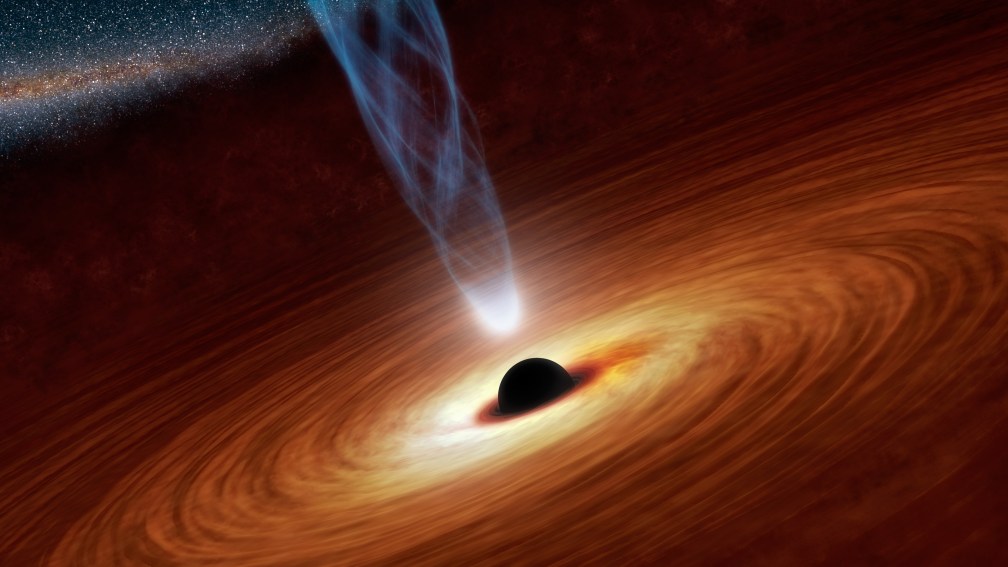
Given that, it then comes to mind that if gravity is the result of a particle, then that particle could be blocked. In fact, it may even have an anti-particle. If you could discover or create a material that could either cancel or block gravitons, you would essentially have created the potential for a free-floating object even in close proximity to extremely massive bodies – not just the earth or the sun, but potentially even black holes! Imagine the implications of that for astrophysics!
So ultimately, though Verne’s predictions have borne out more successfully and accurately, Wells holds the trump card for inventing quantum mechanics twenty years before anyone began doing any serious theoretical work in the field! Einstein, eat your heart out.

Wouldn’t it be cool to be able to sit here – and not get sucked in?
 Satis Writes