Tales of Despair: The Fantastic Descent into Hell

Perhaps disheartened by the difficulty of writing an actual opera, in 1804 Ludwig van Beethoven (1770 – 1827) had the bright idea to tell a musical story without the words, and so was born the programmatic symphony. His sixth orchestral masterpiece, the “Pastoral” symphony, was one of the first great musical creations to not just paint a scene or don a mood, but tell, from start to finish, a coherent and structured tale, through wordless music alone.

And it was a phenomenal achievement; through five intertwined movements, we are taken through the experience of the composer as he travels to an idyllic countryside, breathes in the beauty and serenity of the pastures and streams, and revels in the joyous dancing of the country folk. In a dark turn, we are overcome by a terrifying and violent storm, threatening to ravage the countryside, until finally it passes, and we rejoice with the shepherds. The story is, admittedly, rather naïve, but Beethoven was one of the great advocates of Goethe‘s humanism at the time, desperate for the belief that man was a better creature, and could aspire to beauty and greatness.

As the world moved forward into the romantic era, the youthful idealism became tainted with the dark reality of industrialism, war and poverty. Stories continued to be told, but they became ever darker. Composers and pianists, the rock starts of the nineteenth century, became corrupted by their popularity. Hector Berlioz (1803 – 1869), the infamous French composer, wrote many of his greatest works under the heavy influence of opium. In fact, perhaps his greatest tribute to Beethoven – a twisted retelling of his tale of beauty and serenity – is the Symphonie Fantastique, in which that very drug is the catalyst for a descent into murder and madness.

Being a child of the romantic era, Berlioz was infused with the passion and impetuosity of many of those of his generation, and he found himself infatuated with several women in his life. One of these, an Irish actress called Harriet, caught his fierce attention in Romeo and Juliet, and she became the inspiration for what is today perhaps his most enduring work.

Berlioz’s Symphonie Fantastique is, as was Beethoven’s Pastoral Symphony, a song with a tale to tell. Our young musician, in a dream of passion, discovers a woman who embodies his every ideal, and cannot rid her from his mind. He is delirious, love-struck, despairing and joyful, and sees her in his mind every waking moment. These thoughts consume him even as he passes through life – at a ball, a festive, joyous occasion, he cannot see the lights or the music. Wandering in the fields, by the brook and past the shepherds, he cannot but brood on his terrible loneliness. He wishes – hopes – that he may soon not be alone, but thoughts of betrayal of evil creep through his mind.

And then, the story takes a dark turn, and does not return. Convinced his love has forsaken him, he poisons himself with opium, and as he lays dying, he is plagued with the terrifying dream that he has murdered his only beloved. Powerless from the drug, he watches helplessly as he is captured, and led to the gallows. The crowd looks on, he cries out in despair – and, as the guillotine’s blade descends, he sees her in the crowd – alive.

And it does not end there. Dead, he finds himself transported to hell, lost in the midst of a witches’ Sabbath. Shadows, demons, sorcerers dance sickeningly around him, taunting and teasing him in his own death. And then – horror upon horror – he sees that she is a part of the diabolical gathering, that she is dancing to his death with the witches. As the bells of his death sound, the terrible creatures conspire to mock god, dancing over the ancient music of his wrath, and all is lost to perpetual darkness.

Inspired by the beautiful Harriet, Berlioz went on nonetheless to become engaged to a Camille, instead. When she spurned him, he raced to Paris, seeking to murder her, her mother and her fiancé. Eventually, when this plan failed, he returned to Harriet – and there, he discovered the painful truth behind infatuation. The two wed for a mere two years.

Berlioz would go on to produce one of the most famous renditions of the legend of Faust, who sold his soul to the devil. He separated from Harriet, and though he continued to provide for her for the rest of her life, she died not long after from severe alcohol abuse. His mistress, whom he eventually married, died eight years later. A girl for whom he had affection, only twenty-one years old, died also, and Berlioz was left with nothing but his grief.

At the age of only sixty, he began, in his despair, to wish for death, and not long after, he was stricken with violent abdominal pains. The pains soon grew and spread, and in the end, consumed him. On his death bed, he spoke these final words:

Enfin, on va jouer ma musique.

Tales of Despair: Expectations of Misery

In 1860, a fifty-year-old novelist sat down to write what he later came to call his favorite story; the best he wrote. It was a story of mystery, of abuse, of abandonment and heartbreak; a story of joy and misery, and of despair. It had the gravely misleading title of Great Expectations.

Charles Dickens (1812 – 1870) was no stranger to abuse, neglect and misery. From a wonderful and idyllic childhood, he was thrust brutally into the world of child labour at only twelve years of age, when his father was imprisoned for debt. He worked desperately, in filth and dust, ten hours a day, for six shillings a week: this would be the equivalent of £17 ($26) today. This would indelibly mark him for the remainder of his life, and it was only his own internal strength that kept him alive during this bleak time.

The influence of this impoverished upbringing made itself known throughout so many of his novels, from A Tale of Two Cities to Oliver Twist. Along with this misery grew an unfortunate dislike for women – born from his mother, who even after her husband’s debt was paid, would not let young Charles leave the blackening warehouses.

And in Great Expectations, we see all of this come alive. This is a story of innocence destroyed, and the greatest tragedy is that it is destroyed willfully, wantonly, malevolently, the desolate outcome of a scarred and heartbroken woman, whose sadness turned bitter, and then turned to hate.

And so from the outset, from the first page, we are shown that poor, little Pip, who has never done wrong to anyone – who feels a great guilt for stealing a single pie to feed a terrifying and starving convict – is destined for a life of torment and shame, wherein his very innocence is the thing that leads those around him to take such destructive advantage of him.

There is, awfully, no expectation of greatness in the story. Poor Pip, throughout his childhood, is torn, lost in blind admiration for the cold Estella, ashamed of his own upbringing, and bearing the agony of the emotional torture Miss Havisham and Estella put him through, daily. All the while, he lives in mortal fear of the escaped convict, haunted by nightmares that he might return, might kill him, and destroy his family.

Even his family is a failure for him. His sister, resentful that Pip should be burdened upon her, treats him as a dog, punishing him for the slightest of transgressions. Worse, she treats her own husband equally, and the household is home to misery.

As Pip grows older, and enters into a mysterious fortune, promised to him upon his twenty-first birthday, he fights desperately to become the gentleman he is certain will win Estella’s heart, never knowing that Miss Havisham, in her cruelness, has ensured from her youngest years that Estella has no heart to give. We know this, and we feel the agony that Pip relentlessly pursues this impossible dream.

As the tale progresses, we learn that even Miss Havisham, for all her cruelty, is herself only the victim of trauma herself; the wedding dress, tattered and faded, that she wears for the remainder of her life, is that which she had worn the day she was to be wed; the day her fiancé stole, and killed, her own heart.

And the greatest, most heart-wrenching tragedy of all, is that the one, the only person that would show Pip kindness – the only person who has ever truly loved him – is himself the victim of torment from none other than Pip himself. In his shame of a common upbringing, Pip shames his own father-figure, the simple, honest Joe. Joe, who bears Pip’s harsh words year upon year, and never once voicing complaint against him.

Great Expectations is, for me, the single greatest work of literature of the past two hundred years. I realize that it was merely popular fiction at the time it was written, but its tale of lost love and despair has transcended the years, and is as inspiring as it is heart-wrenching.

Tales of Despair: The Light at the End of the World

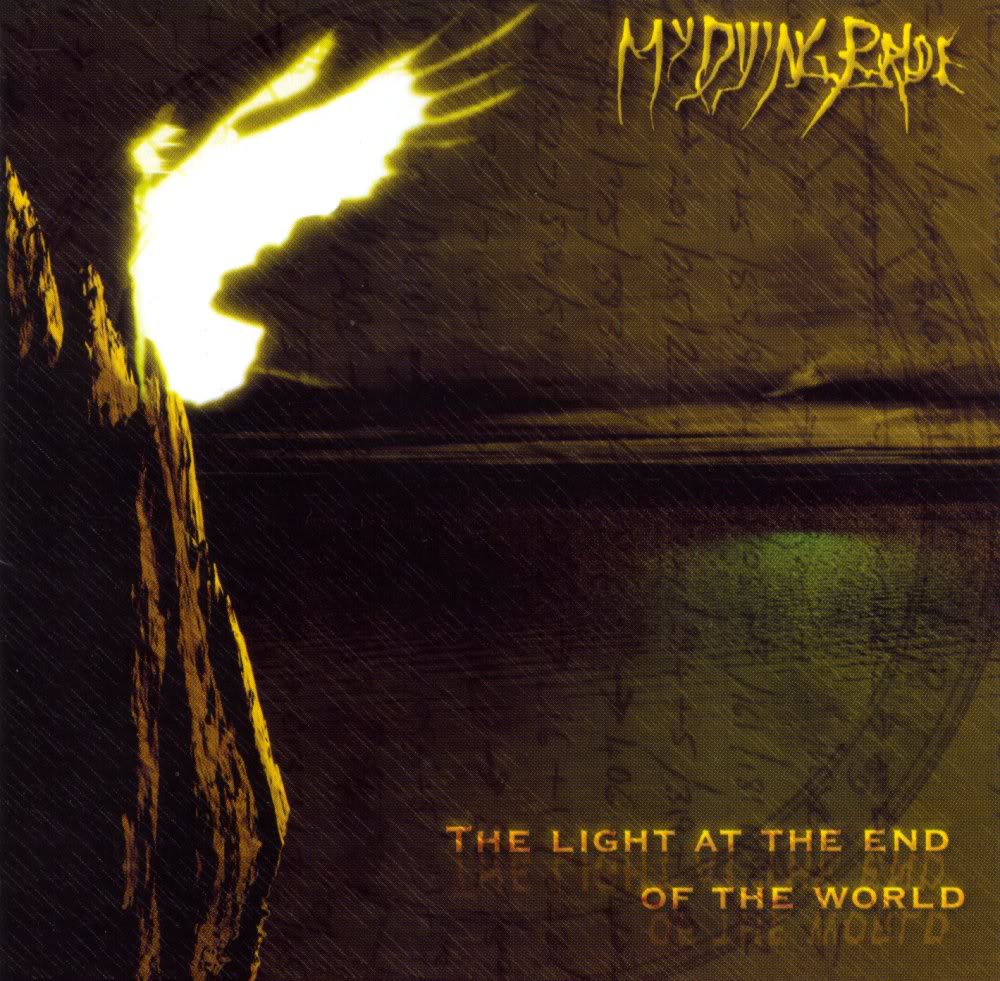
I have spoken of My Dying Bride before in this series, but their canon of despair is vast, and bears revisiting. Here is a tale of utter wretchedness, loneliness, bitterness and despair.

Imagine, for a moment, the abyss of complete isolation. Alone, upon an isle, lost at the end of the world. The sole companion – a light, that burns for no man.

Now consider the wretchedness of the memories of her, of the love that completed you, that made your heart whole, and the bitter knowledge that she is forever gone. Gone, to the winds, dust to the ground, and your fate is to live forever alone, never to be redeemed. Such have the gods done to you.

And the dreams, and the thoughts of madness. Sometimes, the sight of home behind closed eyes, the green trees and the laughter; sometimes, the waking to madness, the knowledge that such a past is forever gone. And sometimes, the bird visits; taunts, tells of life, and raises hope – only to dash it, like the water upon the rocks.

And then, just as the torment becomes the day and the night, to be expected forevermore – the gods bring mercy, and hope beyond hope! They make an offer: to spend one, single night with the woman, the long lost love. But oh, there is a price; this one night would seal the fate of eternity alone, until the ending of life.

Would you take it? Would you throw your hopes to the rocks, for one night with her?

The agony, the soul-crushing blackness, to wake the morning, and to find – after that one, oh-so-brief night – that she is gone. And gone, now and then, for ever, and ever. The doom, the screams, the despair.

Such is the terrible fate of the man who tends the light at the end of the world.

An isle, a bright shining isle

stands forever, alone in the sea.

Of rock and of sand and grass

and shade, the isle bereft of trees.

Small.  A speck in the wide blue sea.  ’Tis the last of all the land.  A dweller upon our lonesome isle, the last, lonely man?

By the Gods he is there to never leave, to remain all his life.  His punishment for evermore, to attend the eternal light.

The lighthouse, tall and brilliant white, which stands at the end of the world.  Protecting ships and sailors too, from rocks they could be hurled.

Yet nothing comes and nothing

goes ’cept the bright blue sea.

Which stretches near and far

away, ’tis all our man can see.

Though, one day, up high on

rock, a bird did perch and cry.

An albatross, he shot a glance.

and wondered deeply, why?

Could it be a watcher sent?

A curse sent from the gods.

who sits and cries and stares at him,

the life that they have robbed.

Each year it comes to watch

over him, the creature from above.

Not a curse but a reminder of

the woman that he loved.

On weary nights, under stars,

he’d often lay and gaze.

Up toward the moon and stars.

The sun’s dying haze.

Time and again, Orion’s light

filled our man with joy.

Within the belt, he’d see his love,

remembering her voice.

The twinkle from the stars above,

bled peace into his heart.

As long as she looks down on him,

he knows they’ll never part.

One day good, one day bad.

The madness, the heat, the sun.

Out to sea, he spies upon land.

His beloved Albion.

Cliffs of white and trees of green.

Children run and play.

“My home land,” he cries and weeps,

“why so far away?”

Eyes sore and red.  Filled with tears,

he runs toward the sea.

To risk his life, a worthy cause,

for home he would be.

Into the sea, deep and blue,

the waters wash him clean.

Awake.  He screams.  Cold with sweat.

And Albion a dream.

Such is life upon the isle,

of torment and woe.

One day good.  One day bad.

And some days even hope.

The light at the end of the world

burns bright for mile and mile and mile.

Yet tends the man, its golden glow,

in misery all the while?

For fifty years he stands and waits,

atop the light, alone.

Looking down upon his isle

the Gods have made his home.

The watcher at the end of the world

through misery does defile.

Remembers back to that single night

and allows a tiny smile.

(His sacrifice was not so great,

he insists upon the world.

Again he would crime,

Again he would pay

for one moment with the girl.)

Her hair, long and black it shone.

The dark, beauty of her eyes.

Olive skin and warm embrace,

her memory never dies.

’Twas years ago, he remembers clear

the life they once did live.

Endless love and lust for life,

they promised each would give.

Alas, such love and laughter too,

was short as panting breath.

For one dark night, her soul was kissed,

by the shade of death.

(Agony, like none before,

was suffered by our man)

who tends the light now burning bright

on the very last of land.

(Anger raged and misery too

like nothing ever before.)

He cursed the Gods and man and life,

and at his heart he tore.

A deity felt sympathy

and threw our man a light.

“Your woman you may see again

for a single night.

But think hard and well young man,

there is a price to pay:

to tend the light at the end of the world

is where you must stay.

Away from man and life and love.

Alone you will be.

On a tiny isle.  A bright shining isle

in the middle of the sea.”

“I’ll tend the light, for one more night

with the woman whom I love,”

screamed the man, with tearful eyes,

to the deity above.

And so it was that very night,

his lover did return.

To his arms and to their bed,

together they did turn.

In deepest love and lust and passion,

entwined they did fall.

Lost within each other’s arms,

they danced (in lover’s hall.)

Long was the night and filled with love.

For them the world was done.

Awoke he did to brightest light,

his woman and life had gone.

To his feet he leapt.  To the sea he looked.

To the lighthouse on the stone.

The price is paid and from now on

he lives forever alone.

Fifty years have passed since then

and not a soul has he seen.

But his woman lives with him still

in every single dream.

’Tis sad to hear how young love has died,

to know that, alone, someone has cried.

But memories are ours to keep.

To live them again, in our sleep.

My Dying Bride – The Light at the End of the World