Revisiting The Lord of the Rings

It’s hard to think that The Fellowship of the Ring first came out in theaters nearly nineteen years ago. It’s even harder to think of a world in which these masterpieces of cinema didn’t exist, and nobody knew what they were in for before their first-ever watch. It’s particularly difficult to imagine that Peter Jackson et al had the most immense difficulty getting these films green lit, filmed, produced, and realized, in an era where CGI was only just starting to take hold of blockbusters and our only experience of motion capture was Jar Jar Binks.

I want to revisit these films in light of their imminent release in 4K, as I am (like many fans the world over) simply dying to see scenes such as wandering the halls of Moria, or the battle of the Pelanor Fields, in even higher quality than ever before. I’m even more excited for the news that remastered editions are coming next year, but 4K will have to do for now.

Like the best of cinema, The Lord of the Rings trilogy is an epic visual feast, from the bright and colorful renditions of the Shire to the overwhelming sight of ten thousand soldiers on horseback running down an even greater number of orcs, and every scene and shot is filled with visual magic – both practical and CGI.

Given that we’re discussing these films in the context of their technological improvement (upscaling, re-rendering, etc.), it’s worth noting that the timing of these films was perhaps a key to their visual success: the burgeoning rise of computer-assisted imagery was vital to Peter Jackson’s vision, yet an enormous number of shots were achieved through much simpler – and much cleverer – practical effects. When comparing these films to later blockbusters – including The Hobbit prequels – it really is the seamless blend of practical and digital effects that allowed this movie to achieve the visual successes that it did. When we see great panning shots around the stone city of Minas Tirith, or witness the breaking of the dam above Isengard, we’re actually watching 100% practical shots, achieved with excessively large miniatures (‘bigatures’, as Jackson’s team would come to call them), enhanced only by the subtle CGI addition of things such as people wandering the streets, or orcs being thrown into cascading rivers.

At the time, audiences were used to CGI being used for very obvious, impossible to visualize effects; think the liquid metal of Terminator 2, or the tracking shot of the bug in the opening to Men In Black. Most other blockbusters of the time – even huge visual-effects-laden hits such as Independence Day – relied primarily on practical effects, sometimes superimposing multiple practical shots with green screen. It was much less common – and at times disastrously obvious – when CGI was used to render entire landscapes, create inhuman characters, or add dazzle to otherwise normal shots.

This means that Jackson was, at the time, at a crossroads of technology; anything was possible with CGI, but it still wasn’t alway the best choice. To create creatures such as Gollum – which, as opposed to Jar Jar Binks, was necessitated by the original source material – Jackson had no choice but to rely on motion capture and an army of digital artists to create his vision. But to create many of the epic landscapes and cities, he relied on something much simpler: the majestic and wildly varied countryside of his native New Zealand. So much of the grandiosity of The Lord of the Rings comes not from CGI, but from the real-life locations in which he chose to film. When we watch Gandalf, on the back of an eagle, soaring high over snow-drenched peaks, we’re watching a small blip of CGI against a completely real world.

In some ways, these are the scenes I’m most looking forward to seeing in 4K: not the crazy, CGI-laden battles of ghosts and oliphants, but the sweeping, majestic landscapes that deserve to be seen in the highest possible quality.

Of course, style is nothing without substance, and whilst there are small moments that detract from the overall interpretation of Tolkien’s original vision (I’m looking at you, Legolas-surfing-down-a-staircase-on-a-shield), the faithfulness of the adaptation, and the clear love Jackson had for the source material, make for one of the most thrilling, and emotional, stories to be put to film. When The Lord of the Rings first came out, many people were concerned at its runtime, and what seemed to be incredibly slow pacing. And arguably, they are a long, slow set of movies; it’s nearly forty minutes into the film before we even leave the Shire, and there’s still half an hour of film to go after the destruction of the One Ring. But this pacing reflects the detail of the film, which in turn reflects the detail of the world-building that Tolkien put so much effort into.

Die-hard purists will complain that the reluctant king trope Aragorn plays in the films is contrary to the original story, or bemoan the loss of Tom Bombadil in the opening chapters, but the other thing Jackson had an uncanny knack for (which he has yet to replicate to such a degree) was knowing what worked well, and what wouldn’t work well, when translated to film. As slow as the films are, they are a masterpiece nonetheless in tension, character- and world-building, and even in the extended editions, nothing is present without reason. Sure, Aragorn doesn’t set out from Rivendell with Andúril in hand, knowing he is to be crowned king, as he does in the books, but this would have worked against the audience’s empathy for him had Jackson stuck hardcore to the text. Modern audiences expect character arcs, and arguably Tolkien was less a master of character-building than he was world-building.

Even when Sam (albeit temporarily) abandons Frodo in the passages above Cirith Ungol (a thing that never happens in the books), it works to the emotional tension of the film, serving as a breaking point, and moment of darkness before moving into the final climax of the film. These changes, I would argue, are for the better – at least in the telling of the story cinematically – and these three movies remain to this day my favorite works of art ever committed to film.

I can’t wait to see them in 4K, and when the remastered versions come out next year, I’ll be first in line!

What are your favorite moments from The Lord of the Rings trilogy? Do they stand the test of time, visually and content-wise? Let me know!
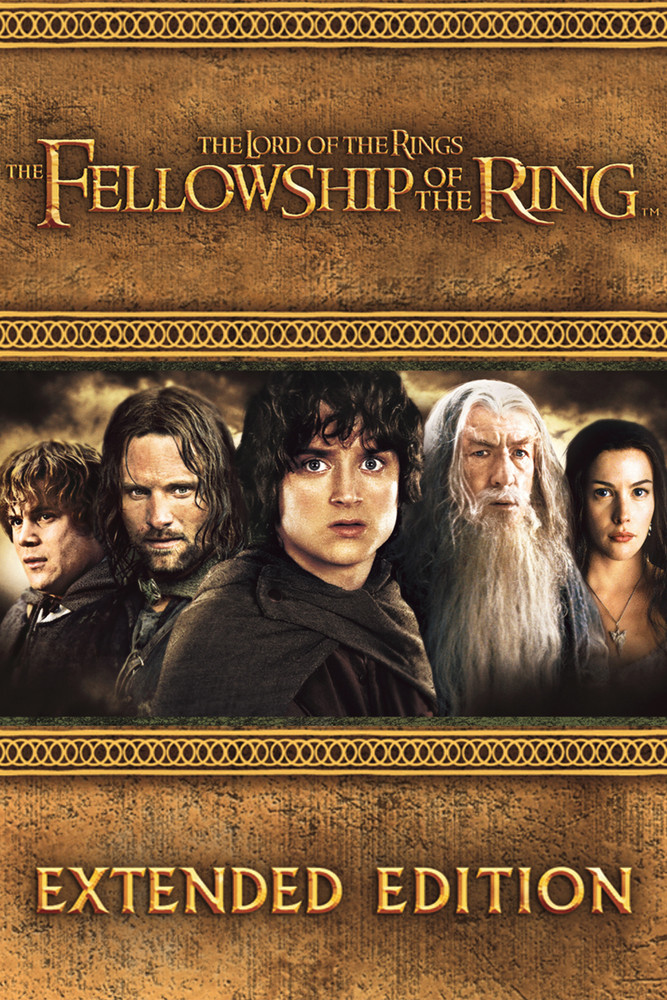
Movie Night: The Lord of the Rings – The Fellowship of the Ring (Part 2)

Part two leads off from the Council of Elrond, through the passage over Caradhras and the mines of Moria, the stay with the elves in Lothlorien, and ultimately the sacrifice of Boromir and the breaking of the fellowship.

Frodo carries on the journey begun in the Shire, and more than ever, we see him begin to realize the danger and power of the ring. Even after Gandalf utters the ring’s inscription in the tongue of Mordor, Boromir of Gondor still tries to convince the council to allow his country to use it as a weapon. Gimli attempts to destroy it to no avail, and even when, through the tension, the council agrees that it must be destroyed at Mount Doom, a bitter argument breaks out over who is to be responsible for its destruction. We see Frodo, watching from the background, witness the mounting enmity through flames reflected in the ring itself. It is in the midst of this that he realizes his fate: he is to carry the ring to its final destruction, or his.

One Ring to rule them all,
One Ring to find them,
One Ring to bring them all
and in the darkness bind them.

This is a thought that is reinforced throughout the remainder of the film; the fear Frodo has in allowing others to touch the ring (first seen when Boromir retrieves the fallen ring in the snow of Caradhras) bears witness to this, and it is reinforced when he talks with the Lady Galadriel in Lothlorien. Having witnessed the loss of Gandalf in Moria, and bearing the guilt of that loss with him, he realizes he can no longer bring peril to the remainder of the Fellowship: his decision is made.

You are a Ring-bearer, Frodo. To bear a Ring of Power is to be alone.

It is of course not until the end of the film that Frodo finds the courage to do so; it takes the betrayal of Boromir, and the evidence of the ring’s maddening effect on those around him, to finally convince him. We see him leave; see Boromir find his redemption, and accept his king; we see Merry and Pippin captured by the uruk-hai. The stage is set for the following two films.

It is not the first time Little Satis and I have watched The Lord of the Rings (not even the extended edition), but each time he observes further details, and now is pointing out things I had not seen myself, or at least had not noticed. He made the distinction tonight between the goblins of Moria, the orcs of Mordor, and the uruk-hai of Saruman. Apparently the uruk-hai are seen only in the first two films; the assault on Minas Tirith is made by a combined army of orcs and men, but there are no uruk-hai. He thought perhaps this was the failing of Sauron; the uruk-hai were fewer, but were stronger. Had he had an army of ten thousand uruk-hai to storm the white city, the outcome might have been quite different.

I can’t wait to see what other things he notices as we continue with The Two Towers; watching with an eight-year-old is certainly a rewarding experience!

Movie Night: The Lord of the Rings – The Fellowship of the Ring (Part 1)

After last week’s fiasco, Little Satis and I decided we were in need of a known-good film (KGF). As we discussed it, we realized that we both had quite the hankering to revisit The Lord of the Rings.

Now as you know, this isn’t exactly a one-night endeavor, and so this will be the main focus for the next few weeks. Particularly since we are watching the extended editions (which in my mind are superior – yes they are), this is going to take us some time. Tonight, we watched The Fellowship of the Ring up to the Council of Elrond. (Fun fact – my computer’s spell-check recognizes the world Elrond.)

There’s not a lot to be said about this epic set of films that hasn’t already been discussed ad nauseum. For me, Peter Jackson’s three films represent one of the finest, most perfect filmic storytelling masterpieces of our time, alongside Ben Hur and Spartacus and Dr. Zhivago and Lawrence of Arabia (and more). I’ve discussed the music at length, and there is little more to be said about that, but there are always new things I notice in terms of the film itself.

In the area of cinematography, Peter Jackson has shown himself to be a genius. Beyond the basic settings of his native New Zealand, the direction is subtle, ingenious and masterful. Tasked with the hideous job of making a 5’6″ actor appear half the size of a 5’11” actor, Peter turned to some innovative effects. While multiple shots against green screen were used when possible, there are moments in the film when such things are simply impossible. A fantastic example of this is in the early scenes when Frodo is riding side-by-side with Gandalf in a cart; both actors – not doubles – are sitting next to each other, and the illusion is perfect. It’s only on extremely close inspection that it appears the cart was specifically built with one side of the seat further away from the camera than the other, thus placing Elijah Wood further away than Ian McKellen.

Peter’s faithfulness to the book is also commendable. I’m aware this is somewhat of a contentious issue, as there are indeed areas where Peter and his wife Fran Walsh took considerable liberties, but there are in each case a wonderfully good reason. The most common reason for changes is Hollywood dramatics; no one is interested in a character called Tom Bombadil. One of the things that impresses me continuously, however, is Peter’s respect for the pace of Tolkien’s books. The Fellowship of the Ring, like the two that follow it, is not a fast-paced film (their 4-hour running times is ample evidence of that). The fact that the opening half hour of the movie revolves around the Shire showcases this, but it serves an important job: it retains the gradual building of tension and the destroying of Frodo that is so incredibly important in the books. Take a moment and look at Frodo in the earliest moments of The Fellowship of the Ring, and compare it to the final moments before the destruction of the ring in The Return of the King. It hardly seems to be the same person.

This insidiousness is, ultimately, what draws me and Little Satis into the movie so deeply. The turning points are many, but subtle. The way Frodo looks at the ring after barely escaping the Nazgûl shows clearly that the deadly seriousness of their plight has only just dawned on him. Later, on Weathertop, the three other hobbits are cooking in the night, and only Frodo has the presence of mind to realize their fire could give them away. These are further things that change as each character experiences their own life-altering experiences.

Perhaps the most compelling scenes in the first half of this film are those at the very beginning, where Bilbo Baggins is musing on the story to write in his home under the hill. He says that a Baggins has always lived there, and always will. In these few words, we see both the beginning and the end of the tale, and are set up for all the bitterness that is to follow.

More to come next week!