Tales of Despair: Perversity

The grunts of his sister and her clients ring loud through the thin partition. Emile hates her as he hates all women; women have only ever spurned him.

Later, her lover beats him, and then invites him to eat with them. Irma will not stop him, though she tends to her brother when he is gone.

Bebert does not like him, and is satisfied when Emile squirms. In the end he will stab Emile in front of his sister. Again, she will not stop him.

Emile will buy a gun, and will desire Bebert’s death; it isn’t his that comes.

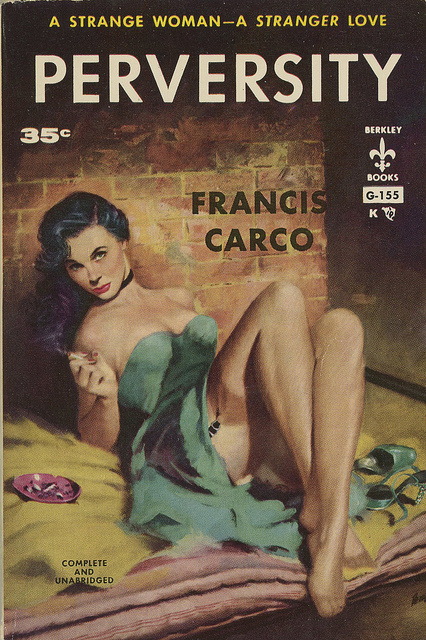
Such are just some of the scenes that bring to life Francis Carco‘s (1886-1958) frankly stomach-churning painting of 1920s Parisian slums, Perversity (French: Perversité). The story is bleak and desperate, centered around three loathsome characters and filled with little hope. Emile is a clerk, unable to function without the reassurance of strict routine. Irma is a prostitute, working from her bedroom in the tiny, two-room apartment she shares with her brother. Bebert is the bully of the tale, lording ownership over Irma and taking great delight in the torment and abuse of Emile.

What is particularly unsettling about Perversity is Carco’s unflinching dedication to the deeply disturbing faults he has built into his characters, and he allows them no redemption. Emile and Irma are pushed to edge of human decency, and repeatedly make decisions that seem against the very grain of morality, yet each time we are left with the knowing that there was, of course, no other way it could have been. One of the most discomfiting scenes occurs half-way through the story, when Bebert walks in to find Emile and Irma talking together. As Emile shrinks away from him, his sister points out that he is afraid of Bebert. Rather than allowing his characters to escape  with a mere argument, Carco builds a tension so great that it is only finally released when Bebert brings out a pocket knife and stabs Emile repeatedly, smiling all the while and insisting that such ‘pricks’ don’t hurt at all, and he shouldn’t act as such a baby. When he is finally finished and allows Irma to bathe him in salt, she comes to him and tells him that Emile is bleeding profusely. His callous response is that such a thing is “quite natural, I assure you. It’s rather the contrary that would astonish me.”

I have read no other book that so encapsulates the despair and hurt of inescapable depression, and forces it on the reader without sympathy. This is a terribly uncomfortable read, and I found myself unable to continue at certain points, often for weeks at a time. Ultimately, it was a rewarding experience, for it is a tale that draws you in and does not let go. The uniqueness of this story is that it is not tension, fear or suspense that hooks its teeth into you, but rather the grim, hopeless lives of these three people who have no reason to live, yet push on regardless in spite of the filth and the pain.

Perversity is available in print and for Kindle on Amazon. Read it at your peril.

Thought of the Week: Free Books

No – sorry about that. I don’t have any free books. Or rather, I have free books, but they’re not for you. They could be, perhaps, when I’m done with them; or they might be yours if you read them after I tell you about them. But for right now, they’re not for you.

I was on a long weekend to Montauk a little while ago, which was nice enough in its own right; there was a lighthouse that we didn’t go to, a giant golden statue and an office building that had been abandoned since 1930, which we also didn’t go to. We did see a World War II bunker that fell into the ocean, and had a milkshake.

On the way back, we also stopped in a town called Bridgehampton, which unsurprisingly is in the Hamptons. When we were there, we discovered that the Bridgehampton library, which is perplexingly called the Hampton Library (in Bridgehampton, which serves Sagaponack as well, as it happens), had some books, which was nice because we didn’t have to pay for them.

Of course, few libraries are in the habit of charging you for their books, which is fortunate, but most of them ask for them back, which is slightly deceitful of them. In this case, the Hampton Library in Bridgehampton that also serves Sagaponack didn’t seem too bothered about it, and had rather trustingly left them unattended on their front lawn. I actually began to wonder why the books (or at least the donation jar) hadn’t been pinched already, until I remembered we were in the Hamptons, at which point of course I felt a little guilty about pinching them myself. Still, it couldn’t hurt to have a look.

It turned out these books were books the library didn’t have room for anymore, and hadn’t been checked out in at least a year and a half or so. I suppose I should have been worried at that point but we hung around anyway, faithful that the library-goers of the Hamptons probably wouldn’t know a good book if it hit them in the eye, and that a gem (or at the very least some zirconia) might be buried in the pile.

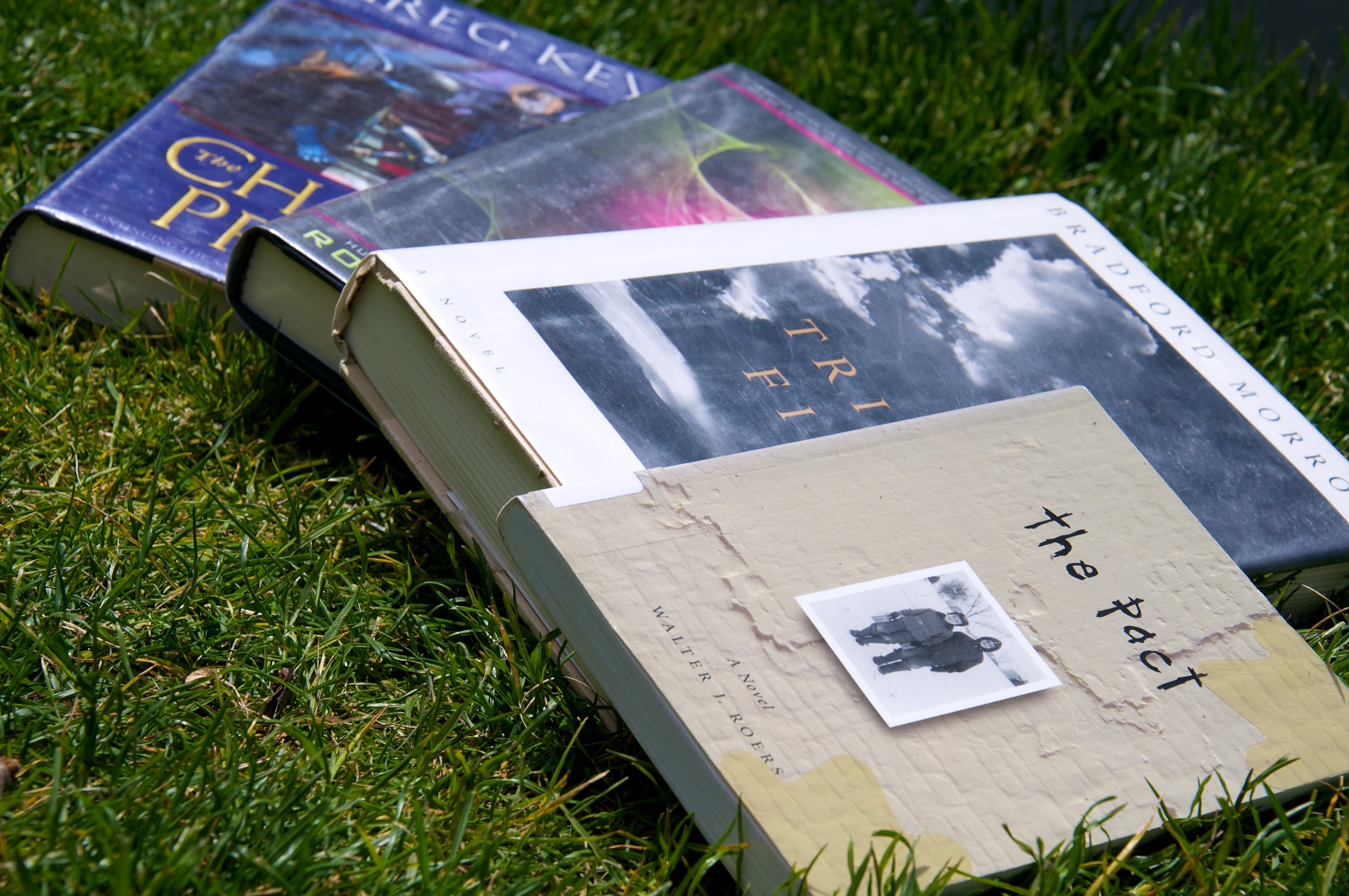
I don’t know if I found any gems. I do know I found four books that at the very least had pleasing titles and covers. This reminded me of choosing an album at a second-hand record store (in this case a second-second-hand book not-store), where I had to pick it based on the cover artwork alone. This used to be a lot of fun, until I’d bought all their good music and was left picking up some really weird stuff like Carter Tutti. These books are:

The Pact – Walter J. Roers

Something about two brothers growing up in the 1940s with abusive and alcoholic parents. Sounds pretty grim.

Trinity Fields – Bradford Morrow

Another book about growing up in the 1940s. Funny, that. This time in New Mexico with atomic bombs.

www:wake – Robert J. Sawyer

This one sounded interesting, if the author can bring a novel take on the subject: self-propagating intelligence via the internet. All through the eyes of a blind girl, so to speak. Creepy.

The Charnel Prince – Greg Keyes

This one seemed fun. I actually have to say it sounded vaguely familiar, and it’s supposed to be a sequel to something called The Briar King, in a series called The Kingdoms of Thorn and Bone. Sounds pretty straight-up fantasy, and I’m hoping, after the first three, it’ll prove some light reading.

I haven’t actually started reading any of them yet. Actually, I don’t have much time for reading at all, which is sad because I really don’t mind it. I am working through a book called The Last Death of Tev Chrisini by Jennifer Bresnick, which I hope to review when I’m done, something I’ve never done before so it probably will be a complete train wreck.

What about all of you? Have you read any of these books? Are there any I should start with first? What about ones I shouldn’t bother with? Actually, that would be the most helpful, since I always seem so short on time. Please let me know which of these four books is a complete waste of time.

Thank-you so much!

Thought of the Week: The Right and Wrong of Revising Your Writing

First of all, I had considered titling this The Wright and Wrong of Wrevising Your Writing, but it seemed a little too kitsch. What do you think?

Secondly, I have no intention of defining right and wrong. I’m not that daft.

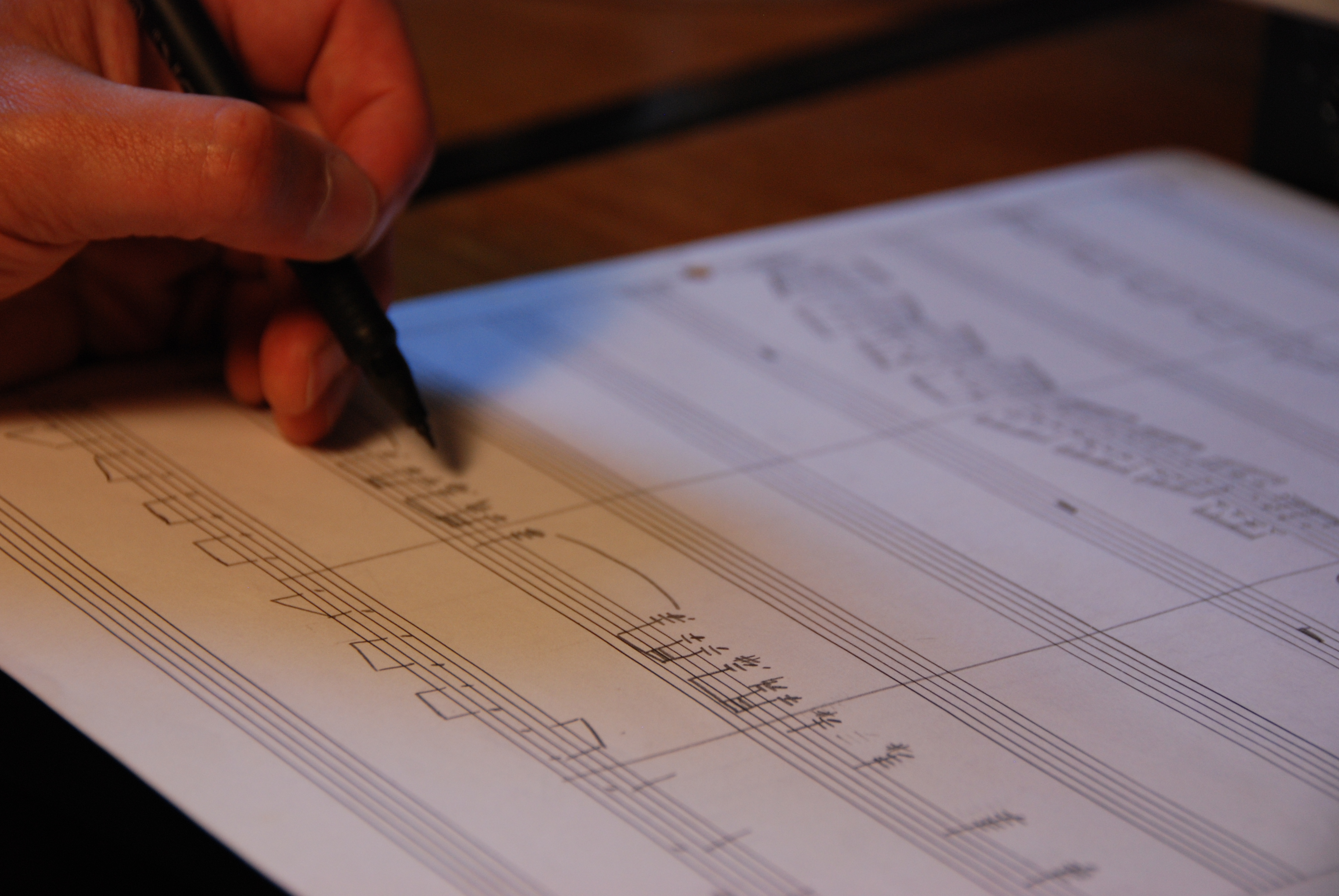
Johannes Brahms (1833-1897) is one of my favorite composers. His four symphonies are of course the best known of his works, the first in particular, opening with its dramatic C minor chords and booming timpani, inspiring pathos and doom in all their forms. However, far more than these massive works I prefer his chamber music, and in particular his works for piano and strings. In his life, Brahms wrote three piano trios, three piano quartets, and one piano quintet. That we know of.

His first piano trio, in B, is one of the most beautiful pieces of music I’ve ever heard, and is a constant player for me. The opening theme is serene and grand, and simply leads onward from there. The scherzo is tense and jittery, with the third movement being the sound of utter beauty. The finale, with its ambiguous tonality, draws on the agitation of the scherzo but adds in a extra melodic element to it.

Here’s the thing: it isn’t what he originally wrote. The piano trio was written and published in 1954, when Brahms was twenty-one. The piano trio we hear and listen to today was written and published in 1891, when he was fifty-eight, and it is almost completely different. In fact, it’s unique that we even know of the two versions, because Brahms spent his entire life revising and rewriting his works, never satisfied with the results. The tragedy of this was that, upon completion of his revision, Brahms would burn the original manuscript, leaving us with no trace of the process of his genius.

This is a shame, for having heard both versions, I actually find myself preferring the simpler innocence of twenty-one-year-old Brahms to his more mature and darker fifty-eight-year old self. I am given to wonder what the first editions of his other works might have been like. Sometimes there is a charm and quality in the passion of the first draft – Black Sabbath’s debut album, recorded on an eight track for £500, is a masterpiece.

My son makes up stories. Mostly in his head at the moment, but he enjoys it. Recently he started inventing back stories for the bounty hunters in Star Wars, which I thought was pretty cool, and not something I had given much thought to. When we discussed it, we realized that a particular detail of his invention couldn’t possibly have happened, because Boba Fett ended up alone on Jabba’s skiff over the Pit of Sarlaac, and so couldn’t have been involved in a smuggler’s ring previously. At first he disagreed with me, and I let him have his way. But a few hours later, he came to me and asked, “Dad…is it okay if I change the history I made up about the Star Wars bounty hunters?”

I thought this was incredibly insightful; having only just invented this history hours before, there was already a danger to him of changing that history – as though it would be telling a lie. If we decided to change our minds and say that it was actually Buzz Aldrin that first walked on the moon, there would be an outcry. “Lynch them!” people would cry. And they would be right.

But then what of fictional history? The natural answer would be, of course you can change it – it was made up in the first place! But look at what happened when George Lucas changed the history of Star Wars, with his revisions of Episodes IV, V and VI, and the release of Episodes I, II and III. Some of the scenery in the original movies was entirely changed. Whole scenes were added, which again changed the meaning of some of the story. Han Solo fired first! In the later films, we learn details that very nearly contradict the original movies entirely, and people have had to greatly stretch the meaning of some of the character’s dialogue in order for it to all fit. And look at what poor George got for his efforts.

So where does that leave us? As a fiction writer, you’ll often find yourself modifying some of your back story so that it makes more sense in the context of the main plot. Heaven knows, half of what I created in the Appendices of The Redemption of Erâth has already been flatly contradicted by the story I’m now writing. And I can’t imagine anyone would question me for that.

So when does it stop being okay to change your story’s history, or even the story itself? I’m sure J.K. Rowling wasn’t 100% happy with every word she wrote; even I can see some passages that leave something to be desired. But would we let her rewrite the book? Is it merely when the book becomes published that we lose the right to change it? Isn’t still in its essential nature our work? Why shouldn’t we be able to change it as we see fit?

I don’t have an answer to this; Brahms got away with it, and George Lucas didn’t. Peter Jackson felt the need to turn the ten hours running time of The Lord of the Rings trilogy into fifteen hours, and most people are okay with that (though not, perhaps, with watching it all). It seems funny how the public become so possessive of another person’s work – as though we owe it to them to stand by the work we created. Is this fair?

Let me know what you think in the comments!

Satis