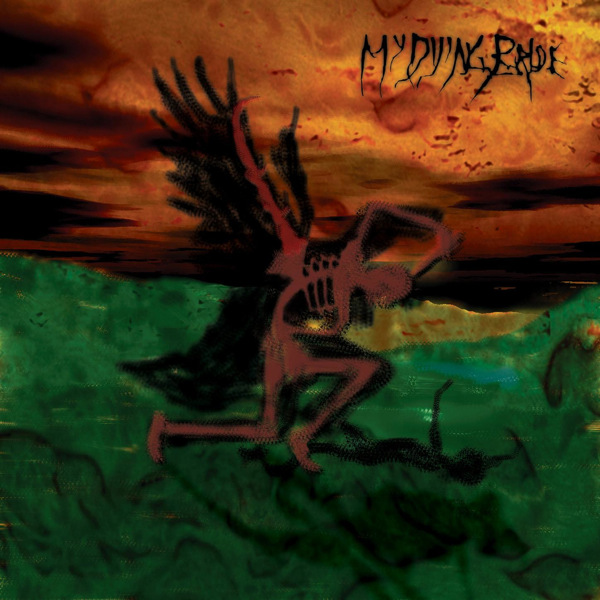
Tales of Despair: My Dying Bride and the Destroyer of Hope

Weeping with you. Arms around them
Flowing with you. Without your men
Keeping with you. Feeling their shiver
Drowning with you. Deep in this river

Tired and lonely. Sitting and staring
Weak and filthy. No longer caring
Wasting to nothing. The rubble of you
Hoping for something. Poison where love grew

People. Feel her mind
She is broken
People. Fill your eyes
Her body is broken

Leave me be, with my memories
I can still see all the lovers of me
I still know those feelings

You’re still mine, my lover
I watch over you
Goodbye my lover
No sorrow. Please, no tears

Holy and fallen. Watch yourself die
Fade and wither. Long lost the fight
Tremble to sleep. Her man long gone
Years, and still weeps. Never forgotten

My Hope, the Destroyer

© 2001 My Dying Bride

It would be impossible for me to write of despair without at least mentioning the beautiful and doom-laden music of British band My Dying Bride. From a musical point of view, there is little else in all the canon of recorded music that is so inspiring of – and inspired by – despair and misery. Over the past twenty years, My Dying Bride have filled the world with misery, in a series of beautifully recorded and artfully written albums and songs. The mastery of these albums is, as much as the musical style itself (slow, morose, often heavy, with achingly tragic vocals), the imagery dredged up by their dark and evocative lyrics. Though they rarely tell a story (The Light at the end of the World is a wonderful exception), the visions painted by these terrible words have endured in my mind for years, and it is these I would share with you.

“My Hope, the Destroyer” is a part of their 2001 album The Dreadful Hours, and is the culmination of an hour-long soundscape of doom. Metaphor and reality blend interchangeably, and from the opening strings, a scene of such utter bleakness is painted that it blackens the very world around you:

There is a man, eyes red and swollen with many tears, arms out to a soul that is not there. In a room, dimly lit, he feels himself drawn ever deeper into a corner of blackness, and the world above fades into utter nothingness. So has he been for days, and now he has not the strength to crawl of the unlit void into which he has been carried away. Voices pass around and over him, and they are distant, unheard and meaningless. Their sound is cold, and bring no comfort.

As this man is ever drawn down a stream of unconscious and black, twisted claws of despair rise from the deep, and he comes to pieces, and is undone. In this dying, he sees his woman, in white on a ground of black stone, stained in red, and the bleak faces of people and demons gather and stare. He is there, again, and in his arms she is lifeless. In the rain, the gray and the red above, the twisted faces of the past stare down, and mock him.

He is carried away on the sea of ink, and there is a stone, upon it a word, and below it a death. The tree above is leafless, and the raven does not move. Water drips on the stone, and it is not rain.

And in the fading twilight of his life, his every thought has ever been bent upon this moment, and turning back on a life of many years, all hope failed that one night, and tears have filled all the nights since.

Such are the scenes in my mind, every time I hear this song, and I am given to wonder – what tragedies inspired music of such despair?

Is there hope yet left in the romantic world?

Romance is an odd concept. It suggests and implies a great many things, from the palpitations of infatuation, the surreptitiousness of forbidden relations, to the turbulent impetuosity of lust. There are romance novels, romantic comedies, romantic getaways and romantic restaurants. But it seems to me that, in what I see around me every day, romance has come to equal love.

And, as we all know, love equals lust.

Stop me if you disagree, but I rarely, if ever, find myself coming across a story in literature or film of recent years that does not feature some, if not excessive, amounts of sex. I love Stephen King, but the guy is obsessed with it. Most titles billed as romantic comedies seemed to follow a fairly prescribed storyline in which two lead characters begin their relationship by sleeping with one another, and thereafter finding some mutual attraction (though even this rarely seems to progress beyond the physical). Even movies that are epic and dramatic in their scope and concept seem unable to pull themselves away from this theme. I think of Titanic, which was in every way a magnificent film, and draws the viewer in from the outset and doesn’t let go to the very end. But – and it’s a big but that I’m sure some will disagree with me on – the sex scene in the car puts a very different slant on the movie. It is iconic, of course, if for nothing but the cinematography, and is arguably indispensable to the plot – it marks the commitment of the ending of her relationship with her fiancé, and the beginning of a new life with Leonardo DiCaprio. However, what does it imply for their relationship? Do the characters genuinely love each other, or is their relationship driven primarily by lust? The sexuality is implicit almost from the very beginning, and is of course strongest in the sketch scene. Is this, then, a romantic story at all?

Rewind 150 years (or even 100, for that matter), and the notion of romance is markedly different. The very age is known in artistic circles as the Romantic era, and the definition of the term meant something quite different. Consider these two definitions:

1. a feeling of excitement and mystery associated with love.

2.  a quality or feeling of mystery, excitement, and remoteness from everyday life.

The term ‘romance’ used to have little to do with love, and implied much more the welcoming of sentiment and personalism into the arts. In fact, it closely resembles another term we have come to use much more frequently: fantasy. There is a great deal of love in many of the best-known fantasies, but very few of them are sexual in any manner whatsoever. There was a love between Frodo and Sam greater than any more recent romance I have come across, with – and I’ll get there in a moment – a few exceptions.

Perhaps with the commodification of our very sentiments and feelings (I’m looking at you, Valentine’s Day!), it is simply easier to equate love, lust and romance to a single common denominator; if there is no difference between them, stories, perfumes and candies can all be reigned into the same arena. And to me this is a tragedy – there is a danger in this of losing love, and romance, as distinct entities in their own right, that may be connected to, but need having nothing to do with, lust and sexuality. Love can exist without sex, but it is inherent to lust.

So where am I going with this? Well, to tell you the truth, I was going to have stopped here. I will admit to having formed a prejudice against virtually all modern love stories along these veins, and – particularly with the recent spate of terrible, terrible love-themed movies whose posters I have been unable to avoid – I had more or less given up hope that there was yet room in the world for stories that could equal Romeo and Juliet focus on love, exploring the themes therein, without being led astray by the temptation of lust.

But, then I started thinking a little bit more. Were there stories, films, that I had come across recently that lived up to this notion? And I began to realize that my prejudice had in fact blinded me from recognizing love in its most enduring form in many recent productions. One of my favorite movies of all time, WALL•E, is a perfect example. Ironically, so is Up, which followed this. Both of these are tales of love as a connection, a commitment made unconsciously by the very fact that this person is someone you cannot live without. Up plays on this notion and turns it into a minor tragedy, and I will admit brought me to tears when I first saw it.

Another great example is the film Love Actually, from a few years back. Although being largely billed as a seasonal romantic comedy, what struck me is that in its attempt to consolidate several unrelated stories of love, the writers were daring enough to tackle love in many different ways. There is the aging rock musician who realizes the love of his life is his manager; the childish crush of the intern on the Prime Minister; the wonderfully ironic twist on lust with the sex actors who in fact want nothing more than to get to know each other. However, my favorite relationship in this film is that between Liam Neeson and his stepson, which does an excellent job of tracing the building of a strong, loving relationship between an adult and a child.

So with these thoughts in mind, I wondered what the rest of the world thought. And, with little true hope, it must be said, I thought I should see what the IMDB lists as the top 10 romance movies of all time. See what you think – I was surprised:

  1. Casablanca
  2. Rear Window
  3. Forrest Gump
  4. City Lights
  5. North by Northwest
  6. Modern Times
  7. Vertigo
  8. Amélie
  9. WALL•E
  10. Life is Beautiful (La Vita è Bella)

My first thought was, I didn’t realize Hitchcock made so many romantic movies. My second was, this isn’t so bad. Though there may be sex in some of these films, not one of them is driven by lust. There is something deeper, something genuinely meaningful (in the vaguest of senses), in each one of these films. And for me, that was an encouraging thought.

So I’ll finish with a quote from one of my favorite bands of all time, My Dying Bride. As you might suspect by now, it has nothing to do with lust:

As I draw up my breath

And silver fills my eyes

I kiss her still

For she will never rise

On my weak body

Lays her dying hand

Through those meadows of Heaven

Where we ran

Like a thief in the night

The wind blows so light

It wars with my tears

That won’t dry for many years

Love’s golden arrow

At her should have fled

And not Death’s ebon dart

To strike her dead.

For My Fallen Angel, from Like Gods of the Sun
My Dying Bride, 1996