Tales of Despair: The Color and the Key of Despair

What mood do you see?

There are certain things that ring so of despair that they are instantly recognizable. In life there are such things — death, sadness, old men crying. In art also, there exists an equal dogma of darkness (even the term darkness serves as such an example). The darker of colors — black, blue, crimson — these are colors of despair. They are the colors of things that are frightening — the black of night, the unfathomable depths of the ocean, the terrifying heat of flame, and the letting of blood.

These colors form a great part of our perception of misery and sadness. Winston Churchill famously referred to depression as his “black dog”. Yet even the shading of these colors is significant; when we describe someone as being “blue”, we rarely imagine the pale, soothing blue of a spring sky. Bright red is a color of excitement and joy; deeper tones convey heat and flame and blood.

I think this man might be useful to me – if my black dog returns. He seems quite away from me now – it is such a relief. All the colours come back into the picture.

— Winston Churchill, 1911

And these tones are carried through into music. Ignoring synesthesia, it isn’t uncommon to think of a song or piece as carrying a particular color. These visual representations of key vary from person to person; if you were to ask any two musicians, you would likely get two completely different descriptions.
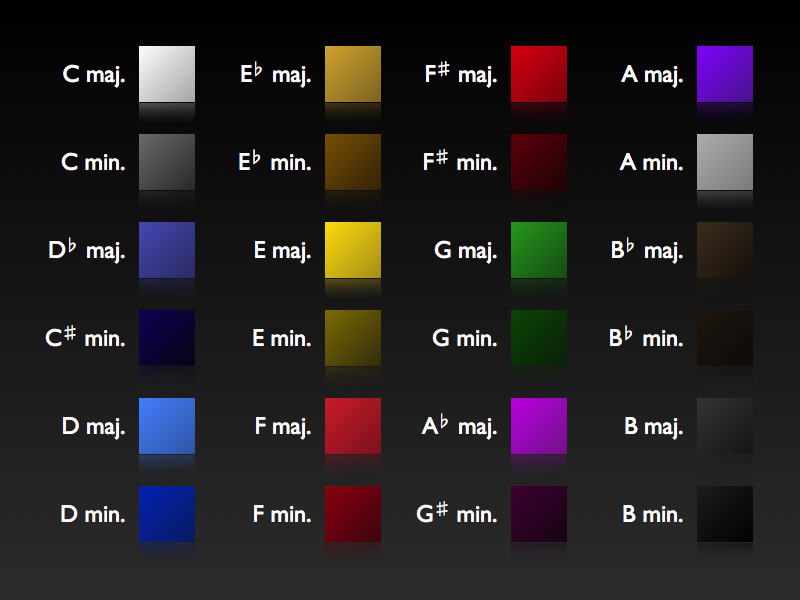
My personal key-color relationships. Even ignoring the colors, notice that the minor keys are universally darker than the major ones.

Having said that, there are certain keys that, almost universally represent sadness, anger and despair. As a starting point, these keys are naturally minor. The bright, exuberant major keys — the clean, purity of C major or the homeliness and warmth of E-flat major — rarely suggest any aspect of darkness. The inherent sad quality of the minor key, however, is inextricable.

The falling of tears.

Part of this is in the psychological impact of the falling semitone; to turn major into minor, the third key of the scale falls by one semitone. The very nature of falling and descent is linked to death (going underground) and sadness (the falling of tears). One of the most heart-wrenching progressions is the fall from the sixth note of a minor scale to the fifth (especially if the root note remains in the bass). A wonderful example of this is the opening of Sotto Vento by Ludovico Einaudi.

However, quite apart from this inherent quality of the minor keys, there is a particular key (or closely related keys) that has throughout the history of western music been used to express the deepest pathos and despair. Countless works have been based on this key, and they are without exception some of the most beautiful, and tragic, pieces of music ever written.

I speak, of course, of B minor (the key that, for me, is represented by the deepest black). There is likely a reason for this; C major, the standard and most oft used key, is above this by one semitone. The shift, the fall from this key of happiness, represents a profound shift from light to dark.

Violin part from the first edition of Beethoven’s fifth symphony.

What’s interesting, however, is that this history of this key is not so straightforward. Though from the 1800s onwards B minor because a de facto standard for sadness, it was prior to this rarely used. Instead, the tonally slightly higher key of C minor was used instead. Mozart wrote a beautiful mass in C minor (despite rarely using minor keys in general); one of his best piano concertos is the twenty-fourth in C minor. Later, Beethoven used this key for one of the most famous and furious of compositions: the raging fifth symphony in C minor. He was attracted to this key several times further: his eighth piano sonata, the Pathétique; the third piano concerto (clearly and heavily influenced by Mozart’s own piano concerto in the same key), and the thirty-second piano sonata (one of the last pieces he ever wrote).

The tragedy of Swan Lake.

Yet something happened in the early nineteenth century that changed this, and suddenly the key of despair dropped a semitone. We began to see works such as Schubert‘s eighth symphony, Chopin‘s third piano sonata, Liszt’s only piano sonata and the wonderful Totentanz, and Brahms’ chamber works (one of the most delicate and beautiful, the first piano trio in B, is in fact half in B minor). And then there was Tchaikovsky. B minor was an epic favorite of this troubled composer, being the home key of his first piano concerto, the beautiful Swan Lake, the furious passages of the Romeo and Juliet Fantasy Overture, and of course the intensely tragic and heartbreaking sixth symphony, the Pathétique.

Though at first it might appear that there are therefore two keys of darkness, and that the choice of key is down to the individual perception of the composer, it turns out not to be so simple. In the eighteenth and nineteenth centuries, there was no set tonal standard, meaning that different countries, and indeed different orchestras, would have their own definitions of standard concert tonality. In most cases, of course, the tonalities were similar – often differing by one semitone.

And to this day, as western tonalities became standardized (a practice that was only formalized in the 1950s), the key of B minor has assumed reign as the common standard for darkness, and despair.
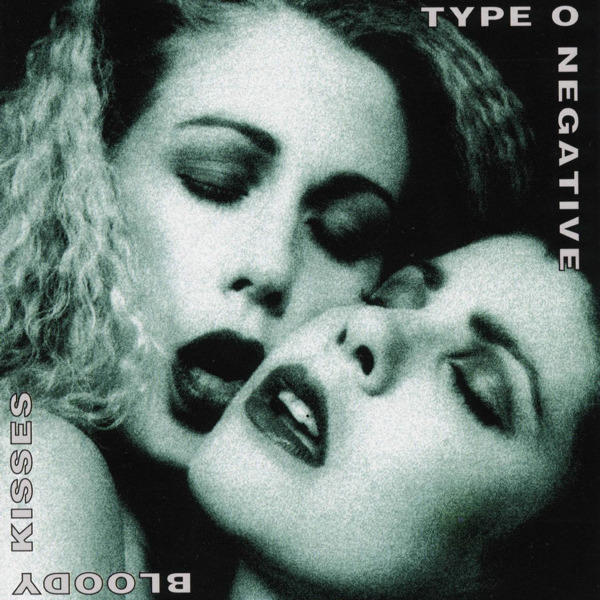
Music I Love: “Bloody Kisses”, Type O Negative (1993)

I spent most of my youth as a Goth (with a capital G), and for those of you who remember that time (or those of you who are still there), the music you listened to more or less defined who you were. In many of my hopeless and black moods, of course, there was nowhere to turn to than the wonderful misery of My Dying Bride, or the gloom-laden ballads of Sentenced. For the anger and fury, there was nothing else but Metallica and Slayer. When it was time to absolutely, once and for all I’m-really-doing-it-this-time slit my wrists, it could only be Marilyn Manson.

But, among all of these, there was one band that defined Goth more than any other I could think of, and this was the music I turned to when I simply wanted to dress in black, don the crosses and the black eyeliner, and sit moping in the back of a pub, pitying the fools who thought they were having a good time. That band was, of course, Type O Negative.

Type O Negative had a long and painful birth. As far back as 1976, four kids from Brooklyn were already gathering together in basements and garages, throwing together punk covers and goth rock. Like any young band, they went through endless lineup changes, finishing off in the eights with basically the same members as they had started out with. However, it took until nearly 1990 for their subversive music to be noticed, and their debut, Slow Deep and Hard to be released.

Ever mocking in their misery, Slow Deep and Hard featured extremely long, totally un-radio-friendly heavy metal doom, with bizarre (yet ultimately comprehensible) titles such as Unsuccessfully Coping with the Natural Beauty of Infidelity, a rather graphic song about being cheated on, to Gravitational Constant: G = 6.67 × 10^8 cm^-3 gm^-1 sec^-2, about suicide. While popular, it wasn’t until 1993 that the band truly broke through with Bloody Kisses.

A gothic masterpiece, Bloody Kisses is ultimately most famous for the title song, and the miserably humorous Black No. 1 (Little Miss Scare-All). The album extends for a full 73 minutes, passing from dark religious cynicism on Christian Woman to the bizarrely drudging cover of Seals and Crofts’ Summer Breeze, to genuine, suicidal misery on Bloody Kisses (A Death in the Family).

In hindsight (hind-hearing?), every song on this album is excellent, including the disturbing interludes such as Fay Wray Come Out and Play and Dark Side of the Womb, but at the time, the songs that truly spoke to me were those drenched in gloom and blackness. Black No. 1, so titled after the popular hair dye, references everything stereotypically goth from vampires to Halloween to the Munsters, and even a nod to Ministry‘s 1984 hit, Every Day is HalloweenChristian Woman, with its rather explicit lyrics of religious control and sexual repression, spoke deeply to the sexually-desperate teenage boy in me.

The one song, however, that truly got to me, that empathized with my own misery and formed the soundtrack for the trips to the darkest places in my mind, was the title track, Bloody Kisses. A depressingly morose song about a girlfriend who had committed suicide, it speaks of the strength it takes to kill oneself, the misery of being left behind, and challenges the dogma regarding suicide as a cry for help, or for attention. Surrounded by darkness, hopelessly depressed, and hopelessly attracted to a girl who was just as hopelessly depressed as I was, the lyrics spoke my own thoughts through the song.

A pair of souls become undone

Where were two now one

Divided by this wall of death

I soon will join you yet

With my blood I’ll find your love

You found the strength to end you life

As you did so shall I

 Bloody Kisses – Type O Negative, 1993

Though my mind is (sometimes) in a better place now, this song continues to hold a special place in my heart, as a reminder of just how dark the world can be. Type O Negative continue to be a favorite band of mine, and their music of darkness and depression are all the more poignant now – Peter Steele, founding member and singer, died in 2010 from heart failure, at the peak of his abilities. He was only forty-eight years old. Needless to say, there will be no further Type O Negative, but the seven albums they left us are a memory unto themselves – a biography of the misery, depression and black humor of the man who created them.

R.I.P. Peter Steele

1962 – 2010

Tales of Despair: Pélleas et Mélisande

Love incites bitterness; revenge leads to death, and the world descends into madness. From the chaos is birthed the new, the pure, and the harmonious. And so the cycle continues.

La Mort du Fossoyeur – Carlos Schwabe

The symbolists of the late nineteenth century were consumed with the goal of depicting the world not in itself, but as a representation of a deeper meaning, of dreams and ideals; life, and love, and death. In painting, angels, demons and death abounded, uniting love, death and despair. A beautiful example of this is Carlos Schwabe‘s La Mort du Fossoyeur (The Death of the Gravedigger). An angel – not white, but dark – looks upon the old man, deep within the grave he has dug for himself. The world is cold and frozen, blanketed in pure snow, and as the angel’s wings curl around the man, ready to bear him hence, she lights a green flame in the palm of her hand, the unearthly glow lighting her face. The angel is death, and transformation; the man is of the weary and aging world, longing to be taken from his agony.

It was against this symbolic background that Maurice Maeterlinck wrote the tragic play Pélleas et Mélisande – a tale of darkness and doomed love. Goulaud, a prince of Allemonde, discovers a young girl by a stream in the woods, lost and afraid, with no memory of who she is, but for her name: Mélisande. Goulaud falls in love with the girl, and they are soon wed in secret. Despite his fear that his grandfather, named Arkël and ailing king of Allemonde, would not approve, word eventually reaches him via Pélleas, who is Goulaud’s brother. Arkël would have his grandson return home nonetheless, and is smitten by the beautiful girl, and gives the couple his blessing.

Soon, though, Mélisande discovers a deep love for Pélleas, and the two begin to spend ever more time with each other. Deep in the woods, Mélisande loses her wedding ring in a well; fearful to tell Goulaud the truth, she tells him it was lost in a dark grotto. He bids her retrieve the ring, and again Pélleas accompanies her, providing her comfort in the terrifying darkness.

Growing ever suspicious, Goulaud brings a warning upon his brother: deep under the castle, he leads him to a great chasm, and darkly tells him to beware: Mélisande is with child, and is not to be his.

Pélleas kisses Mélisande’s beautiful tresses (courtesy of Ken Howard and Metropolitan Opera)

Yet Pélleas and Mélisande cannot deny their love, and in a desperate attempt to save her, Pélleas tells her he must leave, lest they bring Goulaud’s wrath upon them. But even as he departs, Goulaud confronts Mélisande, and in his anger, casts her violently to the ground. In tears, she flees in search of Pélleas, determined to be with him one last time. Once more deep within the woods, they meet and embrace in love – unaware that Goulaud had followed her. Descending upon them in fury, Goulaud runs through his own brother, and in casting him lifeless to the ground, deeply wounds his own bride.

Growing now ever weaker, Mélisande gives birth prematurely to a daughter; upon seeing her face, she bids the nurse to take her away from her, as she is nothing but tragedy to her. And so, in tears, she dies also.

Throughout the play, the story is rife with symbolism. In flirting with Pélleas, Mélisande loses her wedding ring – an symbol of the infidelity to come. The strength of women is also implicit in the grief their loss wreaks upon their men. Arkël, king of Allemonde, has lost his own wife; Goulaud is a widower when he discovers Mélisande; and of course, he brings the death of his second wife, Mélisande, upon her himself.

Maurice believed firmly in the cycle of destruction and rebirth; Eros, mythical god of love, and Anteros, his counterpart as the god of revenge, are at the heart of Pélleas et Mélisande. In the great darkness, love is slowly dying; the kingdom is ravaged by famine, waters are foul, and death surrounds our characters. In seeking forbidden love, Pélleas and Mélisande culminate this, and revenge is visited upon all, now leaving the world ready to begin again.

Pélleas et Mélisande has been influential since in a number of media; best known are Claude Debussy‘s opera, and Jean Sibeliusincidental suite. This latter is a wonderful musical journey of beauty and tragedy; I would highly recommend discovering and listening to this masterpiece.