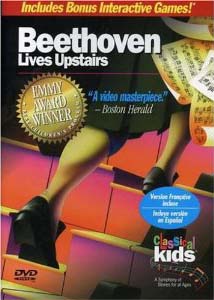
Movie Night: Beethoven Lives Upstairs

Year: 1992

Director: David Devine

Production Company: Devine Videoworks Production

Leads: Neil Munro, Illya Wolloshyn

Beethoven_Lives_UpstairsI had forgotten about this movie for so, so long; I can’t believe it’s been over 20 years! As a young classical music snob this was one of my favorite movies, and revisiting it now I can safely say it still is.

The plot is elegant and simple; young Christoph lives in Vienna with his recently widowed mother, and in order to make a living they rent out their upstairs room. It just so happens that their new lodger happens to be a rather well-known figure: Ludwig van Beethoven.

Predictably, Christoph hates Beethoven for taking his father’s place, and for desecrating his father’s study: in his constant madness and compositional furore, Beethoven writes music on any surface he can find – including the walls and the shutters.

Ah – the shutters. Well don’t worry, after I move you can sell them. I’ve heard they demand a good price.

Eventually though, he comes to understand the source of the man’s terrible frustration – to have such beautiful music to write, and be so totally unable to hear it. Christoph’s uncle Kurt helps him to learn the passion behind the man, and the terrible sadness and humiliation Beethoven lives with every single day. Gradually the two become ever closer, culminating in the hair-raising premier of his 9th symphony (one of the most glorious pieces of music ever penned). The triumph, of course, is made bittersweet by the knowledge that he was to die only three years later.

One of the best aspects of this film is that the score is entirely comprised of music by Beethoven – even the peddler and his monkey on the street corner! So great and varied was the output of Beethoven’s life that there was more than enough material to set the atmosphere of any setting, from overwhelming sadness (Allegretto from Symphony no. 7) to fury (Allegro con brio from Symphony no. 5), reminiscence (Für Elise) and light-hearted joviality (Menuet in G).

The performances are, in hindsight, less than perfect; Illya Woloshyn, in particular, feels like a by-rote actor. Neil Munro, however, is surprisingly excellent as the tempestuous and eccentric Beethoven, passing from raving lunacy to gentle tenderness and everything in between.

Little Satis enjoyed it, although I think I enjoyed it more; he very much likes Beethoven’s music (especially the 5th and 9th symphonies), and he certainly learned quite a few things about the man that he hadn’t known before. He gave it three stars, but I’m afraid I’m going to have to give it

★ ★ ★ ★ ★

There are many princes; there is only one Beethoven!

392px-Beethoven_Signature.svgSatis Logo with ©

Music I Love: “Symphony no. 5”, Ludwig van Beethoven (1808)

bee5_1_mThis is one my favorite works of music. Before you decry it as an obvious choice, let me point out that there is a lot more to this symphony than meets the ear. Aside from the obvious popularity of the opening movement, there is a lot to be enjoyed in the remaining three, including some musical moments that are, essentially, groundbreaking.

Nearly everything Ludwig van Beethoven composed is simply genius (I say nearly – I’m not all that fond of the cello sonatas), but in his early works he tends to stick to the tried and true forms of the classical era. He deviates, pushes the boundaries, but his first four symphonies, the multitude of piano sonatas, and even the violin concerto, still retain obvious and strong connections to the classical stoicism of the past.

So what makes the fifth symphony, written in 1808, so different? The first movement is in a nearly textbook sonata form; the second is a kind of theme and variation; the third a straight scherzo; the fourth a massive but unmistakable rondo. Structurally, there is little here to suggest anything that would upheave the musical dogma for everything to come.

Yet it’s usually accepted that Beethoven forms the bridge between the Classical and Romantic eras; Mozart and Haydn before, Schubert and Mendelssohn after. But at what point can we say that Beethoven was a Romantic composer, and not a Classical one?

Often it’s considered the ninth symphony, with its sprawling themes and instrumental excess, but for me I feel like it traces back to his fifth symphony. The main reason for this is not because of his structure, or indeed his themes, which are (the second movement aside) hardly lyrical. It is because of the emotional drama that he infuses every single note of the symphony with. From the first notes, starting on a weak beat (beat 2.5 out of 4, as it were) yet played with immense force, to the intense finale with its pounding C major arpeggio, the symphony drags the listener into a maelstrom of violent and tempestuous musical material, and doesn’t let go until the clamorous final notes, a single enormous C major chord stretched to infinity.

Though emotion was not anathema to Baroque and Classical composers, it was handled with restraint. Even Mozart’s final symphony, one of the most ingenious and complex pieces he ever wrote, doesn’t linger on any one theme, and moves on throughout its movements with poise and dignity, but never with untamed, rampant joy. Beethoven’s fifth symphony, however, oozes emotion, a roller coaster of joy and fury, of exuberance and despair.

It is this, more than its structure, that t0 me marks the turning point between the Classical and the Romantic eras. Even the most sophisticated Romantic composers such as Tchaikovsky and Mahler still made use of classic sonata, binary, minuet and trio, and rondo forms; it was emotion that these composers sought to infuse their music with. To me, this is the first time a composer did so on such a grand scale.

Symphony no. 5 in C minor, Op. 67

Satis Logo with ©

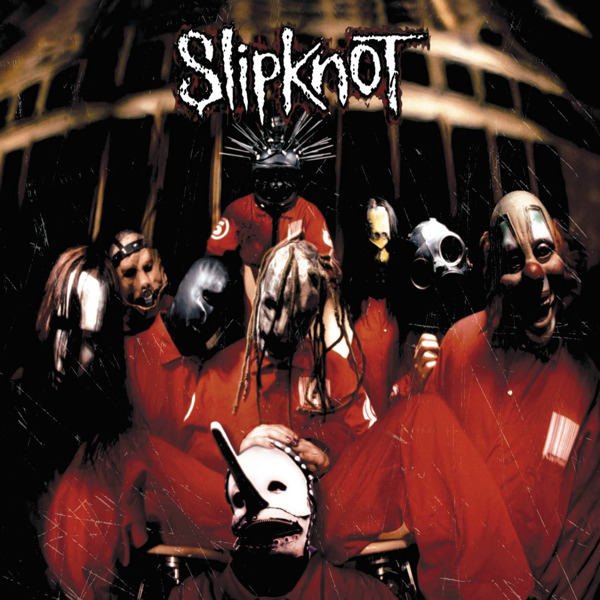
Music I Love: “Slipknot”, Slipknot (1999)

Slipknot

There’s frankly not a whole lot to be said about this seminal album that hasn’t already been discussed ad infinitum in every possible media avenue in existence, but that doesn’t stop this from being one of my absolutely favorite albums of all time. I once wrote a dissertation about the expression of emotion through music, and Slipknot featured pretty heavily.

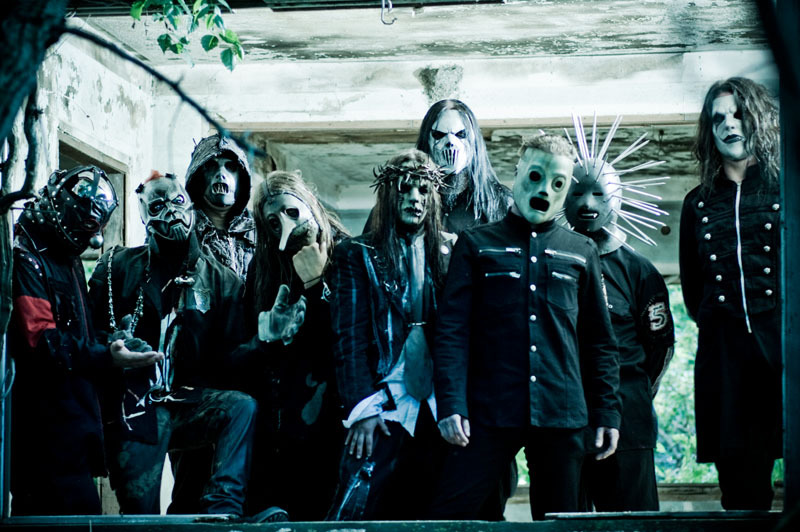
Slipknot were a nine-member (sadly now only eight) band from Des Moines, and to read through any of their lyrics, they had some issues:

Insane – am I the only motherf***er with a brain?

I’m hearing voices but all they do is complain

How many times have you wanted to kill

Everything and everyone – say you’ll do it but never will

Eyeless – Slipknot, 1999

It’s hard to recall the impact these – and the rest of the album’s – words had back in 1999. From the opening few seconds of (sic) you are bludgeoned by a frenetic, nearly incoherent rage, an insatiable fury that could stand up to an atomic blast and win. I can’t think of anything in the realms of rock or metal – or music in general – that even came close to such a level of energetic hate. In particular was the subject of this vitriol; unlike previous “angry” bands like Rage Against the Machine, there were no targets for Slipknot’s hostility, no politics; here was a terrifying group of people with not pity or mercy.

It’s scary enough to be facing an uncontrollable madman, never mind a vicious and calculating psychopath.

Which is ironic, because Corey Taylor and Joey Jordison et al. are, in conversation, a bunch of pleasant guys, albeit many with disturbing or traumatizing pasts. In a way, the band became cathartic for them: a way to express the inexpressible, to release the rage that had built up in them.

Another disturbing aspect of this burgeoning phenomenon was the use of grotesque and terrifying masks and costumes, furthering the disassociation of these people and their music from reality. By dehumanizing themselves, they created a heightened level of terror – an image of demons, quite possibly directly from the pits of hell.

So controversial was their debut album that it was considered likely that the group would either disband or kill each other before ever recording another album. Instead, they released Iowa in 2001, shattering their first album’s popularity by reaching #3 in the US Billboard 200. If Slipknot was an explosion of raw fury and rage, Iowa was a more refined hatred, a feeling of a more calculated and targeted ire, which of course was all the more disturbing; it’s scary enough to be facing an uncontrollable madman, never mind a vicious and calculating psychopath.

Their style and emotion became ever more refined with Vol. 3: The Subliminal Verses, and – if such a thing is possible – a more mellow kind of anger with All Hope Is Gone. However, none of their succeeding albums can come close to the untamed fury of their first album. It’s raw, abrasive, offensive and uncomfortable, and it is because of these qualities that it is such an outstanding work. There is nothing I have come across in the history of music recording that comes so close to the very embodiment of demonic rage and hate; it is likely as far as music can get whilst still remaining coherent.

Slipknot can be cathartic for me, too; whenever I’m feeling stepped on, maddened or infuriated, a play through this album is more than enough to get it all out. Like they said:

Who the f*** are you?  F*** you!

Better suck it up ’cause you bled through

Better get away from me

Stay the f*** away from me

Eyeless – Slipknot, 1999

SLIPKNOT-1