Movie Night: Beethoven Lives Upstairs

Year: 1992

Director: David Devine

Production Company: Devine Videoworks Production

Leads: Neil Munro, Illya Wolloshyn

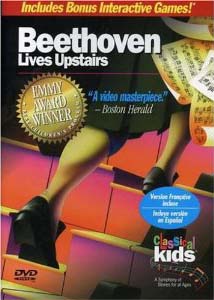
Beethoven_Lives_UpstairsI had forgotten about this movie for so, so long; I can’t believe it’s been over 20 years! As a young classical music snob this was one of my favorite movies, and revisiting it now I can safely say it still is.

The plot is elegant and simple; young Christoph lives in Vienna with his recently widowed mother, and in order to make a living they rent out their upstairs room. It just so happens that their new lodger happens to be a rather well-known figure: Ludwig van Beethoven.

Predictably, Christoph hates Beethoven for taking his father’s place, and for desecrating his father’s study: in his constant madness and compositional furore, Beethoven writes music on any surface he can find – including the walls and the shutters.

Ah – the shutters. Well don’t worry, after I move you can sell them. I’ve heard they demand a good price.

Eventually though, he comes to understand the source of the man’s terrible frustration – to have such beautiful music to write, and be so totally unable to hear it. Christoph’s uncle Kurt helps him to learn the passion behind the man, and the terrible sadness and humiliation Beethoven lives with every single day. Gradually the two become ever closer, culminating in the hair-raising premier of his 9th symphony (one of the most glorious pieces of music ever penned). The triumph, of course, is made bittersweet by the knowledge that he was to die only three years later.

One of the best aspects of this film is that the score is entirely comprised of music by Beethoven – even the peddler and his monkey on the street corner! So great and varied was the output of Beethoven’s life that there was more than enough material to set the atmosphere of any setting, from overwhelming sadness (Allegretto from Symphony no. 7) to fury (Allegro con brio from Symphony no. 5), reminiscence (Für Elise) and light-hearted joviality (Menuet in G).

The performances are, in hindsight, less than perfect; Illya Woloshyn, in particular, feels like a by-rote actor. Neil Munro, however, is surprisingly excellent as the tempestuous and eccentric Beethoven, passing from raving lunacy to gentle tenderness and everything in between.

Little Satis enjoyed it, although I think I enjoyed it more; he very much likes Beethoven’s music (especially the 5th and 9th symphonies), and he certainly learned quite a few things about the man that he hadn’t known before. He gave it three stars, but I’m afraid I’m going to have to give it

★ ★ ★ ★ ★

There are many princes; there is only one Beethoven!

392px-Beethoven_Signature.svgSatis Logo with ©

Movie Night: Stop or my Mom Will Shoot

Year: 1992

Director: Roger Spottiswoode

Production Company: Northern Lights Entertainment

Leads: Sylvester Stallone, Estelle Getty

stop-or-my-mom-will-shootThis was a strange movie, and I have a feeling it was an attempt to capitalize on Arnold Schwarzenegger‘s foray into family comedies (e.g. Twins). Sylvester Stallone should not do family comedy.

Sylvester is a New York cop in L.A. with everything going for him…until one day his mother decides to visit. Sly obviously has mother issues, because he spends the first twenty minutes of the movie trying to call her – to tell her not to come.

It turns out he can’t stop her. How could he? She’s a New York jew (yes, that’s right; Sylvester Stallone, the Italian Stallion, is playing a jew). She arrives, and of course all sorts of chaos ensues. Never mind that she tries to stick her nose into his love life (with his superior on the force, no less), she also vacuums at three in the morning, makes breakfast for twenty, and washes his gun.

It turns out this is an important plot point, because she tries to make it up to him by buying semi-automatic weapons for him from a truck in a back alley. Unsurprisingly, she ends up witnessing a drive-by shooting, and becomes pivotal in tracking down arms smugglers. She, of course, won’t say anything until her son is put back on the case.

Eventually Sly and his mother begin to reconcile, and when the bad guys capture her, it’s time for him to burst in, guns a-blazing. Sort of. The showdown of the movie involves Sly on the ground incapacitated, and his mother blowing away the bad guy with a gun larger than her head. Oh, and he finally makes it with the captain, and they get married. Or something.

The absolute honest truth is that this movie didn’t have a lot going for it. It’s a shame; Sylvester Stallone is an under-rated actor, and Estelle Getty was reasonably humorous. The problem is that the screenwriters didn’t have the guts to push beyond the comfort zone of stereotypes, clichés and tired one-liners. There weren’t any really bad moments in the movie…there just weren’t any really good ones, either. The cast is entirely predictable; the sexy love interest, the overbearing mother, the over-manly protagonist who can’t express his true feelings, the peer who’s got it out for the good guy, the bad guy bent on smuggling those weapons and getting away with it too, if it weren’t for that pesky mother.

I can’t say it felt like a waste of a movie night, but there just wasn’t anything special about it. Oh well. Better luck next time, Sly.

★ ★ ★ ☆ ☆

Satis Logo with ©

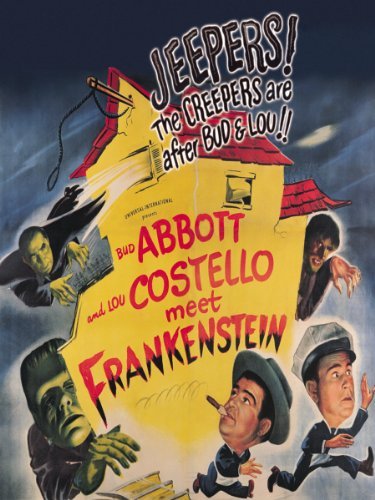
Movie Night: Abbott and Costello Meet Frankenstein

Year: 1948

Director: Charles Barton

Production Company: Universal International Pictures

Leads: Bud Abbott, Lou Costello

Well that’s gonna cost you overtime ’cause I’m a union man, and I work only sixteen hours a day.

A union man only works eight hours a day!

I belong to two unions.

51F4U16LZjL._SX500_Oh my, this was too long in coming. After too many Jackie Chan and superhero movies, it was time to introduce Little Satis to the birth of comedy.

His first impression of course was, “Ew…black and white?”

I tried to explain to him that yes, they did have color back then, but they just didn’t use it very much. I also tried to explain to him that just because it was in black and white didn’t mean it wasn’t any good.

It turned out I didn’t need to do much explaining. Abbott and Costello Meet Frankenstein is a showcase of the duo at their very best, in an absolute farce of a movie with more holes than plot, and whizz-bang cracks every two seconds. What’s so amazing to me in watching these movies is the feel of spontaneity and dynamism that exists throughout; you almost feel as if you’re watching a stage comedy performance. Yet at the same time, every joke and pun fits perfectly into the plot (which is, of course, a joke of its own), and never feels over-rehearsed or generic.

In a nutshell, Dracula travels to the United States with the Frankenstein monster, hoping to find a new brain to revive him and make him his servant. The Wolfman is hot in pursuit, but of course can’t go around at night, because of the full moon (which apparently rises every night). Dracula sets himself on Lou Costello’s brain, of course, it having “no will of its own, no fiendish intellect to oppose his Master.”

Through a series of frankly bizarre and calamitous events Abbott and Costello manage to defeat Dracula, blow up the Frankenstein monster, toss the evil assistant out of a window, and save the girl, who is inexplicably attracted to Costello.

I don’t get it. Out of all the guys around here that classy dish has to pick out a guy like you.

What’s wrong with that?

Go look at yourself in the mirror sometime.

Why should I hurt my own feelings?

However, above the comedic gold, perhaps the true gem of this movie is the chance to see Bela Lugosi return to his infamous role as Dracula (as well as, to a lesser extent, Lon Chaney Jr. as the Wolfman). He is to me the epitome of Dracula (I’m so sorry, Christopher Lee), and to this day when someone mentions the name Dracula, I hear Lugosi’s lilting and sinister Hungarian accent, and see his cape folded over his face. His stone-faced demeanor is such a contrast to the shenanigans of Abbott and Costello that he brings if anything more of a chill than were it a serious movie. His character observes the two as though they are the world’s greatest fools; there’s a moment early on where the expression on Lugosi’s face is priceless:

Screen Shot 2013-03-14 at 11.29.23 PM

Oh, what a joy this film is; and of course the goal was achieved: opening Little Satis’ eyes to movies that were made before he was born.

★ ★ ★ ★ ★