Thought of the Week: Where Did All the Time Go?

Damn it…look at the time!

I’m not fond of Time, for a number of reasons, the primary being that, like money, there isn’t ever quite enough of it. I’m not fond of money, either. (Actually, I rather enjoy money a lot — I just resent it for not being in my pocket.)

Time pops up in the oddest places, and at the oddest…um, times. My birthday is this month, which is always an unhappy reminder that I’m a year further from my youth, and a year closer to my death. It also gives me a chance to reflect on what exactly I’ve done with the past year of my life. Usually, it turns out, not a lot.

I’m reminded of Time when I drive, or when I cook. I’ve come to the conclusion that microwave and car clocks cannot run to time. It’s clearly a fundamental law of the universe. It doesn’t matter how often I set and reset them; within a few weeks, they will both be out by minutes. In every car. On every microwave. A part of me suspects relativity; we all know that as one approaches the speed of light, the faster time passes in the universe around us. So when I’m driving eighty miles an hour (a significant fraction of the speed of light), the world around me has lived a few extra seconds. Compounded over several weeks, it could explain why my car’s clock is always wrong. What about the microwave, you ask? The answer should be obvious: cosmic rays.

There are endless reams of literature on the nature of Time; whether it is finite or infinite, whether it’s continuous or discrete; whether there’s some fundamental, universal unit of time, and why the atomic clock in Berlin isn’t, actually, quite right. I’m going to leave most of that to Stephen Hawking. I would be interested, however, to know whether he’s figured out a way to pack more hours into a day.

This is, probably, my biggest gripe with Time. Why, oh why, are there only twenty-four hours in a day? Especially since I really want to spend most of them sleeping? Couldn’t there be thirty, or forty, hours in a day? And no, don’t bother pointing out that if you made the hour shorter, you’d get more of them in; the universe just doesn’t work that way. Ask Stephen Hawking.

If there could be thirty hours in a day, I could spend ten of them sleeping, eight of them working, and a glorious twelve hours to sit around all day and do absolutely nothing. And dishes. But no, oh no. I get to spend five or six of those hours sleeping, ten of them working, and the rest…

Well, now it comes down to the heart of the matter. There ought to be eight hours left there. So where did they go? It certainly doesn’t feel like they were used for anything terribly productive. Does it take eight hours to eat breakfast and brush your teeth? I suppose dinner has to sneak in there. Bit of bed time reading, maybe some blogging…my point is, nothing that ought to take up eight hours. Eight long, lonesome, missing hours. I feel like I’ve abandoned them.

But while the absence of time will probably remain a mystery to me, I do have the past year to look back on, and reflect that, maybe those eight hours did in fact creep their sneaky way into my life, because it suddenly feels like I’ve got an awful lot done. I started a blog, which has now been going for slightly over a year. Over 6,000 people have stopped by to say hello. I’ve made some good friends in the process.

I wrote a book; 160,000 words including the background material. That’s 400 words a day (I’m not sure I’m glad I just worked that out). I wrote part of another book. It’s only got about 20,000 words so far. Wait…that’s kind of a lot, too.

I’ve begun the process of getting my book published.

I wrote 221 posts.

I got blown about in a hurricane.

And I did some other, less important stuff, like spend Time with my family.

Perhaps I’ll never know exactly where Time went. But if it keeps coming back now and then, I suppose I can’t complain.

Too much.

Thanks for taking the time to read this. I do apologize, but I’m not able to refund it at the moment. All complaints should be addressed to Stephen Hawking.

The War on Smileys, LOLs and ROFLs

I read an article some time ago denouncing the excessive use of exclamation marks (not to be confused with the article I read on the lack of the use of interrobangs). His exclamatophobia was centered around the use of multiple exclamations (!!!!) in written dialogue, particularly in the informal text-speech of online chat rooms, Facebook posts and tweets. Having recently had a friend criticize my use of a single exclamation mark (at a point where I felt it entirely appropriate), I find myself in concordance with this view. Imagine yourself speaking the text you’ve written: would you, in fact, be exclaiming it?

This textual sin, of course, is secondary to the all-caps SHOUT. I shudder.

However, to the exaggerated punctuation of our linguistically declining culture I would like to add a couple more appallingly inaccurate digital metaphors. These have been banished (as much as possible) from my online vocabulary for both their lack of literacy and their overly-distended representation of reality.

I should preface this by saying that I wasn’t always so enlightened. I used to PMSL all the time, allong with ROFLing and LOLing (though my naivety was great – it was some time before someone explained to me that LOL didn’t stand for Lots Of Love; I suddenly felt quite a lot less popular). These misunderstandings are one great reason to avoid such abbreviations; at the very least, spell them out.

Do you actually roll on the floor laughing? Did you, in fact, laugh out loud at the unsurprisingly witless and crude crack your friend made after a night out on the town? Indeed, would you utter “what the f***” out loud (actually, I suppose some of you might; to each their own). (A sin you can see I haven’t yet escaped is the parenthetical). If the answer to these questions is no, why did you imply so to your friend by text or tweet? Was it a desire to appear far more energetic than you actually feel, as you sit in front of the screen at 6:45 AM desperately gulping as much caffeine as you can?

Another deliciously malevolent word-killer is the emoticon: those cringe-worthy smiles, winks, tongues and frowns that unavoidably litter our digital forums. I am not a winker; nor do I stick my tongue out on a regular basis. My frowns are significantly deeper than a slight downwards slant of the eyebrows (indeed, I find the Spock-like countenance difficult to emulate). And I certainly do not spread my mouth as wide as possible to indicate surprise; a slight raise of the eyebrows is sufficient for this.

As I have begun increasingly to write on a serious level, I’ve realized that, more than a simple expression of fun, these abbreviations and icons had begun a decline in my literary fluency. I came to the realization that there is nothing that can’t be said in words – real, genuine words – that can be expressed otherwise. When I am angry or astonished, I may judiciously use an exclamation mark. If I am taken aback, I may even take to using interrobangs. But never again (maybe) will I pepper my written dialogue with anything other than words drawn from the English dictionary (yes, I realize LOL has made its way into several reputable tomes; their downfall).

I challenge you – can you make it a week without using any of these items?

P.S. (Post Script) You are more than welcome to use LOLs and :-)s in your comments, providing their intention is ironic.

Thought of the Week: What’s Going on in There?

I have a confession to make. It’s kind of a big deal, and it’s taking me a lot of courage to share this with you all, so please don’t laugh. Are you ready? Here goes:

I may not, in fact, be entirely sane.

What’s that? You already knew? How insulting.

Okay, fair enough. Most of us are pretty whacked out at times, and sanity is in the eye of the psychologist. Although I kind of think they’re nuts too.

Who does a therapist go to for therapy? Is there some kind of super-therapist? Maybe Batman goes to see him.

Anyway, it occurred to me quite some time ago that my brain is up to no good, and I’m the one stuck with the consequences. For example, sometimes my brain tells me that my life is not worth living, that I’ve brought nothing but pain and misery on everyone around me, and that they’d all be better off if I didn’t even exist.

Anyone else ever have those thoughts? Congratulations, you’re insane too.

Other times, my brain tells me that it’s a good idea to lie down on the floor in a ball while my wife screams at me to stop lying on the floor in a ball. It seems to think that she’s using some kind of reverse psychology, and in fact wants me to stay down there. Just to make sure, my brain won’t let me move for several hours afterwards. If I try, it makes my tummy feel bad.

Takers, anyone? Maybe you’re slightly saner than you thought.

There are, of course, the times when my brain lets me think that things are going all right, that life is good, and that the writing I’m doing is strong. It even convinces me that just around the corner, if I hang on a little bit longer, might be fame and fortune as a world-reknown author.

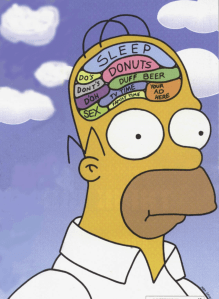
In the words of Homer Simpson, Stupid brain.

Now scientists are doing some pretty awesome stuff at working out just what’s going on in there. They discovered that the funny-looking wrinkly lump of gook inside your head is actually an incredibly complex network of neurons and connections, forming literally trillions of possible pathways for electrical conductivity. Sort of like the wiring in our basement. They worked out that this little bit of the brain in the back called the cerebellum is responsible for motor control. If this bit gets damaged, you can’t really move anymore. There are some pretty nasty genetic diseases that do this.

They also worked out how the neuronal system works (sort of). Ions pass in and out of the neuronal cells, carrying charge with them. When the charge reaches a joining point, it makes the cell spit out a whole host of chemicals so that the next cell can pick them up. These chemicals, or “neurotransmitters” (big air quotes), kind of make sure signals go where they’re supposed to. Sometimes the insulation on these neurons breaks down, and the charge sort of leaks out. This means not as much gets to the next cell, and all sorts of things go wrong. Multiple sclerosis does this.

Stupid multiple sclerosis.

And sometimes, the brain just messes up completely, and spits out too much neurotransmitter, or not enough, or the wrong damn kind. Now, figuring out why this happens is still being worked on. Ironically, some of the drugs that are supposed to help with this aren’t even fully understood themselves. Chlorpromazine was intended as an anesthetic in the fifties; it turned out to be more useful as an antipsychotic in schizophrenic patients.

So we’re sort of trying to figure it all out. The scientists are working on it from a chemical point of view (my wife conducts research on a particular type of chemical sensor with important roles in learning and memory); the shrinks are working on it from a cognitive point of view; the priests are working on it from a god point of view.

But in the end, my brain is still kind of messed up. It makes me do these pretty odd things, like repeating phrases over and over again, shaking when I’m upset (getting upset, a lot), feeling generally miserable and depressed, actually enjoying feeling miserable and depressed, and consistently doing things that I know are going to cause major problems down the line. I checked it out; I don’t really quite fit depression; I don’t really quite fit bipolar; I don’t really quite fit asperger’s; I don’t really quite fit schizophrenia (I have an uncle who is, though; he barks at the moon and is otherwise a lovely guy).

It could be some time before someone works out what’s going on with my brain. It could be the scientists; it could be the shrinks. It could be my wife, though I think she’d just as much rather I get rid of the damn thing entirely, and upgrade to a new one. I sort of agree – it is getting a little long in the tooth.

Until then, though, I guess I’ll just let my brain figure itself out. If it can’t, it’s no membrane off my frontal lobe.

Hey – maybe your brains can help! What do you think my brain is up to?