Tales of Despair: Eternal Blood

The Vampire – Philip Burne-Jones

I was one of the (probably many) goth kids who grew up obsessed with all things dark; lord amongst the demons and monsters were, naturally, the vampires. What a beautiful romance these creatures held; to live eternally, at the price of the blood of your fellow men and women. The visceral attraction of blood, warm and flowing, the bitter metallic taste, the swoon of the letting – these were the things that captured my mind.

With this came the gloriously evil tales – not only the fantasies of Nosferatu and Dracula, but the terrifying histories of Vlad the Impaler, and the Countess Báthory. Drinking, bathing, delighting in blood – all was dark, brooding, and beautiful. A natural part of this was the romanticism of the vampire, and I will hold my hand up and say that I watched many vampire movies – notably Francis Ford Coppola‘s Bram Stoker’s Dracula, long before reading of the literature.

Gary Oldman as Dracula (1992)

Francis paints a picture of a medieval man, tortured by war and death, renouncing god for eternal life upon the suicide of his one, only, true love – that he will await her forever, fed on the blood of men. And wait he does, until by happenstance, he sees her likeness in Mina, the fiancée of Jonathan Harker, a minor solicitor visiting his Transylvanian castle. Determined to fulfill his prophecy, he abandons Jonathan to his fate amongst the vampires of his castle, traveling to England in a desperate attempt to be with her. He meets with her, charms her, and seduces her – only to be torn apart again as she leaves him to be wed to Jonathan (resulting in one of the most memorable performances by Gary Oldman, weeping in agony over his loss of her).

Yet his work is done; she remembers him, and becomes infatuated, and begs him to transform her as well. And then, as she begins to change, Dracula retreats once more to his home. Now bound to him, Mina can think of nothing else, and Jonathan, now accompanied by the delightful Anthony Hopkins as Van Helsing, realize they must pursue and destroy the count if they are to save her. In the bitterest of endings, the wounded Dracula begs his long-lost love to give him peace, and – having lived to see he beloved one last time – he is put to death by her own hand.

First edition of Bram Stoker’s Dracula

Little did I know how little – and how much – this romanticized tale had in common with Bram Stoker‘s brilliant and seminal novel from 1897. While the characters remain the same, their intentions, motivations and desires could not be more different. Strikingly told from the perspective of journal entries and newspaper clippings, the loose plot is similar – Jonathan Harker, the newly-appointed solicitor, traveling to Transylvania to aid the Count Dracula in finalizing his purchase of land in London, and to teach him the ways of the English. Gradually ensnaring Jonathan in his castle with the three vampiric sisters, Dracula comes to London – for the pure desire to live amongst the great population, and to feed at his leisure.

Dracula does turn Mina, but not out of any romantic desire – it is a punishment, revenge against the men who would destroy him. He uses her, tracks his foes through her visions. In doing so, however, he betrays his own intentions, and is eventually hunted down and destroyed.

By all accounts, Bram’s original text is heart-stopping and gripping; the format of its writing ensures the survival of no character, for there is no narrator. We are left until the very end to know, even, whether the party of vampire hunters have triumphed over the bloodthirsty Count. In some ways, Francis’ version is one filled with emotional torment, anguish and despair – to pine for a lost love for four hundred years, only to be denied a life with her in the final moments is a heartbreak of unsurpassed proportions. Yet Bram’s original tale is by far the most frightening, and reeks of an entirely different form of despair: the knowledge that you are fighting an all-encompassing evil, one that delights in the destruction of all men.
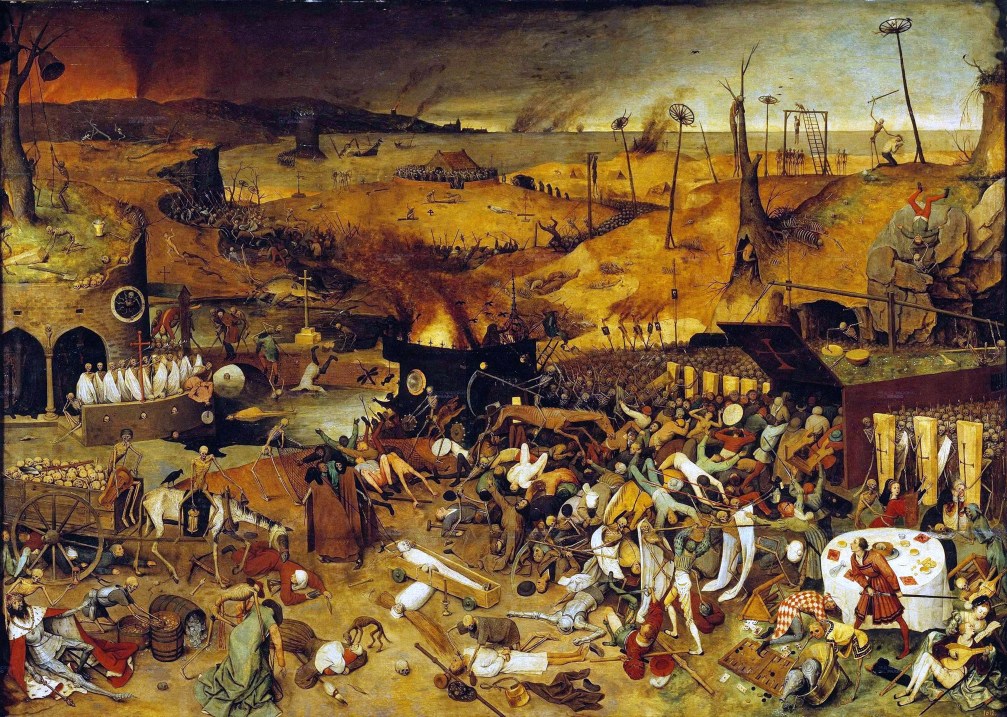
Tales of Despair: The Triumph of Death

I am no student of art, and I know little of the medium and its history. However, I came across this painting some years ago, and even to my untrained eye it is exceptional for its time.

Pieter Bruegel (1525 – 1569) was a Flemish painter at the height of the Renaissance, when secular art began to be accepted in European culture, and people suddenly started painting people and fish, and not just god. Bruegel in particular has become renown for his paintings of everyday life, depicting peasants, hunters and even beggars, working hard to capture the scenes all around him (a kind of 16th-century George Bellows). In many of his works, however, he allowed fantasy to creep into the scenes, such as Landscape with the Fall of Icarus.

Detail showing a king, all his riches powerless to slow the advance of time, and the coming of his death.

Still, none of his paintings (including Dull Gret) come nearly as close to the dark and twisted nature of The Triumph of Death. This is a massive work – the original is some five feet across – and it portrays hundreds of figures, fallen upon by an army of death. There is too much here to even begin to go into, so complex is the entire painting, but there are some points within it that genuinely stand out to me.

Overall, it seems painting seems to emphasize death as the lord of all – kings and peasants as one fall victim to its clutches. In one corner, a great king, cape in ruins, cannot prevent a grinning skeleton from pillaging his gold. As a reminder of his despair, a second skeleton holds up an hourglass, driving home the fact that he will not long last in this world.

Detail showing a man and woman playing music, unaware of death mocking them behind; a moment of black humor in an otherwise bleak work.

The detail of the agony and despair in this painting is astonishing, and excruciating; every inch of canvas is covered by death. Even where there are people yet alive, death is yet hounding them. In one small detail, a man, stripped and naked, seeks refuge from the horror by hiding under the roots of a tree. It is, of course, futile – a spear protrudes from his back. In another, a man fleeing desperately, is set upon by the starved hounds of hell, while a skeleton looks on nonchalantly, waiting as they take down their prey. In particular, though, I am drawn to a small detail that shows two people – perhaps the only people in the entire painting – who seem unaware, or unaffected, by the death and torture around them. The man is playing a lute; the woman is singing from a songbook with him. The man looks worried, as though he perhaps should be thinking about something other than their music, but the woman rests a reassuring hand on his shoulder, and carries a calming expression, as though music is untouchable by death. In an inspired moment of irony, Bruegel adds a skeleton, hiding behind them, accompanying them both on the fiddle.

Church – and god – are no escape for the coming of death.

Though the Renaissance was, of course, a time of artistic awakening, religion was nonetheless and inescapable and fundamental part of culture, and every person’s life. Prayer, and the hope of an afterlife, was often the only consolation for peasants who slaved for a lord, starved, and grew ill with terrible disease. For Bruegel, however, even the church is unable to give deliverance from death; in what may have been nearly heretical at the time, he depicts the skeleton army invading the house of god, desecrating its windows, drowning people in its river, and mockingly calling the ring of silver trumpets. To the right, a very large portion of the canvas is given to showing the skeletons herding people in droves into a cross-embossed box, while their armies await on either side, holding shields bearing crucifixes. It is as though Bruegel was verily denouncing religion itself as false hope of life.

The scene is a grim twist on the artist’s nature and style. Whilst many of his works depict ordinary scenes of peasant life, here he takes a scene from almost every class imaginable, and treats them to the same horror and finality. The princes and the poor, the pious and the sinners, all succumb alike. In the distance, the fires of hell glow bright, while skeletons ring a great funeral bell. Ships burn on the horizon, and the earth is barren of all growth. The only life that seems to persist are the crows, likened as always to companions of death.

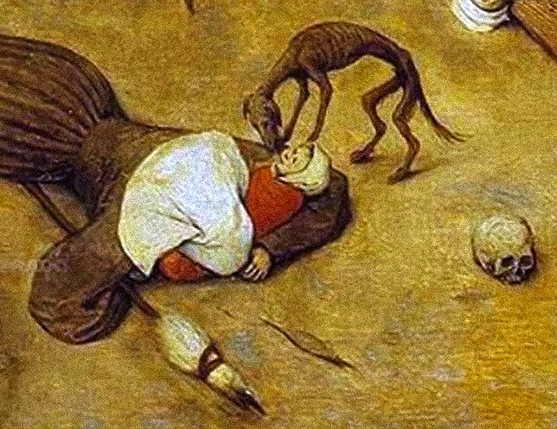
In Bruegel’s eye, death spares no one, and nothing. By the river, a large whale or dolphin lies butchered, and in the distance, skeletons hack at the few remaining trees. However, the true depth of the artist’s horror, and the epitome of death’s cruelty, is in a small detail at the bottom of the painting. Prostrate, a mother lies dying, her bundled infant dead in her arms. The true ghastliness of this scene, though, and the terrible truth of death, is the skeletal hound of hell, feasting on the dead child’s flesh.

On the Nature of the Gothic

First of all, my appreciation goes out to tablite for the inspiration tonight; your recent post sharing an old poem of yours prompted me to delve (deep) into the writings of my own past. I have long been out of touch with the nature of the darkness from which my love of the bleak and macabre stems, and it was quite a trip back in time! If you’re lucky (or maybe not), I’ll share one when I’m done.

In my youth, I was a goth. It’s curious to me to find myself speaking in the past tense, because, of course, the sensibilities and mindset of this term is something I carry to this day. There was much debate, even then, about exactly what a ‘goth’ was; we were the true goths, of course, reveling in depression and despair, while the fake goths got off on dressing in black and listening to Madonna. Or something. They weren’t sad, so of course they couldn’t be goth. It was a mindset, a statement, and way of life, heralded by the oh-so-familiar aphorism, “goth isn’t just a fashion statement.” I realize now, of course, that I was actually just severely depressed, but the very word “gothic” was an outlet, a culture of other people who were in one way or another just as messed up as I was, and were, of course, the only ones who could truly understand. Much of what I wrote at the time was steeped in this mentality, and reading over some of my old stuff reminded me of that old word, and I started wondering what it meant – what it really meant.

So tonight, I – astonishingly – did a little research, and I actually discovered some things that I did not know, and make a huge amount of sense. The word ‘gothic’ does not, of course, mean what it did originally, and yet, somehow it does. The history of this little word is kind of neat.

First, we had the Goths. They were kind of cool; they were tough and violent, came from Scandinavia, and helped bring about the fall of the Roman Empire. They were brutal and devious; one sect (the Ostrogoths) joined the Huns and later revolted against them, while another (the Visigoths) became subjects of the Roman empire before revolting against them and sacking Rome. Eventually, though, even they fell – the Ostrogoths to another clan from Scandinavia, and the Visigoths to the Moors.

Then came the medieval times, and everything was pretty dismal and depressing for a very long time. Though in many ways the middle ages are responsible for much of the culture we take for granted today, most people during this period spent their time thinking about god, or painting god, or killing other people in the name of god. In fact, god was pretty important to these people, and the stuff they built – like cathedrals – started to become pretty impressive, with lots and lots of arches and spires and things that sort of pointed up at god.

But then, something happened. This thing called the Renaissance (re-birth) happened, and all of a sudden people realized that they could actually write books and paint pictures and build buildings that weren’t about god, and when no one got struck down by lightning, they realized this was a good thing. In fact, they got a little bit embarrassed of how silly they had been for the last thousand years, and started calling all those tall, pointy cathedrals gothic, because it seems they remembered the goths as being pretty rude, and these structures – which fortunately they couldn’t get rid of – seemed pretty rude as well.

So by the 1600’s, gothic was a bad thing, being associated with all those nasty medieval cathedrals people had built before they realized god didn’t really care how big their steeple was. Instead, baroque was the latest craze, and art started being created to evoke tension, and drama, and great big emotional responses. Eventually, though, all the little frilly bits on buildings started to tick people off, and they thought, hang on a minute – the romans never had this problem; let’s build stuff like they used to. So we got the neoclassical (new classical), and all these roman columns started cropping up. Now here’s where it gets kind of funny, because eventually this style started to get annoying, and people said, hey, I know – let’s build stuff like they did in the middle ages! You know, that style we thought was barbaric and crude and nasty.

Guess what they called it? Yep – neogothic. Of course, it reminded people that these big, huge spires and arches were pretty awe-inspiring, but since god didn’t really matter that much anymore (it is 1750, after all), and this thing called romanticism was on the rise, it became a natural fit for the drama, tragedy and heaving bosoms of the romantic era. People who had been always so prim and proper up until that point began to get a bit of a thrill out of hearing – and reading – about men that cried and women that cried even more, and literature became the horror movies of the 19th century. It seems it all started when a guy called Walpole wrote a story that was all love and death and drama, set in a gothic castle (it kind of helped that he called it A Gothic Story).

You started to get these tales like Faust and The Pit and the Pendulum, as well as Varney the Vampire, and the gothic/horror novel was born. Frankenstein was pretty cool, too. Fast-forward to the early twentieth century and, while the term ‘gothic’ fell out of usage, the spirit of it was alive and well in horror and romance.

Then, it all came back again in the 80’s when some guy at the BBC called Joy Division ‘gothic’. Funny, really – he meant it as dramatic and theatrical, which is exactly how it all started out way back in the 16th century. Anyway, it kind of caught on, and all these cool bands like Bauhaus and Sisters of Mercy and Fields of the Nephilim started getting labelled as ‘gothic’. It sort of started to just mean dark, miserable and depressed, and hey – no one was arguing. Novelists got in the act too, and Ann Rice put out a whole bunch of stuff about sad vampires, and the whole thing just kind of got out of hand.

And that’s pretty much where I came in. I was a teenager, I hated my life, I was depressed and I wanted to die, and suddenly there were all these other people who hated their lives and wanted to die and they were the goths. It was all pretty cool, because we could all say together how much we hated life, and how neat it would be to be a vampire and be sad for ever and ever, and how no one understood tragedy like we did, and so on and so forth.

So what’s the point of all this? To me, gothic simply had connotations of darkness, despair, sadness, loneliness, and all the imagery and art that conjured up. I had never, until now, bothered to look deeper into it, and what I found was a bit of an epiphany; without ever realizing it, I was living the very definition of gothic: I was romantic, dramatic, tragic, and completely full of myself. This, in turn, seemed crude and and nasty to everyone around me who saw my black eyeliner and inverted crosses, and I was of course proud to piss them all off. In effect, if Giorgio Vasari, inventor of the word ‘gothic’ back in 1530, could see me, I’d fit the bill perfectly.

As it happens, I may possibly have some Scandinavian blood, so that helps too.

So to all you goths out there, enjoy the misery and the despair and the tragedy, and feel safe knowing you are legitimate in calling yourself a goth! Unless you just do it for the fashion, in which case you can  drop dead.

And finally, here is one of my favorite poems I wrote back when I was a goth:


Elegy

I am sitting by your side

Around us, sickening branches claw the sky

The tower is shrouded

In her thick, grey shawl

Light is fading slowly

And I perceive new shadows amidst the fog

Our silence is broken

By nothing at all

The path leads beckoningly

Onward toward the gate

The bell tolls for you or me

Time has come to leave here

Rest a hand against the cool stone for just a moment longer

Before looking to myself—

I am sitting by your side

And you are not moving