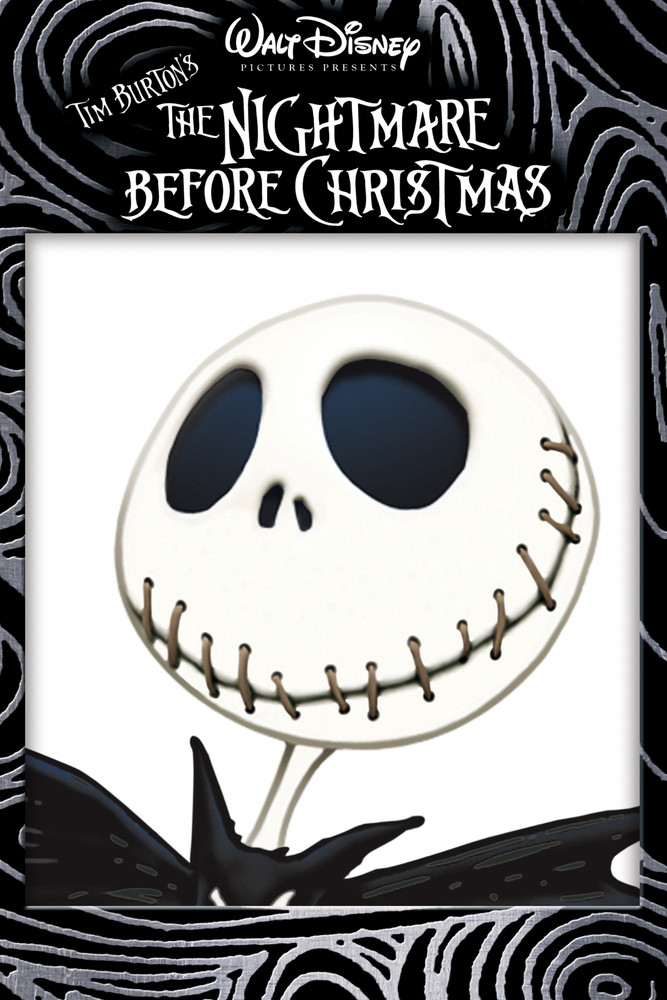
Movie Night: The Nightmare Before Christmas

Year: 1993

Director: Henry Selick

Production Company: Skellington Productions

Leads: Danny Elfman/Chris Sarandon, Catherine O’Hara

Tim Burton Movie BundleThis may come as a surprise for an ex-goth like me, but I had actually never seen The Nightmare Before Christmas until now. How I got through my teens without this is beyond me, but if finally got to the point where I simply couldn’t go another Christmas without trying it out.

And I’m very glad I did. It was a brave decision for Selick to make a feature-length stop-motion film; at the time, this technique had mostly been reserved for TV shorts, advertisements and special effects. The production of such a work must have required a fearsome single-mindedness and determination, requiring over 100,000 individual frames to be taken. Selick’s background as a Disney animator gave him a measure of experience in this, however, and the result became a now beloved cult classic.

Having come to The Nightmare Before Christmas after films such as Coraline and Corpse Bride, the marvel of the film’s technical aspects became more intellectual; the animation quality is noticeably lower than these other films. In such a regard, the real impressiveness of it was in the seamlessness of something that had really never been attempted before. However, the charm of the film lies ultimately not in the animation, but in the story it tells.

Made long before the formulaic Burton/Depp amalgamations that eventually came to follow this, there is a novelty and purity to the idea of a skeleton from Halloween wanting to bring Christmas back to his fellow ghouls. Far from being dark, the film in fact possesses a comforting and warm light-heartedness, a sort of innocence that so many films now greatly lack. The humor is subtle and witty; rarely drawing out-loud laughs, I instead found myself smiling throughout entire scenes, without even being aware of it. Images such as Jack Skellington looking in wonder as he first glimpses Christmastown, unaware of what snow is; the hopelessly pathetic appearance of the dismal Christmas lights strung about his home in Halloweentown; even the unexpected appearance of the Easter Bunny; these stick in the mind as much for their humor as for their emotional detail. The thought that every movement, every minute item and detail was deliberately created – even those that pass unnoticed – is simply wondrous.

There were a few bizarre problems during our screening, such as French subtitles popping up every so often, a feature that no amount of fiddling with settings was able to resolve. The film (at least the version we were able to find) was also a shade off widescreen, which always leaves me feeling that there’s a little bit of the movie I’m missing – even if it’s only half an inch from the left and right.

Altogether, this was a charming and magical evening, and I am only sorry that I waited so long to introduce this into my life. I can see this becoming a staple of our Christmas canon in years to come.

★ ★ ★ ★ ★

Movie Night: 20,000 Leagues Under the Sea

Year: 1954

Director: Richard Fleischer

Production Company: Walt Disney

Leads: Kirk Douglas, James Mason, Paul Lukas, Peter Lorre

Twenty_thousand_leagues_under_the_2Things got all Jules Verne-y a couple of weeks ago when Little Satis picked up an abridged children’s copy of 20,000 Leagues Under the Sea. We started talking about it, and then I started listening to an audiobook of the original on the way to work, and it wasn’t long before we naturally just had to watch this movie. (Incidentally, I’m very glad this is a movie that hasn’t been remade.)

This was another one of those films that I recalled vividly from my childhood, the kind that thrilled me, scared me, gave me nightmares, and fueled my young imagination (I remember endlessly drawing the Nautilus battling that giant squid). Equally, therefore, it was also a film that I was apprehensive about revisiting. What would I think about its special effects? What of the fifties overacting? Essentially, would it have stood the test of time?

I was happily relieved to discover that this favorite of my childhood not only was everything I had remembered it to be, but in some ways, even more. There are things that, as a young person, you don’t particularly notice, or take into account. The movie is life-size, breathing, and real. There is  no lie to the camera (there is no camera, in fact); that squid was simply real, and that’s all there was to it. And this leaves an influence; even when I read the original novel in high school, the vision in my mind of the Nautilus was Disney’s design. The film won two Academy Awards for set design and special effects, and the movie shows why: the interior of the submarine, the underwater diving scenes, even the opening drama of an unknown, luminous creature advancing upon a steam ship – all are tangible, and alive with reality.

And in revisiting it, I was struck at how strong the cast was. Kirk Douglas was the outrageous American, indignant and violent, yet ultimately with a good heart. Paul Lukas was suitably intrigued as a scientist by the wonders around him, and as a person by the unfathomed hate and pain of Captain Nemo. The inimitable Peter Lorre is simply wonderful as the under-spoken aide Conseille, keeping both Ned and the Professor in check with his quick wit.

But it is James Mason, as Captain Nemo, who completely steals the show. There could have been no one else. From the very first moment he appears on camera, he physically and emotionally embodies the very character Jules Verne created: noble, imposing, harsh, supremely confident, and utterly beyond all of mankind’s laws and morals. His impassiveness as he ambivalently sends the Professor – a person whom he professes to admire – to be cast off his ship early in the film is galling; the despair and rage in his eyes as he plays Bach’s Toccata and Fugue on his built-in organ is heart-wrenching.

All of this, combined with a lush (if occasionally twee) score, makes an unforgettable movie. It was a pleasure to watch it after so many years, and it was a pleasure to see Little Satis enjoy it as much now as I did then.

★ ★ ★ ★ ★

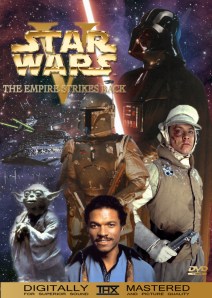
Movie Night: Star Wars Episode V: The Empire Strikes Back

Star Wars Episode V_ The Empire Strikes BackAll right…I’m a bit of a Star Wars fan(atic). Nothing adventurous this week for Little Satis and I, just good, old-fashioned fun.

We’d been talking about Star Wars in the car (specifically about Star Wars music), and were humming different theme tunes to each other. I stumped him with the asteroid chase music (you know: dum, dum-dum-dum, da-dum, dum), and this brought us onto The Empire Strikes Back, and frankly, there wasn’t any more question about it.

It’s interesting to watch these movies with the consideration of all that’s come after. Most die-hard Star Wars aficionados will claim that The Empire Strikes Back is the defining film; the one that epitomizes Star Wars in all its glory. It’s hard not to agree; the bigger budget compared to A New Hope paved the way for some spectacular special effects, and the story became quite rich in dynamics, without pandering (as some will say Return of the Jedi does). In particular, having just been reminiscing about the asteroid chase scene, I was particularly keen to relive this, and twenty-two years later it still stands up. The unrefined, authentic realism of the early Star Wars movies is untouchable by the CGI eye-candy of the prequels. A part that stands out to me is when Han rides his Tauntaun into the hangar bay on Hoth. The senses are flooded with the sights of a busy mechanic’s garage: welders, sparks, smoke; debris scattered on the ground; all of these qualities that are utterly missing from almost any modern film, and especially the prequels.

However, another thing that stood out to me with the knowledge of the prequels (and the extensive Star Wars literature) is the surprising consistency between the stories of twenty-five years ago and today. People are quick to point out the plot discrepancies, but I find there is far more continuity than one might think. This is particularly evident in the dialog between Yoda, Ben and Luke as Luke struggles to decide whether to help his friends or not. They tell Luke that he still can’t control the force, that he will be tempted by its ease to use the dark side to defeat Vader. When I first watched this (and many times following), this always seemed like fairly generic philosophical banality. Now, however, it suddenly takes on a much deeper meaning. Yoda tells Luke that if he truly believes in the cause Leia and Han fight for, then he would let them die. Luke is unable to break his emotional attachment to his friends, and rushes in regardless. This is exactly the same behavior we see with Anakin; his emotional attachment to Padmé blinds him to the corruption that is befalling him.

It’s curious, really, how well these things fit together. Given that over twenty years passed between the releases of Episode IV and Episode I, George Lucas either quite genuinely had the three prequels in mind at the time, or he deliberately left historic events vague enough that the prequels could tie into them. There are discrepancies, yes; Ben says that Yoda trained him, while we know that in fact, Qui-Gon Jin was mainly responsible for Obi-Wan’s Jedi training. But the whole ties together wonderfully well.

Ultimately, I still feel that The Empire Strikes Back is the quintessential Star Wars. The rawness of A New Hope lends to it a timeless quality anyway; Return of the Jedi pushed the effects of the time to their limits, and delivered a highly-polished Hollywood blockbuster. The Phantom MenaceThe Attack of the Clones and Revenge of the Sith, despite their many shortcomings, actually delve much deeper into the history and intrigue of the Star Wars world, and paints an exceptionally realistic portrayal of the downfall of an entire civilization into tyranny. But The Empire Strikes Back remains the one where everything just suddenly fit together. The characters gel seamlessly, the plot flows uninterruptedly, and, of course, we get an awesome asteroid chase scene. It also contains one of the best, most relevant pieces of wisdom not just of Star Wars, but of perhaps any film at all:

Luke: I don’t believe it.

Yoda: That is why you fail.