Tales of Despair: Perversity

The grunts of his sister and her clients ring loud through the thin partition. Emile hates her as he hates all women; women have only ever spurned him.

Later, her lover beats him, and then invites him to eat with them. Irma will not stop him, though she tends to her brother when he is gone.

Bebert does not like him, and is satisfied when Emile squirms. In the end he will stab Emile in front of his sister. Again, she will not stop him.

Emile will buy a gun, and will desire Bebert’s death; it isn’t his that comes.

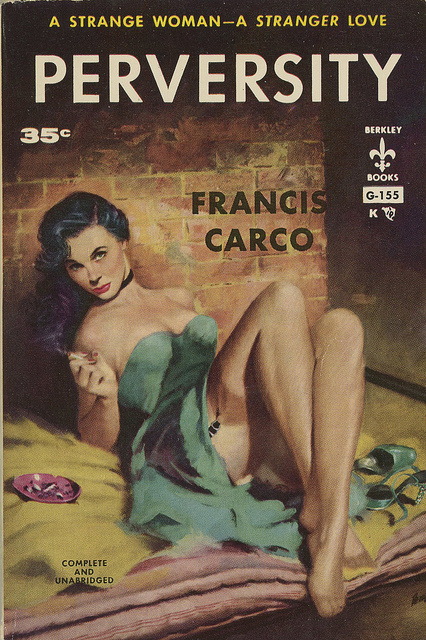
Such are just some of the scenes that bring to life Francis Carco‘s (1886-1958) frankly stomach-churning painting of 1920s Parisian slums, Perversity (French: Perversité). The story is bleak and desperate, centered around three loathsome characters and filled with little hope. Emile is a clerk, unable to function without the reassurance of strict routine. Irma is a prostitute, working from her bedroom in the tiny, two-room apartment she shares with her brother. Bebert is the bully of the tale, lording ownership over Irma and taking great delight in the torment and abuse of Emile.

What is particularly unsettling about Perversity is Carco’s unflinching dedication to the deeply disturbing faults he has built into his characters, and he allows them no redemption. Emile and Irma are pushed to edge of human decency, and repeatedly make decisions that seem against the very grain of morality, yet each time we are left with the knowing that there was, of course, no other way it could have been. One of the most discomfiting scenes occurs half-way through the story, when Bebert walks in to find Emile and Irma talking together. As Emile shrinks away from him, his sister points out that he is afraid of Bebert. Rather than allowing his characters to escape  with a mere argument, Carco builds a tension so great that it is only finally released when Bebert brings out a pocket knife and stabs Emile repeatedly, smiling all the while and insisting that such ‘pricks’ don’t hurt at all, and he shouldn’t act as such a baby. When he is finally finished and allows Irma to bathe him in salt, she comes to him and tells him that Emile is bleeding profusely. His callous response is that such a thing is “quite natural, I assure you. It’s rather the contrary that would astonish me.”

I have read no other book that so encapsulates the despair and hurt of inescapable depression, and forces it on the reader without sympathy. This is a terribly uncomfortable read, and I found myself unable to continue at certain points, often for weeks at a time. Ultimately, it was a rewarding experience, for it is a tale that draws you in and does not let go. The uniqueness of this story is that it is not tension, fear or suspense that hooks its teeth into you, but rather the grim, hopeless lives of these three people who have no reason to live, yet push on regardless in spite of the filth and the pain.

Perversity is available in print and for Kindle on Amazon. Read it at your peril.

Thought of the Week: Free Books

No – sorry about that. I don’t have any free books. Or rather, I have free books, but they’re not for you. They could be, perhaps, when I’m done with them; or they might be yours if you read them after I tell you about them. But for right now, they’re not for you.

I was on a long weekend to Montauk a little while ago, which was nice enough in its own right; there was a lighthouse that we didn’t go to, a giant golden statue and an office building that had been abandoned since 1930, which we also didn’t go to. We did see a World War II bunker that fell into the ocean, and had a milkshake.

On the way back, we also stopped in a town called Bridgehampton, which unsurprisingly is in the Hamptons. When we were there, we discovered that the Bridgehampton library, which is perplexingly called the Hampton Library (in Bridgehampton, which serves Sagaponack as well, as it happens), had some books, which was nice because we didn’t have to pay for them.

Of course, few libraries are in the habit of charging you for their books, which is fortunate, but most of them ask for them back, which is slightly deceitful of them. In this case, the Hampton Library in Bridgehampton that also serves Sagaponack didn’t seem too bothered about it, and had rather trustingly left them unattended on their front lawn. I actually began to wonder why the books (or at least the donation jar) hadn’t been pinched already, until I remembered we were in the Hamptons, at which point of course I felt a little guilty about pinching them myself. Still, it couldn’t hurt to have a look.

It turned out these books were books the library didn’t have room for anymore, and hadn’t been checked out in at least a year and a half or so. I suppose I should have been worried at that point but we hung around anyway, faithful that the library-goers of the Hamptons probably wouldn’t know a good book if it hit them in the eye, and that a gem (or at the very least some zirconia) might be buried in the pile.

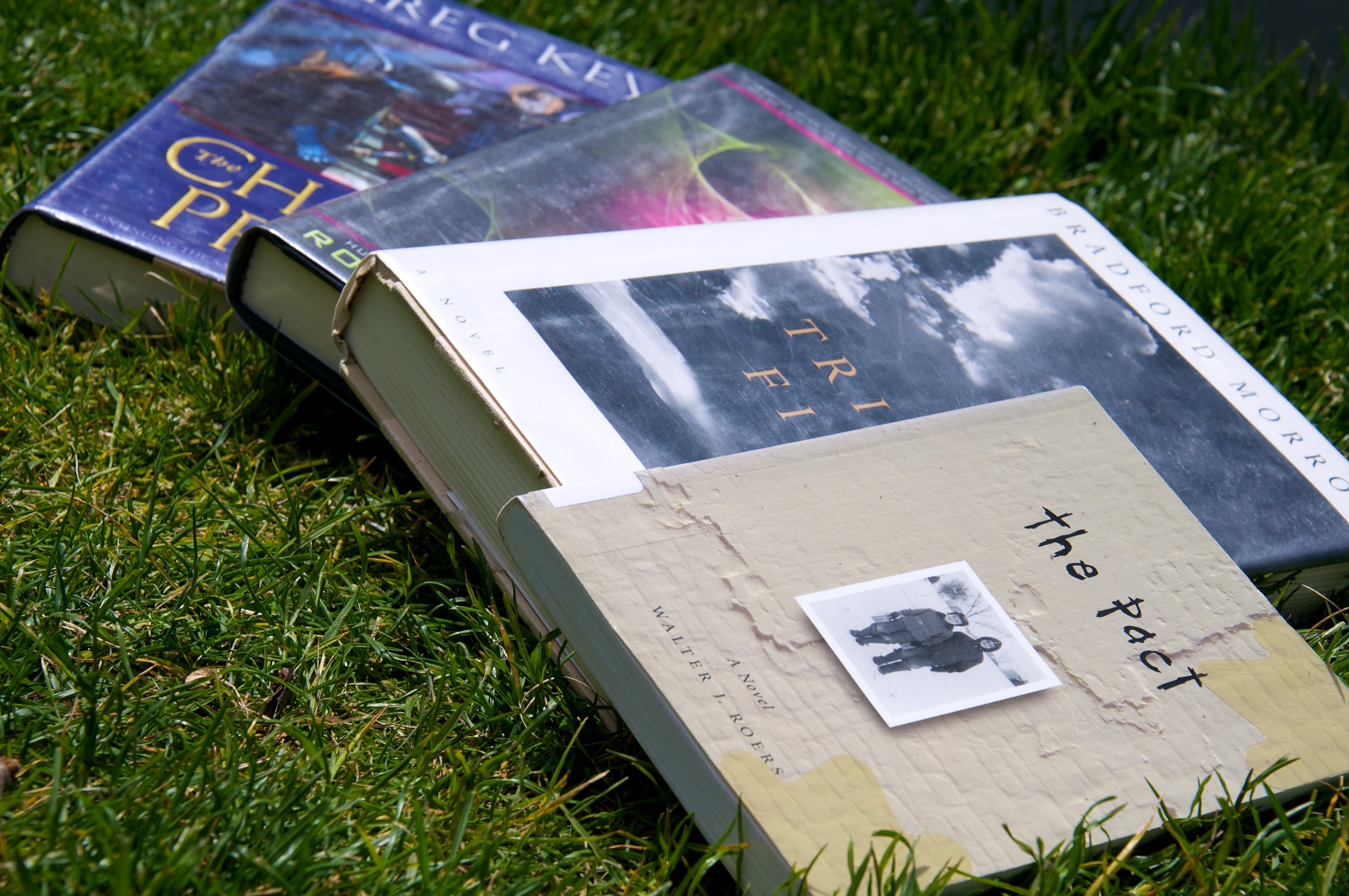
I don’t know if I found any gems. I do know I found four books that at the very least had pleasing titles and covers. This reminded me of choosing an album at a second-hand record store (in this case a second-second-hand book not-store), where I had to pick it based on the cover artwork alone. This used to be a lot of fun, until I’d bought all their good music and was left picking up some really weird stuff like Carter Tutti. These books are:

The Pact – Walter J. Roers

Something about two brothers growing up in the 1940s with abusive and alcoholic parents. Sounds pretty grim.

Trinity Fields – Bradford Morrow

Another book about growing up in the 1940s. Funny, that. This time in New Mexico with atomic bombs.

www:wake – Robert J. Sawyer

This one sounded interesting, if the author can bring a novel take on the subject: self-propagating intelligence via the internet. All through the eyes of a blind girl, so to speak. Creepy.

The Charnel Prince – Greg Keyes

This one seemed fun. I actually have to say it sounded vaguely familiar, and it’s supposed to be a sequel to something called The Briar King, in a series called The Kingdoms of Thorn and Bone. Sounds pretty straight-up fantasy, and I’m hoping, after the first three, it’ll prove some light reading.

I haven’t actually started reading any of them yet. Actually, I don’t have much time for reading at all, which is sad because I really don’t mind it. I am working through a book called The Last Death of Tev Chrisini by Jennifer Bresnick, which I hope to review when I’m done, something I’ve never done before so it probably will be a complete train wreck.

What about all of you? Have you read any of these books? Are there any I should start with first? What about ones I shouldn’t bother with? Actually, that would be the most helpful, since I always seem so short on time. Please let me know which of these four books is a complete waste of time.

Thank-you so much!

Thought of the Week: Get Inside Their Head

A couple of things this week have got me thinking about the concept of empathy, and what it takes to actually think along someone else’s lines. This is something of a two-pronged thought, for the idea of being able to put yourself in someone else’s place is dreadfully important, both in fictional writing and in real life.

I owe the inspiration for this post to The Random Fangirl for her excellent post on bullying. Apart from the naturally troubling nature of such a subject, there was something she said at the end that really got me thinking:

And I didn’t understand. And I still don’t understand. Didn’t these people have parents who taught them better? Couldn’t they see the pain they were causing? Didn’t they care?

Now, empathizing with bullies – particularly those who abuse, harm and kill – may not sound very tactful. But bear in mind – empathy is not sympathy. I couldn’t help but wonder if I could understand, if I could out myself in the place of a person who could willingly cause such harm.

The initial reaction to this is to rationalize. Something must have happened to them in their youth. They must have terrible home lives. Perhaps they genuinely are psychopathic, and unable to understand the feelings of others.

The trouble is, this is the very antithesis of empathy – there is no emotion here. It is incredibly difficult and painful to force yourself to feel what another person feels – all the more so when you find their actions abhorrent. Think for the moment about the phrase “in one’s shoes”; the implication is of switching places, literally standing where the other person is.

Imagine you witness a terrible beating; a person is punching, kicking, tearing and clawing at another – or perhaps you – and will not stop, despite all the screams, the tears, the pleas and the blood. Now, imagine you are the person delivering the abuse. Don’t make yourself stop – continue beating that poor person within an inch of their life.

Why are you doing this? What terrible events could possibly have led you to enact such violence upon another person? What would possess you to continue kicking them in the teeth even as you look upon the blood and the tears and the fear?

And here is the crux – the crossing point into genuine empathy. Answer those questions, genuinely and from the heart. Don’t stop until you uncover the reasons why you would do such a terrible thing. It won’t be easy – you’ll almost certainly be outraged, and unwilling to acknowledge that you could ever be capable of such injustice, because it is so far from the core of your being.

But what makes you different from that terrible person? We are all of the same ilk at birth. For me, the only reason I have to descend with such viciousness upon someone is pure, blinding hate. Then I am given to ask – what could cause such hate, especially if this person hasn’t wronged me? Perhaps I am convinced they have – I see something within them that I am desperately jealous of. Perhaps I am terrified of them, and see no other option – like killing a wasp so it won’t sting me. Then a new question follows this – why am I jealous?

This line of thought will lead you to a great many questions, each one burying down into a new depth of your own soul, into places you didn’t even know existed, or worse, wouldn’t accept. This has taught me that I would most certainly be capable of such despicable actions – in just the right scenario and given the right set of circumstances that led to it. It will be torture to acknowledge these terrible parts of you, but if you can face it, if you can admit to your own failings and insecurities, you might find yourself suddenly able to understand behaviors that you, yourself could never dream of doing.

And this very same line of thought applies to creating the characters in your story. No matter how brilliant and inventive your plot, the entire story hinges on the believability of your characters. Unfortunately, this is probably the hardest part of writing. Hands up who is 100% confident of the quality of your dialogue. What’s that? Only a few? I’m right there with you. Why is it so hard to write convincing dialogue?

For me, part of the reason for this is the instinct to write dialogue out as though I was speaking it myself. All of it. Imagine watching a movie where every character spoke in the same way! Come to think of it, this does happen in film – think of someone like Johnny Depp. For all his brilliance as an actor, a huge number of his films rely on him being Johnny Depp, whether he allows it to run rampant (Pirates of the Carribbean) or tones it down (Charlie and the Chocolate Factory).

It becomes all too easy when coming up with a storyline for the characters to become the vehicle to carry the plot to its end. The difficulty here is that it can lead to shallow characters, who speak only to further the plot, and act as needed, not as they must.

So I would encourage you to do the same soul-searching for your characters as you would for other, real people. Imagine yourself stabbing someone in the back, or having to decide between saving your by friend or your lover. Forget the plot you intended – it might not work! Follow your character, see what they get up to, and above all, imagine yourself in their place, and then ask yourself: why would I have done this? Your characters – and your readers – will thank you.

Your friends just might, as well.