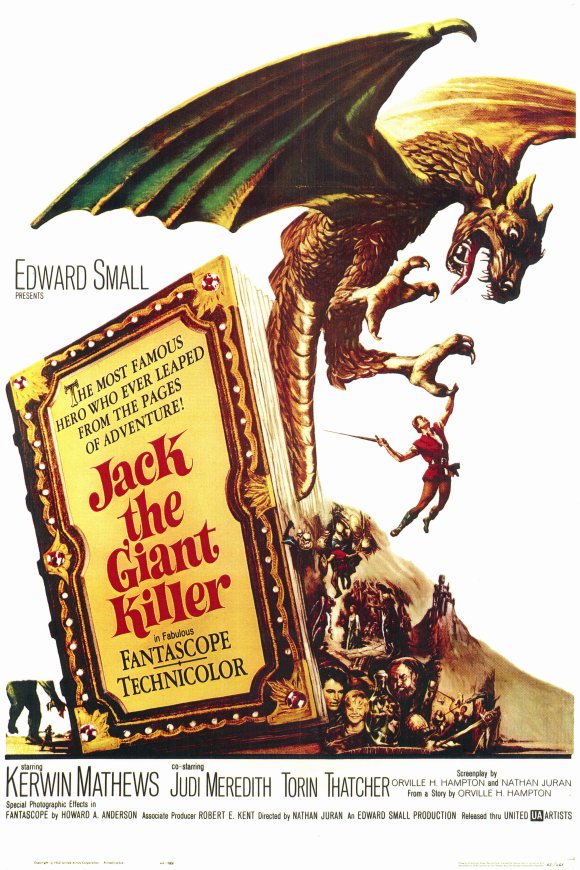
Year: 1962
Director: Nathan Juran
Production Company: Edward Small Productions
Leads: Kerwin Matthews, Judi Meredith
 Tonight’s feature was a new discovery for both Little Satis and I. The name caught my eye, though it’s only now that I realize there’s a movie by the same name coming out next year. It’s certain to be a big, epic affair, with all the big guns like Ewan McGregor and Stanley Tucci, and it will probably be full of mind-blowingly spectacular CGI effects, and absolutely none of the charm that adorns this enchanting little film from fifty years ago (there – I challenge any of me readers to say they saw it in the theater).
Jack the Giant Killer is originally an English fairy tale, set in the southwest county of Cornwall. (As it happens, Cornwall is home to St. Michael’s Mount, from whence came the giant King Arthur slew.) The original tale (which I have not read, though I now intend to) appears to feature an awful lot of giants, an awful lot of blood and guts, and distressed damsels and princesses galore. It seems to have first come into being in the early eighteenth century, and presumably catered to the tastes of the time.
Orville Hampton‘s adaptation bears little resemblance to this tale, save in name and spirit, and a lot more to do with the campy evil wizard Pendragon. On the birthday of the royal princess, Pendragon visits the kingdom in disguise, and sends a giant to whisk her away. The giant, however, doesn’t get far before it is beset by handsome farmer Jack, who slays it with a scythe. Enraged, Pendragon sends his demonic witches to capture her as she flees to safety on a ship, and transports her back to his castle, where he bewitches her.
In a number of subsequent adventures, in which Jack takes custody of a young boy and befriends a viking with a leprechaun (you can’t make this stuff up), he fights his way to the dark wizard’s castle. Passing through the final trials, breaking the spell upon the princess and defeating Pendragon (who turns into, of course, a dragon), Jack finally rescues the damsel, and in true sixties style, wraps up with a wink at the camera and a great big smooch.
The film features a cast of second-rate actors and first-rate effects. I had to explain to Little Satis that they didn’t have computer graphics in 1962, and that all of the special effects were composited or rotoscoped afterwards, frame by frame (then I had to explain frames and film reel and…oh, the headaches). Considering this, the combination of animatronics, live-action footage, costumes, puppets and lighting make for an exciting showcase of the film technology of the time. While some of the stop-motion animation is mediocre (nothing compared to Jason and the Argonauts), particularly effective was the costumery of the witches and demons, and the striking luminescent painting as they flew down upon the stranded ship bearing Jack and the princess.
Another strength of the film, considering the nature and time of the film, was the surprising performance of Judi Meredith as Princess Elaine. From the introduction at the start of the film, we fully expected the damsel in distress to be just that – a helpless, shrieking frail flower, to be guarded and protected from the evil demons that want to capture her for the dark prince. And at first, that’s exactly what we got. Her acting was fairly poor, and her screams fairly annoying. The big surprise, however, came when she was bewitched, and transformed into an evil queen. It was as though, quite suddenly, she woke up to the role of a villain, and relished it. From the sly smiles to the dangerous hand movements, Judi appeared to come into her own. It would have been delightful to see more of her as a villain in other films, but sadly it seems she never really did anything of particular worth again.
I’ll be curious to see what the upcoming big-scale version of this tale will be like; from what I can tell, it will bear as little resemblance to the 1962 film as it will to the original eighteenth century tale. However, I won’t be holding my breath – there’s something rather charming about this one.
★ ★ ★ ☆ ☆
 Satis Writes