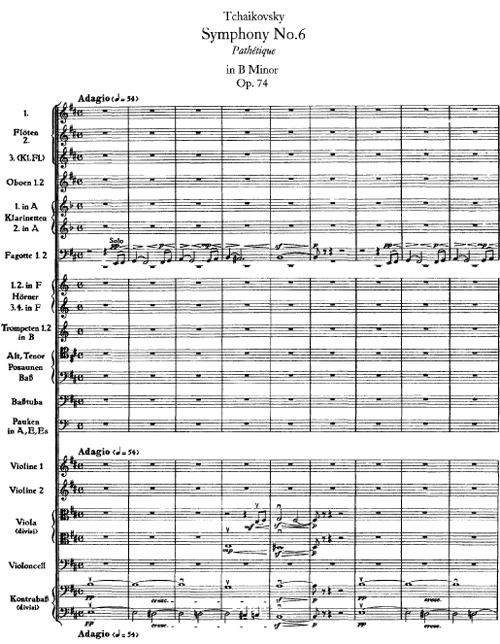
Tales of Despair: The Tragedy of the Symphony “Pathétique”

Foreword:

This is the first post of what I hope will become an ongoing series on the nature of despair. What I envisage is to introduce a work of art – be it imagery, poetry, music, film or novel – that was created from the darkest places of the soul. Darkness and despair have been a part of my life since my early teens, and as I have grown accustomed to it, and rediscovered joy in the midst of it, I have become inextricably marked by depression, and to this day there is nothing in the world so comforting as a warm, dark corner where no one can see me, My Dying Bride playing in the background, and a glass of wine reflecting the candlelight.

Being a musician and composer by training, many of these tales are likely to revolve around songs, symphonies and albums. However, I hope to reach out to further art forms, and discover among the canon of literature, film and imagery endless tales of despair.

The Tragedy of the Symphony Pathétique

There is in my mind no more fitting work of art more wrought with despair than Pyotr Illyich Tchaikovsky’s sixth symphony, popularly known as the Pathétique (in Russian, Patetičeskaja). This is a piece of music that passes through a sea of emotions of an intensity beyond anything I have heard or seen in my life. From the moodiness of the opening to the fury of the first movement’s climax, the calm sadness of the lilted waltz to the dizzying madness of the third movement, and ultimately the chilling, profoundly bleak finale, in fifty minutes this symphony takes the listener through a world of thought and a lifetime of tragedy.

The symphony’s name derives from the Russian word for passion, not pity, and it is a just name. The deep and overwhelming sadness of this music, however, is how closely it ties to Tchaikovsky’s turbulent personal life. Six days after its world première, Tchaikovsky died. He claimed to his brother that the symphony was steeped in meaning, but he would not reveal the music’s subject to anyone. Some have since said that it was his final death letter.

Tchaikovsky’s own life was a mirror for this tragedy. His sorrows began with the death of his mother at the age of fourteen, and from that day onwards he succumbed to a cloud of depression that even the recognition he eventually garnered could not completely break him free of. His life was a tale of abandonment, despair and frustration; Though homosexual, the social convictions of Victorian Russia prevented him not only from being open about this, but even from acknowledging it in his own mind. He suffered two affairs, both of which ended with the woman he cared for leaving him. He did eventually marry, but they lived together for less than two months, and she eventually bore children from another man.

Even the one light of hope – his patron, Nadezhda, with whom he corresponded for thirteen years in over a thousand letters – ceased communication with him in 1890, and he remained hurt, bitter and bewildered over this for the remaining three years of his life.

Tchaikovsky died in 1983 by his own hand. Perhaps he had become overwhelmed by the depth of despair into which his life had sunk; perhaps he could no longer bear the terrible conflict of his sexuality, which culminated in an attempted affair with his own nephew. On the night of the première of the sixth symphony, Tchaikovsky drank a glass of unboiled water, contracted cholera, and died six days later.

The terrible pain, sadness and despair is overwhelmingly prevalent in this symphony. Before his death, Tchaikovsky confided to his brother that the symphony was full of a deeper meaning, but would not say what it was. After he died, his brother realized he had been speaking of his own death – his final symphony, a monument to tragedy, was his suicide note. A parallel for his own life – childhood sadness, angst and fear at odds with the fervor and passion of creativity. Tchaikovsky destroyed more manuscripts than he completed – the artist’s madness refusing to allow him to ever be content with his own music.

This symphony, even out of context, is a tragic and moving musical journey; always a master of emotion, the composer filled his final work with every skill he possessed, and left us thus with his greatest work being his last. When considered as the final cry of a doomed man, a testament to despair, the final, terrible notes of the finale take on the reek of death, and speak of the utter finality of the grave. Tchaikovsky knew as he wrote that this symphony would be his last, and killed himself upon its completion.

On the Nature of the Gothic

First of all, my appreciation goes out to tablite for the inspiration tonight; your recent post sharing an old poem of yours prompted me to delve (deep) into the writings of my own past. I have long been out of touch with the nature of the darkness from which my love of the bleak and macabre stems, and it was quite a trip back in time! If you’re lucky (or maybe not), I’ll share one when I’m done.

In my youth, I was a goth. It’s curious to me to find myself speaking in the past tense, because, of course, the sensibilities and mindset of this term is something I carry to this day. There was much debate, even then, about exactly what a ‘goth’ was; we were the true goths, of course, reveling in depression and despair, while the fake goths got off on dressing in black and listening to Madonna. Or something. They weren’t sad, so of course they couldn’t be goth. It was a mindset, a statement, and way of life, heralded by the oh-so-familiar aphorism, “goth isn’t just a fashion statement.” I realize now, of course, that I was actually just severely depressed, but the very word “gothic” was an outlet, a culture of other people who were in one way or another just as messed up as I was, and were, of course, the only ones who could truly understand. Much of what I wrote at the time was steeped in this mentality, and reading over some of my old stuff reminded me of that old word, and I started wondering what it meant – what it really meant.

So tonight, I – astonishingly – did a little research, and I actually discovered some things that I did not know, and make a huge amount of sense. The word ‘gothic’ does not, of course, mean what it did originally, and yet, somehow it does. The history of this little word is kind of neat.

First, we had the Goths. They were kind of cool; they were tough and violent, came from Scandinavia, and helped bring about the fall of the Roman Empire. They were brutal and devious; one sect (the Ostrogoths) joined the Huns and later revolted against them, while another (the Visigoths) became subjects of the Roman empire before revolting against them and sacking Rome. Eventually, though, even they fell – the Ostrogoths to another clan from Scandinavia, and the Visigoths to the Moors.

Then came the medieval times, and everything was pretty dismal and depressing for a very long time. Though in many ways the middle ages are responsible for much of the culture we take for granted today, most people during this period spent their time thinking about god, or painting god, or killing other people in the name of god. In fact, god was pretty important to these people, and the stuff they built – like cathedrals – started to become pretty impressive, with lots and lots of arches and spires and things that sort of pointed up at god.

But then, something happened. This thing called the Renaissance (re-birth) happened, and all of a sudden people realized that they could actually write books and paint pictures and build buildings that weren’t about god, and when no one got struck down by lightning, they realized this was a good thing. In fact, they got a little bit embarrassed of how silly they had been for the last thousand years, and started calling all those tall, pointy cathedrals gothic, because it seems they remembered the goths as being pretty rude, and these structures – which fortunately they couldn’t get rid of – seemed pretty rude as well.

So by the 1600’s, gothic was a bad thing, being associated with all those nasty medieval cathedrals people had built before they realized god didn’t really care how big their steeple was. Instead, baroque was the latest craze, and art started being created to evoke tension, and drama, and great big emotional responses. Eventually, though, all the little frilly bits on buildings started to tick people off, and they thought, hang on a minute – the romans never had this problem; let’s build stuff like they used to. So we got the neoclassical (new classical), and all these roman columns started cropping up. Now here’s where it gets kind of funny, because eventually this style started to get annoying, and people said, hey, I know – let’s build stuff like they did in the middle ages! You know, that style we thought was barbaric and crude and nasty.

Guess what they called it? Yep – neogothic. Of course, it reminded people that these big, huge spires and arches were pretty awe-inspiring, but since god didn’t really matter that much anymore (it is 1750, after all), and this thing called romanticism was on the rise, it became a natural fit for the drama, tragedy and heaving bosoms of the romantic era. People who had been always so prim and proper up until that point began to get a bit of a thrill out of hearing – and reading – about men that cried and women that cried even more, and literature became the horror movies of the 19th century. It seems it all started when a guy called Walpole wrote a story that was all love and death and drama, set in a gothic castle (it kind of helped that he called it A Gothic Story).

You started to get these tales like Faust and The Pit and the Pendulum, as well as Varney the Vampire, and the gothic/horror novel was born. Frankenstein was pretty cool, too. Fast-forward to the early twentieth century and, while the term ‘gothic’ fell out of usage, the spirit of it was alive and well in horror and romance.

Then, it all came back again in the 80’s when some guy at the BBC called Joy Division ‘gothic’. Funny, really – he meant it as dramatic and theatrical, which is exactly how it all started out way back in the 16th century. Anyway, it kind of caught on, and all these cool bands like Bauhaus and Sisters of Mercy and Fields of the Nephilim started getting labelled as ‘gothic’. It sort of started to just mean dark, miserable and depressed, and hey – no one was arguing. Novelists got in the act too, and Ann Rice put out a whole bunch of stuff about sad vampires, and the whole thing just kind of got out of hand.

And that’s pretty much where I came in. I was a teenager, I hated my life, I was depressed and I wanted to die, and suddenly there were all these other people who hated their lives and wanted to die and they were the goths. It was all pretty cool, because we could all say together how much we hated life, and how neat it would be to be a vampire and be sad for ever and ever, and how no one understood tragedy like we did, and so on and so forth.

So what’s the point of all this? To me, gothic simply had connotations of darkness, despair, sadness, loneliness, and all the imagery and art that conjured up. I had never, until now, bothered to look deeper into it, and what I found was a bit of an epiphany; without ever realizing it, I was living the very definition of gothic: I was romantic, dramatic, tragic, and completely full of myself. This, in turn, seemed crude and and nasty to everyone around me who saw my black eyeliner and inverted crosses, and I was of course proud to piss them all off. In effect, if Giorgio Vasari, inventor of the word ‘gothic’ back in 1530, could see me, I’d fit the bill perfectly.

As it happens, I may possibly have some Scandinavian blood, so that helps too.

So to all you goths out there, enjoy the misery and the despair and the tragedy, and feel safe knowing you are legitimate in calling yourself a goth! Unless you just do it for the fashion, in which case you can  drop dead.

And finally, here is one of my favorite poems I wrote back when I was a goth:


Elegy

I am sitting by your side

Around us, sickening branches claw the sky

The tower is shrouded

In her thick, grey shawl

Light is fading slowly

And I perceive new shadows amidst the fog

Our silence is broken

By nothing at all

The path leads beckoningly

Onward toward the gate

The bell tolls for you or me

Time has come to leave here

Rest a hand against the cool stone for just a moment longer

Before looking to myself—

I am sitting by your side

And you are not moving