Tales of Despair: The Darkness of Children’s Magic

As a child, there are many things we are afraid of. Some of them, of course, are entirely natural: we are afraid of unearthly creatures – the snakes, the spiders; we are afraid of injury, and therefore of heights, and of blood. Some things are learned: we are afraid of strangers, we are afraid of loneliness, and of isolation; we are afraid of the world, and afraid to lose the protection of our parents.

And then, of course, there are the fears that stay with us. The fear of the dark; the fear of the unknown and the inexplicable; the fear of power that is outside of our control. And most of all, there is the fear of things that just don’t quite seem right. These are the things that scare us the most for they look normal, and they behave normally; they walk and talk and appear in every way to be right, and proper – yet somehow, they aren’t. Something lurking in the background tells us their shadow doesn’t sit right, or the light behind their eyes is of an ill color.

Any story that captures some of these elements is bound to be frightening; a children’s tale that touches on all of these fears is outright terrifying – and powerful.

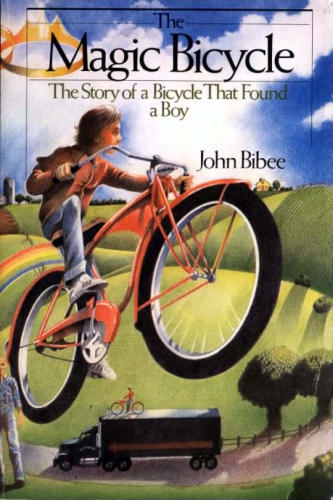
Such is The Magic Bicycle, by John Bibee. This is a tale that, as a child, thrilled, terrified, and enthralled me. I read it endlessly, and each time I was spellbound, shivers dancing across my skin on every page.

John is a boy; a young boy, a good boy – the kind who is loved, the kind who does well, the kind who gets into trouble, but whose parents nonetheless understand him.

Except his parents are dead, and he is raised by his aunt and uncle, and their daughters. He fits right in, of course – they love him as they did his parents, but he knows he isn’t quite part of their world. As it turns out, the bicycle he discovers in the town dump will take him into an entirely different world altogether.

It isn’t a world far removed from his own; he continues to go to school, to do his homework, to be picked on by the school bullies. But slowly, things begin to happen that shouldn’t. The bicycle, it turns out, isn’t an ordinary bicycle. When he pushes down on the handlebars, he discovers it can fly. And as John is discovering the remarkable abilities of his new treasure, men in black bowler hats begin sneaking around at night, offering strange candies to bullies and encouraging them to steal and destroy John’s bicycle. Snakes begin to appear, manifested in skid marks and dark clouds.

Gradually, it becomes clear that a power greater than John is intent on seeing through the destruction of his bicycle, at any cost. And as John begins to learn of the bicycle’s power and the meaning behind it, and the bond it has to his parents, the dark forces move against him, and he is left, alone, to rescue his family from the shadows.

This is the true magic of this tale – John’s remarkable command of his readers, bringing them to the edge of fright, and then helping us to see behind the curtain, and to understand the things that frighten us. Even the forces of evil have weaknesses, even as we do; they can be tempted, frighten, and cast out.

Yet John doesn’t leave us with such a cut-and-dry tale of good and evil; The Magic Bicycle is as much a tale of lost innocence and growing up as it is an adventure of a young boy, and the ending is bittersweet, at best. This is a timeless tale of strength, fear and morality, and it has forever touched my mind.

Tales of Despair: The Dancing Dead

Dance of Death, by Michael Wolgemut

There is little more terrifying than the thought of the dead risen; grim skeletons, grinning with their scythes and bearing down upon you, inescapable.

Death was everywhere in the fourteenth century. For a hundred years, France and England had been pitting their men against each other, drenching the earth with blood and filling graves with the mutilated bodies of the wounded. The crops grew poor, and the poor grew hungry; famine and disease were rampant. And most terrifying of all, a death that crept upon the young and old alike, one that grew great boils upon the skin and moved from person to person with frightening swiftness. The plague decimated nearly half of the European population during its time, and the lives of men hung by a thread.

It is against this background that the first records of the Totentanz, the Dance of the Dead, are known. In a cultural landscape dominated by murder, war, adultery and disease, people grew suddenly terrified of god’s wrath, knowing they could be struck down at any moment. In an effort to find reprise from the horrors of life, the vision of one, last moment of joy, even on the way to the end, swept across the lands: the final dance to the grave.

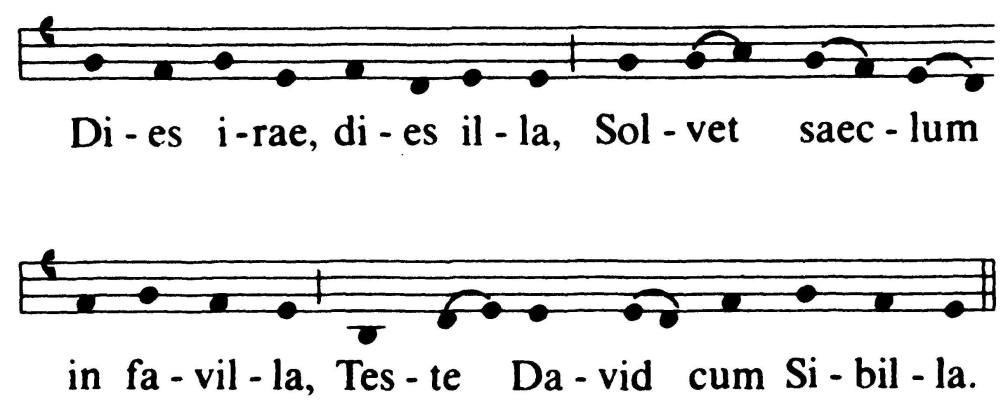
In these times, where salvation was futilely sought in the houses of god, the hymns of mass began to see the introduction of a new plainchant: the Dies Irae. This melody, full of gloom and storm, speaks of the wrath of god, the day of judgement and the ending of the world.

Original Dies Irae plainchant (c. 1260)

These sights and sounds of horrifying death endured, and nearly six hundred years later, were still incorporated into the art of the Romantic era. Franz Liszt (1811 – 1886) was one of these artists: an eccentric, infamous and exceptionally talented pianist and composer. He was the rock star of his day, sought after to perform, dazzling men and women alike with his superhuman pianistic wizardry (Liszt had enormous hands, and to this day some of his scores remain unplayable due to the stretches required).

Part of the original manuscript, in Liszt’s hand, for Totentanz for Piano and Orchestra.

Liszt was also a macabre individual fascinated by death and the medieval; he would often visit asylums, hospitals and even the dungeons of condemned prisoners, fasciated by those on the edge of death. Many of his works show the influence of these thoughts, but perhaps none more so than the dismal, thunderous and terrifying Totentanz for piano and orchestra. A set of variations on the Dies Irae plainchant, it begins with a rumbling, indiscernible piano, across which cuts the lowest instruments the orchestra has to offer, growling the Dies Irae with threatening ferocity. From there, we are swept away on a journey of madness and death, the pianist battling frantically against the inexorable march of the orchestra, flying to great heights and abysmal depths in an attempt to flee. At times, we are taken to one side, shown a moment of compassion, a moment of sadness, or even of humor – but always, we return to the rush and the doom.

Finally, the work builds to a frenetic climax, the pianist and orchestra verily trembling in fright, before plunging, without compromise or reprise, into the depths of the grave.

Liszt’s Totentanz is one of the most technically difficult pieces he ever wrote, and one of the darkest. Only some of his late compositions for piano, such as Nuages Gris, truly suggest a maudlin resignation to the ending of life, while many more of his compositions center around the country tunes of his native Hungary, and the sparkle and showmanship that gained him such fame that he wanted for nothing by his mid-forties.

Nonetheless, Liszt remained obsessed with death until the ending of his own life, in 1886. In his last years he suffered from many illnesses, some of which left him partially paralyzed and unable to play. His preoccupation with death increased with the knowledge that his own was fast approaching, and in July, he died in his bed. He has left us with a legacy of beauty, darkness and despair, and his works remain worthy of awe to this day.

Tales of Despair: Metamorphosis


School has a way of taking beautiful works of art and literature and turning them into the most abysmal, monotonous and over-analyzed trite. I was very glad to have read To Kill a Mockingbird long before high school, because it most certainly would have ruined for me. The same is true of The Catcher in the Rye and Of Mice and Men; thanks to my mother’s literary promiscuity (now that doesn’t sound good, does it?), I was exposed to a great canon of wonderful books at a young age, long before school was able to ruin them for me. Some were unsalvageable; I can’t see Macbeth without my mind involuntarily calling up hours of drudgery, trying to find the social implications of the blood on Lady Macbeth’s hands.

One that I barely escaped with was Franz Kafka‘s bizarre tragedy, The Metamorphosis (Die Verwandlung). I discovered it in the school library one day, after someone had suggested it as a great example of existentialism. I’m not to convinced of this anymore, but at the time existentialism was one step away from nihilism, and I was sorts of crazy.

The Metamorphosis is only short, and is very nearly a study in fictional writing taken to an extreme. The best fiction is that which is almost real – introducing a single fantastical element, and watching the fallout. Such is the case when traveling salesman Gregor Samsa wakes up as a giant insect. This is, in a way, the only fiction in the tale; the rest is reactionary.

Imagine being that insect; there is nothing tying you to the reality you knew only the night before; your very body has betrayed you, you are unable to control your movements, and your voice is unrecognizable. Your family, those closest to you, are disgusted by your appearance. Your father wishes you dead, your mother pretends you aren’t there, and only your sister – your closest friend – has even the courage to throw table scraps into the room.

Gregor begins to hide under furniture, all the while desperately clinging to his humanity. His family, seeing his grotesque form, are unaware that he is still able to hear and understand their every word…even when they discuss his own demise.

And eventually, of course, the tale ends; as befits a cockroach, Gregor eventually crawls under a couch, and dies.

Kafka had the strength of will to push his story to its final, logical conclusion; so often remiss in modern fiction, he realized the nature of Gregor’s metamorphosis, and the importance of its permanence. The great changes in life are undoable – both the good, and the bad. Many of us, I’m sure, have at times felt as though we are that insect; deviant, shunned, unwanted and loathed, a burden on those closest to us. And in this, Kafka doesn’t shy away in asking: are we all merely looking for that couch to crawl under?