Tales of Despair: Eternal Blood

The Vampire – Philip Burne-Jones

I was one of the (probably many) goth kids who grew up obsessed with all things dark; lord amongst the demons and monsters were, naturally, the vampires. What a beautiful romance these creatures held; to live eternally, at the price of the blood of your fellow men and women. The visceral attraction of blood, warm and flowing, the bitter metallic taste, the swoon of the letting – these were the things that captured my mind.

With this came the gloriously evil tales – not only the fantasies of Nosferatu and Dracula, but the terrifying histories of Vlad the Impaler, and the Countess Báthory. Drinking, bathing, delighting in blood – all was dark, brooding, and beautiful. A natural part of this was the romanticism of the vampire, and I will hold my hand up and say that I watched many vampire movies – notably Francis Ford Coppola‘s Bram Stoker’s Dracula, long before reading of the literature.

Gary Oldman as Dracula (1992)

Francis paints a picture of a medieval man, tortured by war and death, renouncing god for eternal life upon the suicide of his one, only, true love – that he will await her forever, fed on the blood of men. And wait he does, until by happenstance, he sees her likeness in Mina, the fiancée of Jonathan Harker, a minor solicitor visiting his Transylvanian castle. Determined to fulfill his prophecy, he abandons Jonathan to his fate amongst the vampires of his castle, traveling to England in a desperate attempt to be with her. He meets with her, charms her, and seduces her – only to be torn apart again as she leaves him to be wed to Jonathan (resulting in one of the most memorable performances by Gary Oldman, weeping in agony over his loss of her).

Yet his work is done; she remembers him, and becomes infatuated, and begs him to transform her as well. And then, as she begins to change, Dracula retreats once more to his home. Now bound to him, Mina can think of nothing else, and Jonathan, now accompanied by the delightful Anthony Hopkins as Van Helsing, realize they must pursue and destroy the count if they are to save her. In the bitterest of endings, the wounded Dracula begs his long-lost love to give him peace, and – having lived to see he beloved one last time – he is put to death by her own hand.

First edition of Bram Stoker’s Dracula

Little did I know how little – and how much – this romanticized tale had in common with Bram Stoker‘s brilliant and seminal novel from 1897. While the characters remain the same, their intentions, motivations and desires could not be more different. Strikingly told from the perspective of journal entries and newspaper clippings, the loose plot is similar – Jonathan Harker, the newly-appointed solicitor, traveling to Transylvania to aid the Count Dracula in finalizing his purchase of land in London, and to teach him the ways of the English. Gradually ensnaring Jonathan in his castle with the three vampiric sisters, Dracula comes to London – for the pure desire to live amongst the great population, and to feed at his leisure.

Dracula does turn Mina, but not out of any romantic desire – it is a punishment, revenge against the men who would destroy him. He uses her, tracks his foes through her visions. In doing so, however, he betrays his own intentions, and is eventually hunted down and destroyed.

By all accounts, Bram’s original text is heart-stopping and gripping; the format of its writing ensures the survival of no character, for there is no narrator. We are left until the very end to know, even, whether the party of vampire hunters have triumphed over the bloodthirsty Count. In some ways, Francis’ version is one filled with emotional torment, anguish and despair – to pine for a lost love for four hundred years, only to be denied a life with her in the final moments is a heartbreak of unsurpassed proportions. Yet Bram’s original tale is by far the most frightening, and reeks of an entirely different form of despair: the knowledge that you are fighting an all-encompassing evil, one that delights in the destruction of all men.

Thought of the Week: Dinotopia

As a child, I loved to read; perhaps even more then than now. Even at a young age, my obsessive nature was evident: I was incessantly hooked on vast series, reading one after another after another. I believe I read nearly every Hardy Boys book that has ever been written; a guilty pleasure (even now) were Star Trek novels, from all four series (yes, four; I refuse to acknowledge Star Trek: Enterprise as viable Star Trek material).

But sometimes, here and there, I would come across books of a different breed: books that were, in their very essence, magical. Books that engaged my young mind, books that opened my eyes to the realities and fantasies of many other worlds, and many other lives. Some of these I have spoken of  already in these pages; books like Jonathan Livingston Seagull, The Trumpet of the Swan, Goodnight, Mr. Tom, and even a little book called The Whipping Boy. These were tales of inspiration, tales of darkness, of danger and excitement, filled with emotion and sharp characters. They encouraged beautiful visions in my mind, and fueled my imagination.

However, there was one book, one I discovered quite a bit later, that stood out apart from any other tale I had ever read. A book that, to this day, I read with reverence and awe. That book is Dinotopia.

What an utterly beautiful cover.

Dinotopia is a tale of shipwreck, mystery and lost worlds. Arthur Denison, and his young son Will, find themselves cast upon an uncharted island when their ship is brought down during a terrible storm. In their immediate quest for food and survival, they begin to happen upon very odd, strange things: creatures, like giant lizards, of an era long-extinct.

To their further astonishment, they discover that, living in harmony beside these ancient creatures is a great civilization of humans, men and women who are able even to communicate with the beasts.

Arthur, being a scientist, begins in ernest to interact and document all he can on this astonishing and impossible island. His son, however, is much more taken by the folk of Dinotopia, and begins rapidly to become one with the men and women of the lost world.

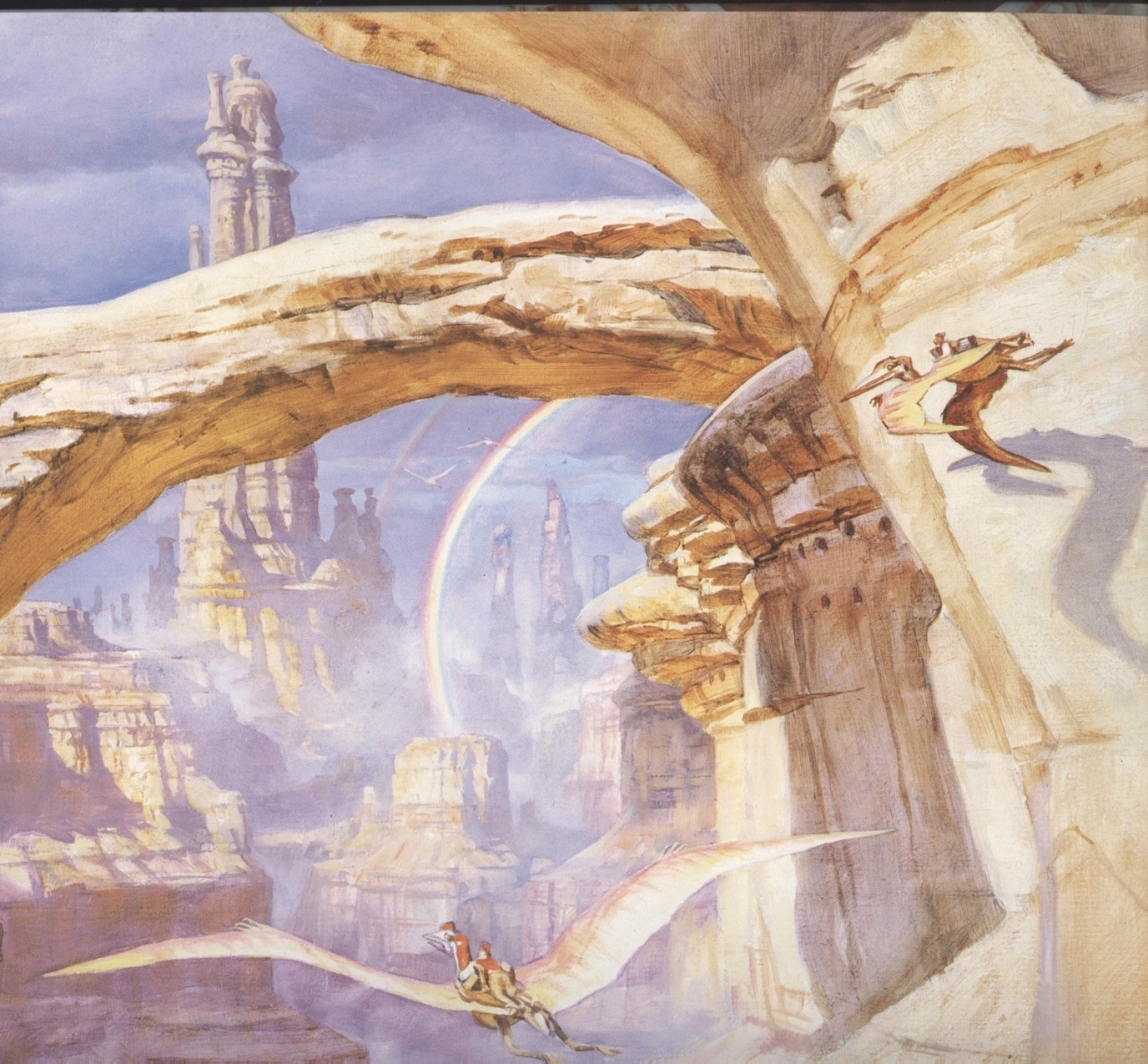
As time goes on, Will befriends humans and dinosaurs alike, and even becomes one of an elite troop of skybax riders, flying in symbiosis with the free-soaring flighted dinosaurs of the island.

However, whilst the tale itself is indeed wondrous, far more astonishing – breathtaking, even – are the incredibly detailed and vivid illustrations that fill each page of the book, bringing to the utmost life the world of Dinotopia. James Gurney, who both wrote and illustrated the book, is certainly one of the most talented artists of our time. The striking watercolors that fill the book depict the majesty and grandeur of the civilizations of the land in astonishing and graphic detail. From the simple homes of the small villages to the sweeping beauty of the landscapes and the glorious cities that mark the centers of culture and learning, every place of this world is realized, leaving the reader breathless as they read the words that are as beautiful as the art that accompanies them.

Eventually, James went on to create several sequels to the first book, which later became known as A Land Apart from Time. However, none of them manage to quite live up to the splendor of that first, groundbreaking and inimitable style of the first book, Dinotopia.

The Forbidden Mountains.

The soaring heights and fathomless gorges of the Skybax’s domain.

The first sight we have of Waterfall City is by far my favorite illustration of the whole book. I could stare at this painting for hours, so vivid and beautiful.

The Redemption of Erâth: History of Erâth – The Second Age (Part II)

(ii) The Twelve Kingdoms of Men

During the Second Age there were established twelve kingdoms of Men, spread across the three remaining continents of Erâth: Cathaï, Thaeìn and Aélûr. Of these, three were founded in Cathaï, four in Thaeìn and five in Aélûr. Each kingdom governed their own small territory of the world, though much of the world remained uninhabited except by the creatures of darkness.

It was the power of the Portèn that made it possible for men to regain the world, but Men soon forgot the influence of this race. The Portèn, for their part, were happy to leave the world of Men to itself, having restored what they could of Erâth, and retreated to long slumber, unnoticed and ignored by Men. This left the lands of Erâth open to the conquest of the Duithèn and the Namirèn, and the Sarâthen were too few to do much more than hold them at bay. This left Men to resist the powers of darkness alone, and it is for this reason that the lands of Aélûr, and in particular Cathaï, long the strongest refuge of the Portèn and life itself, were the first to fall to darkness. […]

Read the complete section here.