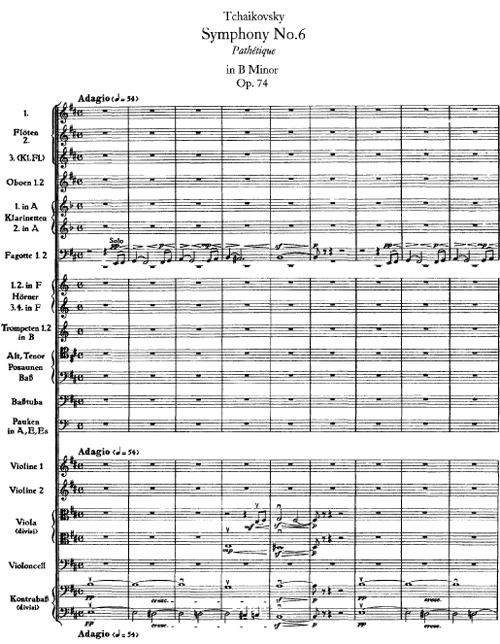
Tales of Despair: The Tragedy of the Symphony “Pathétique”

Foreword:

This is the first post of what I hope will become an ongoing series on the nature of despair. What I envisage is to introduce a work of art – be it imagery, poetry, music, film or novel – that was created from the darkest places of the soul. Darkness and despair have been a part of my life since my early teens, and as I have grown accustomed to it, and rediscovered joy in the midst of it, I have become inextricably marked by depression, and to this day there is nothing in the world so comforting as a warm, dark corner where no one can see me, My Dying Bride playing in the background, and a glass of wine reflecting the candlelight.

Being a musician and composer by training, many of these tales are likely to revolve around songs, symphonies and albums. However, I hope to reach out to further art forms, and discover among the canon of literature, film and imagery endless tales of despair.

The Tragedy of the Symphony Pathétique

There is in my mind no more fitting work of art more wrought with despair than Pyotr Illyich Tchaikovsky’s sixth symphony, popularly known as the Pathétique (in Russian, Patetičeskaja). This is a piece of music that passes through a sea of emotions of an intensity beyond anything I have heard or seen in my life. From the moodiness of the opening to the fury of the first movement’s climax, the calm sadness of the lilted waltz to the dizzying madness of the third movement, and ultimately the chilling, profoundly bleak finale, in fifty minutes this symphony takes the listener through a world of thought and a lifetime of tragedy.

The symphony’s name derives from the Russian word for passion, not pity, and it is a just name. The deep and overwhelming sadness of this music, however, is how closely it ties to Tchaikovsky’s turbulent personal life. Six days after its world première, Tchaikovsky died. He claimed to his brother that the symphony was steeped in meaning, but he would not reveal the music’s subject to anyone. Some have since said that it was his final death letter.

Tchaikovsky’s own life was a mirror for this tragedy. His sorrows began with the death of his mother at the age of fourteen, and from that day onwards he succumbed to a cloud of depression that even the recognition he eventually garnered could not completely break him free of. His life was a tale of abandonment, despair and frustration; Though homosexual, the social convictions of Victorian Russia prevented him not only from being open about this, but even from acknowledging it in his own mind. He suffered two affairs, both of which ended with the woman he cared for leaving him. He did eventually marry, but they lived together for less than two months, and she eventually bore children from another man.

Even the one light of hope – his patron, Nadezhda, with whom he corresponded for thirteen years in over a thousand letters – ceased communication with him in 1890, and he remained hurt, bitter and bewildered over this for the remaining three years of his life.

Tchaikovsky died in 1983 by his own hand. Perhaps he had become overwhelmed by the depth of despair into which his life had sunk; perhaps he could no longer bear the terrible conflict of his sexuality, which culminated in an attempted affair with his own nephew. On the night of the première of the sixth symphony, Tchaikovsky drank a glass of unboiled water, contracted cholera, and died six days later.

The terrible pain, sadness and despair is overwhelmingly prevalent in this symphony. Before his death, Tchaikovsky confided to his brother that the symphony was full of a deeper meaning, but would not say what it was. After he died, his brother realized he had been speaking of his own death – his final symphony, a monument to tragedy, was his suicide note. A parallel for his own life – childhood sadness, angst and fear at odds with the fervor and passion of creativity. Tchaikovsky destroyed more manuscripts than he completed – the artist’s madness refusing to allow him to ever be content with his own music.

This symphony, even out of context, is a tragic and moving musical journey; always a master of emotion, the composer filled his final work with every skill he possessed, and left us thus with his greatest work being his last. When considered as the final cry of a doomed man, a testament to despair, the final, terrible notes of the finale take on the reek of death, and speak of the utter finality of the grave. Tchaikovsky knew as he wrote that this symphony would be his last, and killed himself upon its completion.

Movies I Am Already Looking Forward to This Year

I am not a great fan of movies that are billed as “the most original since…” or “brilliant ★★★★” (how I loathe those stars). I don’t particularly care for gut-wrenchers that seem to exist solely to beat your spirit to the ground with an iron rod. And I wouldn’t go out of my way to catch an avant-garde, indie film whose creators lost sight of the story amidst their obsession with being different.

What I do enjoy are films that have a strong story, strong characters and strong directing. Actors are neither here nor there; I’ve rarely seen a good movie ruined by a poor actor, and never seen a bad movie saved by one. Cinematography is important, but must take second place to the story. Explosions, too, are important, but must also be a passenger to the story. Effects in general should serve the story, and not the other way around. This is why Hugo was amazing, and Transformers was not.

My favorite films include Alien, Angel Heart, Corpse Bride, The Crow, The Da Vinci Virus (not Code), The Dark Knight, Donnie Darko, Dracula (Francis Ford Coppola’s version), Ginger Snaps, The Goonies, The Hitcher (with Rutger Hauer, not Sean Bean, love him though I do), Jacob’s LadderThe Lord of the Rings Trilogy, Love Actually, The Lovely Bones, The Muppets’ Treasure Island, Ring (Hideo Nakata’s version), Sin City, Star Wars (yes, all of them), This Is Spinal Tap and WALL•E.

An odd mix, perhaps, but it sets the scene, I suppose. Some of these have spectacular visual effects; Coppola in particular impressed me by using absolutely no digital effects at all in his Dracula. Jackson impressed me just as much with his almost entirely digital Lord of the Rings. Both of these were based on exceptionally good story material. In fact, I like to think the same could be said of each of the above. And so that is why the following films are the ones I am looking forward to seeing the most this year (knowing, of course, that some might change):

April 13: The Cabin in the Woods

Can’t say I know much about this; critics are being very wary of giving anything away, and this in itself is intriguing me. It reminds me of the glory days of Hitchcock (or even E.T. The Extraterrestrial for that matter) when nothing but actually seeing the movie would tell you anything about it. People are calling it art-horror, and I’m good with all of that. [IMDB]

April 27: The Raven

An interesting play into the fictional history genre; detectives seek out Edgar Allan Poe to help them capture a murderer inspired by his own writing. I love Poe; I love John Cusack; I love period films. Period. [IMDB]

May 11: Dark Shadows

I’ll be honest – I didn’t even look this one up. It’s based on a TV series, apparently. Tim Burton and Johnny Depp…enough said (no Helena Bonham Carter though, disappointingly). [IMDB]

June 8: Prometheus

Ridley Scott has done an excellent job of keeping the nature of this movie a secret, and even the tantalizing images and trailers that are leaking out are giving nothing away. Remember the first one in my list of favorite films? Yep. [IMDB]

June 15: Brave

Disney and Pixar’s thirteenth outing is a must-see for me because I have an eight-year-old, and…well, just because. Pixar are gods in my eyes, and this goes way beyond the animation; WALL•E was a dangerously unorthodox love story, as was Up, which followed it. This one looks like an interesting departure from the usual tales, however – as someone pointed out to me, it is the first Disney/Pixar release to feature a female lead. I also like Scotland. [IMDB]

June 15: Abraham Lincoln, Vampire Hunter

I’m not sure how this film ever got green-lit, but I’m glad it did. Like The Raven, we’re looking at fictional history, and this time it just looks plain silly. Tim Burton at the helm again (he’s busy this year!), and Abe looks awesome wielding an axe! [IMDB]

July 20: The Dark Night Rises

Pretty predictable, I guess – first summer blockbuster of the year, and probably going to outsell every other single film in the history of anything, ever. Batman Begins was good. The Dark Knight was astonishing, and unexpected. I was brought to the edge of my seat, and was so glad that Christopher Nolan didn’t back off, and pushed the story all the way off the edge and into darkness. I’m anxious to see if The Dark Night Rises falls somewhere between the two, or becomes simply the most amazing action movie of all time. [IMDB]

August 3: Total Recall

I don’t think they could possibly top Arnold Schwarzenegger and Sharon Stone, but still…I’m just going to have to see it, for the hell of it. Along with Robocop next year. [IMDB]

October 5: Frankenweenie

A return to the magic of Tim Burton animation. I can’t wait. [IMDB]

October 29: Cloud Atlas

This movie looks impossible, in concept at least. The characters are spanned across time and space, and are yet connected to each other in way that has not been revealed, and will probably rent the fabric of the universe when it is. Oh, and I should mention: Tom Hanks, Hugo Weaving, Susan Sarandon, Halle Berry and Hugh Grant. I realize I said actors were neither here nor there…but these ones are all here. [IMDB]

December 7: Les Misérables

If they do to this what they did to Chicago, we’re in for a treat. [IMDB]

December 14: The Hobbit: An Unexpected Journey

I have been looking forward to this movie for ten years, and it can not come soon enough. In a way, though, I’m glad I still need to wait another 274 days; no matter what happens this year, no matter how terrible things might get, finishing 2012 with The Hobbit will make it all okay. This is magic of another kind. [IMDB]

And that’s it. Maybe more will come out, and there might be some I’ve somehow missed. I don’t really keep up on these things; these are just the ones Zite told me about. Perhaps you’d like to share the films you’re most excited to see this year?

Note: The further away the movies’ release dates are, the less accurate these dates will be. The ones I’ve given are as stated on the IMDB as of writing.

On Creativity, Credit, and the Popular Idol

My wife is watching American Idol. As you can tell, I am not. I don’t strictly loathe the program; I just really, really don’t like it.

I’m aware it’s a very popular little show. Not just my wife watches it, apparently; there’s a guy at work who mentioned in passing as well. And, as long I’m being honest with you all, I don’t actually mind the talent on display, even if it does seem like a grossly overblown, shameless televised debutante ball for people with a little more lung than the rest of us.

The key thing for me is, what talent exactly is on display? There is something indeed unique and special about the contestants on American Idol (at least, those that make it through the first few rounds). Whether they’ve got a Dave Grohl grin or don’t care two whits about their audience, most of the people up on that stage share a common talent: their voice. They are, for the most part, good singers. Some are great, and would be at home on Broadway, or at the opera.

And I am a huge fan of musical talent. Alfred Brendel, Yo-Yo Ma and Isaac Stern are unparalleled to this day (and I am quite fortunate to have a recording of Brahms’ chamber music with most of these fellows playing). Joe Satriani and Eddie Van Halen can shred like none other. Mike Portnoy is an astonishing drummer, and hey – love him or hate him Axel Rose can sing. These are all exceptionally talented musicians, performers who rank in the top 1% of their art. But – and here is the argument’s focus – how far does their credit and fame extend?

As much as I enjoy consuming media (books, music, movies, etc.), I also create it as well. I am by training a musician and a composer. I am by my own hand a writer. And I have made a couple of terrible home movies. And whether it is in poring over the score of Beethoven’s sixth symphony, or marveling at the poetry of Dickens’ words, or admiring the artistry of Coppola’s Dracula, it is always driven home to me the intense passion, the sweat and tears, the frustration and the determination, that these artists have invested in their work.

Think, for a moment, about the song you’re listening to. Is it three, four, five minutes long? How long did it take to write, rehearse, perform and record that music? Chances are, several months. Production began last year on The Hobbit, which is due for release this Christmas. And the script was in the works ten years ago. Stephen King began work on his Dark Tower series in 1975 and is still working on it today. These are creations of human imagination, and while many of us have wild fantasies, stories and songs that run through our hears, these few are the ones with the bravery, the foolishness, and the love of self-immolation to commit those fantasies to permanence.

Yet in all of this, music – and specifically popular music – stands alone in several ways from all others. I won’t comment on the idea that pop songs are created for money; all art is, in one form or another. Nor will I say anything about the formulaic characteristic that defines most pop music; how many Agatha Christie clones are out there in the literary world?

No, the one thing that I can’t help but notice – the one thing that frustrates me to no end, and drives to to tears to think of it – is the credit given to the creators of these works. What springs to mind when I say The Hobbit, Vertigo, Titanic, Alien, Dune, or The Pit and the Pendulum? More likely than not, J.R.R. Tolkien, Alfred Hitchcock, James Cameron, Ridley Scott, Frank Herbert and Edgar Allen Poe. Yet if I ask you who wrote any one of Britney Spears’ eleven Top 10 songs, how many of you would be able to answer, Max Martin?

Turns out, Max Martin wrote chart-topping songs for The Backstreet Boys, NSYNC, Kelly Clarkson, Pink, Katy Perry, and even Usher. Now I don’t typically listen boy bands, pop rock or hip hop. Not out of any sense of pride – it just doesn’t speak to me. My tastes do vary – anything from The Cure and The Sisters of Mercy to Iron Maiden and Napalm Death, along with more or less the entire canon of western classical music from the 1600s on. It wasn’t until recently, however, that I started to wonder why I was attracted to these styles of music in particular. The answer that came to me, ultimately, was art. These musical styles represent art in its highest form. Like looking at a Picasso or reading Jules Verne, through the art you are in touch with the artist, and you have the chance, if you slow down, to marvel at every brush stroke, or wonder how the writer chose their words, and why they hold such magic.

When I listen to Porcupine Tree (one of my favorite bands), I don’t just hear the music. I hear Steven Wilson, writer, producer, singer, performer, making sure every single sound I hear is there on purpose, for me to recognize and revel in. I imagine him sitting in a studio, expensive headphones on, changing the reverb from 5 milliseconds to 6 milliseconds, smiling, and thinking – that’s perfect.

I wonder if Britney Spears ever does that.

In classical music, the composer is prized above all else, even the performer. “Simon Rattle conducts Beethoven’s Ninth Symphony” – the work of art belongs to the composer.

In film, it is the director, though the producer, screenwriter, and composer are all credited as well; “Stanley Kubrick’s 2001: A Space Odyssey.”

In literature – surprise – the author.

And even in contemporary popular music – rock, rap, jazz, punk, metal, house and hip-hop – it is rarely questioned that the artist and songwriter are not the same. We assume that Kurt Cobain had some hand in writing the music and lyrics to Smells Like Teen Spirit. Even Flo Rida wrote “Good Feeling” (under his real name of Tramar Dillard). So what happened to generic-brand pop? When did the performers begin to overshadow the creators?

So I won’t cry shame on American Idol; after all, showcasing talent is (ostensibly) what the show is all about. I have no problem with a nobody from Arkansas being given a shot at fame. But spare a thought for the songwriters who gave their lives to make this happen. Continue to give them credit as you sing.

And who knows? Maybe one day we’ll have a talent show for songwriters and composers. Admittedly, it would be a lot less fun to watch. But it would certainly be more interesting.