Tales of Despair: Standing on the Edge, and Daring to Jump

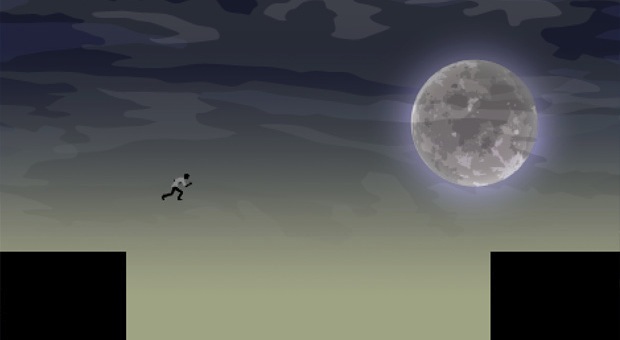
There is a game I played on my iPhone. It’s called One Single Life and I didn’t play it again. The game’s concept is very simple: you run, you jump, and you land on the next building. There is just one catch: if you die, you die. You do not get a second chance. This is one of the most thrilling games I have ever played; the knowledge that my quarter-inch avatar is about to leap quite possibly to his tiny death sends tremors to my fingers. My heart beats fast, and my palms are as dry as dust. I am terrified.

I know this sensation well, and it is the pause before the leap. In my youth, I spent a great deal of my time rock climbing, mostly at indoor rock gyms since the weather was usually bad. Some of the long routes were scary; one curved wholly over the ceiling of the gym, some sixty or seventy feet off the ground. Still, there was always a sense of safety, of a second life: the floor was cushioned, you were roped in, your climbing buddy had you.

But there was a time when a friend and I went walking in the Swiss Alps. I say walking, but we were young and foolish, and couldn’t resist the temptation to race each other up small cliffs here or there, quite proud of our budding climbing skills. This naturally delayed us, and we found ourselves quite late in the day still on a glacier, not even close to where we needed to be, and so decided quite wisely to take a shortcut over a low peak to the north. The peak had looked innocent enough on the map, but when we arrived at its base, we realized we were faced with a hundred-foot cliff face that was not quite vertical…and of course we just had to climb it. After all, it would surely be faster than going around.

I won’t speak of the abandoned Swiss military base at the top of this mountain – that is for another time – but it was halfway up this ridiculously foolish ascent that I first truly realized that I could die. Despite my confidence, the rock was loose, and in grasping for a handhold, the stone simply came free in my hand. For a single, endless moment, I wheeled slowly, sickeningly away from the cliff, releasing the rock and knowing it might hit my friend below me, and all the while grasping in utter desperation at the cliff with the two remaining fingers that attached me to it. Somehow – I have no memory of it to this day – I did not release my grip from the wall. I believe I was in tears when we finally arrived at the top.

The free fall in the stomach, the dryness of hands, the hypersensitivity to every touch and sound, are the hallmarks of standing on the edge of death. Sadly, my experience in the Alps was not the only time this sensation came over me. Countless times since then, I have found myself on that edge, often with a blade to my wrist. I have lived with people who have stood on that edge with me, and we would stare into the darkness together. The sensation, as the steel bites into your skin, or the rope rubs roughly on your neck, is not of pain, or of comfort, or even of anguish: it is the dusty, gliding feeling of standing right on that edge, toes over the abyss, and deciding to leap.

In the end, I never leapt. Some I know did, but were caught, and survived. Some leapt and we never saw them again. I could never overcome the sensation, the thrill of death that had saved me that day in the Alps, and fell back from the edge each time. I was crushed, dismayed, guilty and furious, and all this would collapse into the deadness that I was doomed to live for yet another day; but I was nonetheless alive.

This was all some time ago, and though I still see the edge each day, I keep my distance. I wouldn’t want to fall off by mistake. I can’t convincingly say that the fear of the leap has taught me anything, but I am glad of it, for had I jumped I would not know my wife, and I would not know our son, and the world would have been a darker place.

Still, I wonder at the thoughts of those others, at the moment they chose to make the leap. I imagine it was release – the final decision they would ever need to make was done, and there was no need to look back.

The Virtue of Voices

My iPad told me it is World Book Night tonight, and Emily Temple on Flavorwire thinks it would be nice if everyone read a book to someone else, instead of to themselves. As an exuberant fan of the spoken tale, I really couldn’t help sharing my own thoughts on this, which is that it’s pretty great. One could argue a spoken story is like the best conversation in the world: you get to say your piece, and everyone actually listens to you.

I remember so very, very fondly the stories and tales I would hear in bed every night from my father growing up. Often it would be a book; Curious George, and then Shel Silverstein, and then The Famous Five. My father had a wonderful, even-paced baritone, his skewed northern accent a lilting lullaby to my young ears (before you get too worked up, not all my memories of you are fond, dad!).

My mother read to me when I was older; Great Expectations was our treat together, and though I often didn’t understand all the words, Dickens’ imagery through her voice simply flowed through me, and I saw every detail of Satis, the house where Miss Havisham lived pent up for so many years (yes…that’s where my blog handle comes from).

Even my older sister, one camping trip in the Italian Dolomites, read me a story which I had forgotten the name of; a magical tale of wishes that came true, and the lessons the children learned from this. I particularly remember the divining rod that found the stream, and how the water that gushed out flooded the farm. I only just now, decades later, rediscovered what it was: The Wish Giver, by Bill Brittain. I thought I had lost this book forever, but its memory – from a single, spoken telling – has stayed with me ever since.

The thing that was missing, though, from many of these tellings, were the voices. Certainly, my mother would get quite excited, and Magwitch got quite a growl to him. I always knew when a character was speaking when my father read to me, but not always which character. There was an exception to this, however, and this was when my father would invent a story. This happened rarely, but was magic when it did: a Story With No-No Book. These were the dark tales, and the grim, and quite suddenly, when the words of the page were no longer there, the voices were all that was left, and it was thrilling. Often these stories would be mysterious, and more than any written book I would be terrified, not daring to know what was going to happen to the hero, who always seemed oddly to share my own name.

And now, of course, I am reading to my own son. Sometimes we share a Story with No-No Book. More often we are reading from a real book (or an eBook). And what I remember from my own childhood has stayed with me: the voices are everything. The narrator may tell the tale, but the characters make it. The Secret Garden was full of (terrible) Yorkshire accents. Treasure Island was full of pirates who sounded just like Robert Newton (except for Squire Trelawney, who sounded like something out of Little Britain). Gandalf was unashamedly my impression of Ian McKellen. It gets to the point where my son not only knows who is speaking when, but will actually call me out if my accent slips even a bit (you try keeping Harry, Ron and Hermione’s voices all distinct).

Even so, with all these wonderful voices (and mind you, it gets pretty difficult to remember what an Ent sounds like a book and a half later), sometimes there’s one character, here or there, that really steps beyond the page and truly, truly comes to life. I’ve only done this a few times myself; the Witch-King of Angmar was so sepulchral and creepy I gave myself shivers as I read his lines. Reeta Skeeter, in Harry Potter and the Goblet of Fire, somehow came out with a wonderful lisp, at once sugary and sinister.

Not all voices come out well, of course. Sometimes I’ve had to change a voice halfway through the book, realizing it didn’t fit the character (or that my poor throat couldn’t handle quite that much gargling). Sometimes I just can’t remember what someone is supposed to sound like. Willy Wonka was great in the Chocolate Factory, but somehow went all wrong in the Great Glass Elevator. I attribute it to his being in space for too long.

So what is the upshot of all this? Nothing really…just to say that, if you are going to read to someone aloud, get the voices. It’s all about the voices. Dig deep in your mind, or pull from the latest movie version, but give those characters the life they deserve. Hell – read aloud to yourself! Go on – read the next chapter of whatever book is in your hand aloud. I can guarantee you two things: you won’t miss a word of the story, and your characters will quite suddenly become more alive than they ever had been before.

What are your favorite memories of reading and being read to?

Tales of Despair: Mostly Hopeless

Douglas Adams is dead.

As it happens, he’s been dead for quite some time, given that he suffered a fatal heart attack after working out almost exactly eleven years ago, which is a shame. Let this be a lesson to you, though, and never, ever do any exercise of any kind, or you’ll probably die too.

Douglas Adams left us with a veritable treasure trove of magic, a whole lot of unfinished work, and a perfectly unsatisfying ending to The Hitchhiker’s Guide to the Galaxy series of novels. Like most artists, Douglas suffered from spells of depression and despair, a trait he shared with his long-time (and still very much alive) friend, Stephen Fry. This is something that creeps into his writing, inevitably, and it’s fascinating to consider the emotional turmoil in his life through the lens of the Hitchhiker series.

I’ve always found the connection between creativity and despair to be fascinating. Finnish rock band HIM (His Infernal Majesty), throughout their career, have released album after album of music almost entirely about the pain and heartache of failed love, except for a large gap of time between 2003 and 2005, when the lead singer finally found himself in a stable relationship. Funny how the creativity there stopped for a bit.

Yet beyond even this, the connection between art and depression seems all the stronger in the realm of comedy. Countless comedic artists have used the laughter of their medium to help survive against the inside torture of personal despair. Woody Allen, Jim Carrey, Spike Milligan, David Walliams…the list goes on. Often, their wittiest and best-loved work comes from the darkest times in their lives. Occasionally, though, the unhappiness leaks through and stains their work in a way that transcends the humor, and bares the sadness in their soul. This is not black humor – this is depression.

The Hitchhiker’s Guide to the Galaxy began life as a radio comedy in the late seventies, ending up translated into a plethora of mediums, including film and TV, but perhaps best known as a series of novels. The five books in the series are The Hitchhiker’s Guide to the Galaxy (1979), The Restaurant at the End of the Universe (1980), Life, the Universe and Everything (1982), So Long, and Thanks for all the Fish (1984), and Mostly Harmless (1992).

The Hitchhiker’s Guide to the Galaxy, the original tale in the world of Arthur Dent, is a voyage of essentially pure silliness, introducing us to such wizardry as the infinite improbability drive, the person who designed Norway’s fjords, Deep Thought, and of course, 42. The Restaurant at the End of the Universe, published only a year later, essentially continued this same plot line, and in fact the titular restaurant features only briefly at the beginning of the story, before meandering away to discover the universe is run by a single man in a shack in the rain, and abandoning Arthur Dent and Ford Prefect on prehistoric earth.

The Restaurant at the End of the Universe is possibly the beginning of a downward slide for the author and the tale; despite the wit and humor throughout, the themes of abandonment and confusion lend the story a sense of frustration – a feeling that despite all effort and will, the world will never quite make sense. The fact that the book ends with what appears to be Arthur’s resignation to his fate, rather than a desire to escape it, is one of the first signs we get in the ongoing tale that things may just not quite pan out for our characters.

The third tale, Life, The Universe and Everything, seems to pick itself up out of the lethargy at the end of Restaurant, involving quite of bit of intrigue and action, and ultimately ending with Arthur saving the entirely of the universe from ultimate destruction.  The fourth tale, So Long, and Thanks for All the Fish, brings the story out of the haze that had surrounded the previous two books, and allows Arthur to actually find the love of his life, in the form of Fenchurch (rather amusingly named after the train station in which she was conceived). The whole book, from start to finish, feels imbued with a feeling of warmth and hope, from the fact that earth was replaced by dolphins to the touching and bittersweet ending in which Marvin, decrepit and ancient, is able to see god’s last message to creation just before he finally expires. It perhaps no coincidence that the publication of this book arrived at the same time that Douglas met and fell in love with his future wife, whom he would be with until his death, seventeen years later.

Then we have a break. Eight long years before the next Hitchhiker book. And oh my, what a tragic difference. Mostly Harmless opens with Arthur having lost Fenchurch, and the entire tale from there on follows his desperate and impossible search throughout time and multiple universes to find her again. The story is filled with despair, doom and tragedy, to such an extent that the sense of loss begins to overpower the humor.

In the years since the publication of So Long, Douglas endured a drawn-out and troubled relationship with his wife-to-be, including several separations, which even resulted at one point in their engagement being called off. Ultimately, the two rejoined and were married in late 1991, but perhaps the damage was done, and the material for Mostly Harmless already planted firmly in Douglas’ head.

In the end, we are treated to a lost love, a plot to destroy earth in every possible universe, an unwanted child and insolent teenager, and even an unintended assassination attempt. Even the one, brief moment of happiness we are allowed, when Arthur takes up as a sandwich-maker on a small, backwater planet, is torn apart when Random arrives, followed not long after by Ford Prefect. In the end – right at the very end – earth is destroyed, taking along with it every main character in the series. And this is how it ends – not with a bang, but a silent whisper into the night.

Every time I read the series (I am lucky enough to have all five stories combined into one giant anthology, and I find I have to read them from start to finish), I am left with the unnerving sensation that I am surreptitiously paralleling Douglas’ own personal traumas, and being led down the path to despair whether I would go there or not. Mostly Harmless does not relent, and in this the seams begin to show. The book’s humor lies entirely in the writing, while the plot itself is allowed to descend into ever-greater bleakness.

It was for a long time assumed Douglas intended to, at some point, write a sixth installment (it turns out a sixth was written, though not by him, and so far I haven’t read it). Even without any further knowledge of what Douglas would have intended for this new tale, it is interesting to contemplate the very fact that he had been planning it; almost by definition, resurrecting the destroyed characters and throwing into yet a further adventure would have felt like a return to hope – we haven’t abandoned them entirely.

As it is, however, we are left sad, miserable and unsatisfied, and in relation to those other famous tales of despair in the world, this makes it almost the very definition of a tragedy. In some ways, I am reminded of Tchaikovsky’s Symphony Pathétique, with its manic third movement and utterly desolate fourth movement; so the Hitchhiker series feels in the realm of literature.

And in the end, of course, it should have been no other way.