Tales of Despair: Werewolves in Suburbia

This is a tale of depression, misanthropy and suicide. Of coming of age, and of dying. It speaks of the banality of modern society, and the terrible havoc of a demon from long ago.

In a basement, two sisters live. In the dim light, they dream of their escape, by flight or by death. In the waking world, they are disliked by all; in the dungeon of their home, their dislike is only for themselves, and for life. Though their parents live above them, they have little contact with them, and the disconnect between their lives is total.

And then, the eldest sister is mauled by the beast. They know not what the beast is, nor its provenance, but the girl’s transformation becomes slowly unmistakable. The physical is preceded by the mental and the emotional, and she turns upon her own sister, ostracizing her in favor of encounters that satisfy her newfound and ravenous sexuality, and her equally ravenous and terrible appetite.

Refusing to leave her sister to her fate, the younger girl pursues her, even as she starts down an irreversible path of death and destruction, beginning with the devouring of pets, and leading to the murder of a local girl. In a rare lucid state, the elder sister helps her sister bury the dead girl, but the realization comes to the younger one’s mind that her sister is not the person she once knew: she would eat the dead girl, given the chance.

Desperate to redeem her sister, her only soulmate, the younger sister discovers a possible cure – but it is too late. Despite barring her in their shared bathroom, her transformation has become too great, and she escapes, leading her to their school. Frantic, the younger sister follows her, encounters her as she seduces a boy, the only one who believes the truth of her transformation. In pain and torment, they subdue her, and drag her to their home, where the last dregs of their cure remains. But it is too late – her transformation is complete. Now a beast herself, the boy is murdered before her eyes, yet her devotion to her sister, terror through she now is, is resolute: she will cure her, or release her from her pain.

And in the end, of course, the cure is forsaken, and the girl, weeping, is left with no choice, and plunges the knife deep into her sister’s heart, listening to the beast’s slow and ragged breathing until, finally, it ceases.

Go watch Ginger Snaps.

Music I Love: “War Requiem”, Britten (1962)

Benjamin Britten (1913-1976), though a life-long pacifist (he remained a conscientious objector throughout World War II), was nonetheless touched by that war, as were almost all others who lived through that time. Two of his closest friends were killed in combat, and a third, Piers Dunkerley, having survived the storming of the Normandy beaches, killed himself fifteen years later, two months before he was due to be wed. It was with these thoughts, among others, that Britten took to the composing of his War Requiem, which is undoubtedly the crowning achievement of his musical career.

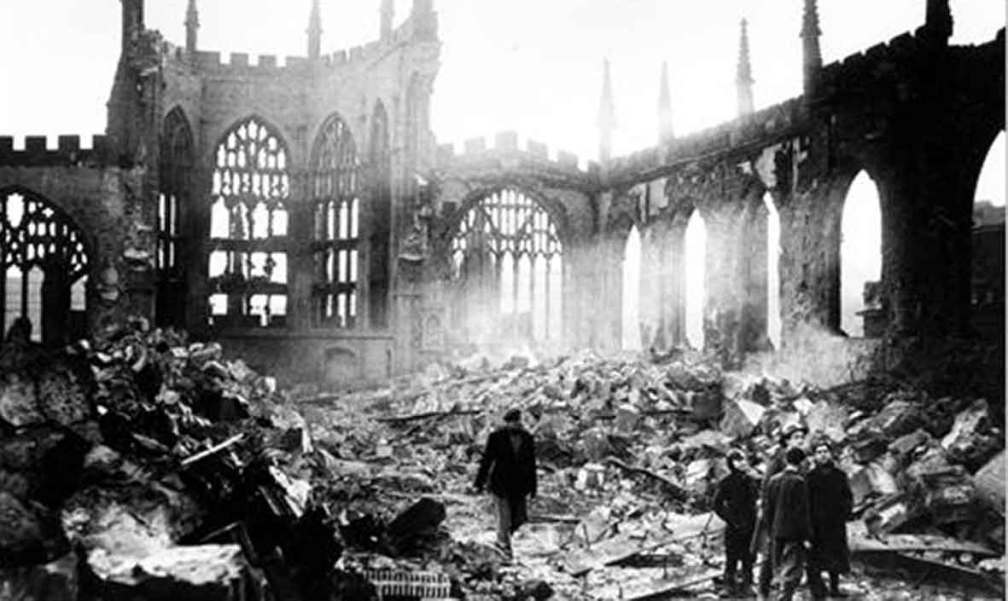
The War Requiem was commissioned for the reconsecration of Coventry Cathedral, a fourteenth-century church destroyed by German bombs in 1940. Given no other brief, Britten was allowed the freedom to tell such a story as he wished through his music, and the result was a monumental, moving and epic ode to the dead and the fallen in war. Britten paired the traditional Latin Mass for the Dead, sung by choir and soprano, with the heart-wrenching poetry of Wilfred Owen, performed by tenor and baritone.

The Requiem begins with the discord of the tritone – the two most musically distant notes in Western music – whispered in by the main orchestra and choir. This is a musical theme that forms the foundation of the entire work, its dissonance and subsequent resolution a parallel for the horror of war and the final peace of death. In the opening Requiem Aeternam, the full orchestra and choir, along with the second orchestra and soloists, and the organ and boys’ choir, are juxtaposed against each other, but never sound together. In fact, the separation of these elements within the Requiem persists until the closing of the whole work, with the entirety of the massive orchestral body coming together for the In Paradisum, before dissolving into a final Requiem Aeternam, and Britten’s own touch – the final words of the Requiem, sung to the same terrible discord as the opening, and resolving only to a perfect chord on the last note, are Requiescant in Pace – Rest in Peace.

Throughout the work, we are taken on a trip of sadness, horror, rage and joy, with the monumental climax of the Libera Me shuddering the very foundations of the church in which it was first performed. Yet by far the most chilling, shivering and touching aspect of the War Requiem is the poetry of Wilfred Owen, interspersed between the major sections of the Requiem and accompanied by the sparseness of a chamber orchestra:

What passing-bells for these who die as cattle?

Only the monstrous anger of the guns.

Only the stuttering rifles’ rapid rattle

Can patter out their hasty orisons.

No mockeries now for them; no prayers nor bells;

Nor any voice of mourning save the choirs, –

The shrill, demented choirs of wailing shells;

And bugles calling for them from sad shires.

What candles may be held to speed them all?

Not in the hands of boys but in their eyes

Shall shine the holy glimmers of goodbyes.

The pallor of girls’ brows shall be their pall;

Their flowers the tenderness of patient minds

And each slow dusk a drawing-down of blinds.

Anthem for Doomed Youth – Wilfred Owen, 1917

Thought of the Week: The Right and Wrong of Revising Your Writing

First of all, I had considered titling this The Wright and Wrong of Wrevising Your Writing, but it seemed a little too kitsch. What do you think?

Secondly, I have no intention of defining right and wrong. I’m not that daft.

Johannes Brahms (1833-1897) is one of my favorite composers. His four symphonies are of course the best known of his works, the first in particular, opening with its dramatic C minor chords and booming timpani, inspiring pathos and doom in all their forms. However, far more than these massive works I prefer his chamber music, and in particular his works for piano and strings. In his life, Brahms wrote three piano trios, three piano quartets, and one piano quintet. That we know of.

His first piano trio, in B, is one of the most beautiful pieces of music I’ve ever heard, and is a constant player for me. The opening theme is serene and grand, and simply leads onward from there. The scherzo is tense and jittery, with the third movement being the sound of utter beauty. The finale, with its ambiguous tonality, draws on the agitation of the scherzo but adds in a extra melodic element to it.

Here’s the thing: it isn’t what he originally wrote. The piano trio was written and published in 1954, when Brahms was twenty-one. The piano trio we hear and listen to today was written and published in 1891, when he was fifty-eight, and it is almost completely different. In fact, it’s unique that we even know of the two versions, because Brahms spent his entire life revising and rewriting his works, never satisfied with the results. The tragedy of this was that, upon completion of his revision, Brahms would burn the original manuscript, leaving us with no trace of the process of his genius.

This is a shame, for having heard both versions, I actually find myself preferring the simpler innocence of twenty-one-year-old Brahms to his more mature and darker fifty-eight-year old self. I am given to wonder what the first editions of his other works might have been like. Sometimes there is a charm and quality in the passion of the first draft – Black Sabbath’s debut album, recorded on an eight track for £500, is a masterpiece.

My son makes up stories. Mostly in his head at the moment, but he enjoys it. Recently he started inventing back stories for the bounty hunters in Star Wars, which I thought was pretty cool, and not something I had given much thought to. When we discussed it, we realized that a particular detail of his invention couldn’t possibly have happened, because Boba Fett ended up alone on Jabba’s skiff over the Pit of Sarlaac, and so couldn’t have been involved in a smuggler’s ring previously. At first he disagreed with me, and I let him have his way. But a few hours later, he came to me and asked, “Dad…is it okay if I change the history I made up about the Star Wars bounty hunters?”

I thought this was incredibly insightful; having only just invented this history hours before, there was already a danger to him of changing that history – as though it would be telling a lie. If we decided to change our minds and say that it was actually Buzz Aldrin that first walked on the moon, there would be an outcry. “Lynch them!” people would cry. And they would be right.

But then what of fictional history? The natural answer would be, of course you can change it – it was made up in the first place! But look at what happened when George Lucas changed the history of Star Wars, with his revisions of Episodes IV, V and VI, and the release of Episodes I, II and III. Some of the scenery in the original movies was entirely changed. Whole scenes were added, which again changed the meaning of some of the story. Han Solo fired first! In the later films, we learn details that very nearly contradict the original movies entirely, and people have had to greatly stretch the meaning of some of the character’s dialogue in order for it to all fit. And look at what poor George got for his efforts.

So where does that leave us? As a fiction writer, you’ll often find yourself modifying some of your back story so that it makes more sense in the context of the main plot. Heaven knows, half of what I created in the Appendices of The Redemption of Erâth has already been flatly contradicted by the story I’m now writing. And I can’t imagine anyone would question me for that.

So when does it stop being okay to change your story’s history, or even the story itself? I’m sure J.K. Rowling wasn’t 100% happy with every word she wrote; even I can see some passages that leave something to be desired. But would we let her rewrite the book? Is it merely when the book becomes published that we lose the right to change it? Isn’t still in its essential nature our work? Why shouldn’t we be able to change it as we see fit?

I don’t have an answer to this; Brahms got away with it, and George Lucas didn’t. Peter Jackson felt the need to turn the ten hours running time of The Lord of the Rings trilogy into fifteen hours, and most people are okay with that (though not, perhaps, with watching it all). It seems funny how the public become so possessive of another person’s work – as though we owe it to them to stand by the work we created. Is this fair?

Let me know what you think in the comments!

Satis