The Redemption of Erâth: History of Erâth – Geography of Erâth

As noted in the Overview, Erâth is a flat world. The origins of this are a mystery; certainly this does not fit the laws of the Universe in which we live, but it is clear Erâth does not exist in quite the same lifespace. In finite terms, Erâth spans approximately 3,000 leagues in an East-West direction, and slightly more than 2,000 North-South. Most places in Erâth are of temperate climate, with cold winters and warm summers, rainfall and leaf-fall in Spring and Autumn.

Erâth’s surface is made of six major land masses, with one, large, interconnected sea separating them all. There is also one very small island in the northernmost part of Erâth, no more than 200 leagues East to West, unique in that it does not appear to have originated from any of the larger land masses.

These seven land masses form the seven regions of Erâth, and are Golgor, Naruun, Faerün, Cathaï, Thaeìn, Aélûr, and Oríthiae. The names of these lands are one of the few remnants of the Ancients; as long as there have been men in Erâth, so have the seven lands been named. However, they have not always been as they are

[…]

Read the complete section here.

Tales of Despair: The Suffering of Artists

This is a slightly different take on Tales of Despair this week; rather than focusing on a particular artist, I want to address the nature of despair and depression in art – why is it that darkness forms such a large part of the things we create? What is it that drives the most wonderful among us to the brink of despair?

There was once a young boy who grew up in an idyllic family environment; a boy who enjoyed life and love to paint and draw. And then, when he was only seven years old, his parents divorced. No one spoke to him about it. No one asked him how he felt. His father promised not to remarry, and did. He had another child, and the boy felt replaced. His mother remarried, and was beaten, and abused, and hospitalized. The boy watched each time. The adults, they didn’t see him. They didn’t care.

He continued to draw, and to paint. His work grew dark. He learned to play, and his music was dark. He took drugs, and it took his mind away, and relived the pain for a short moment.

And when he left his home, he avoided people; he made few friends, and they shared his misery. Some of them played too, and they began to play together. Out of the depths of depression, the music they made lifted him; he wrote about his pain, and he sang it to the world. And the world – they drank it deeply, and said he was a great artist. They said he was the voice of a generation; they said he would change the world.

And he didn’t care for what they said. Each word of praise demeaned his writing, abused his art. His music hated the world, and they were too dumb to see it. And he lost the joy his music brought him, and he began to despair. He sank, and was consumed by the black, and knew the world, for him, was ended. One April day, he locked himself away, and killed himself.

He was twenty-seven, and his name was Kurt.

His death was untimely, and it is accepted as a tragedy. Yet it is a tale that is told, over and over again, throughout history and the world of creators.

We suffer, we despair, and the rest of the world asks, why? Of course, the rest of us understand it all too well; insight grants us the pain of doubt, the fear of rejection, the knowledge that all goodness comes to an end.

Yet, why is it that so many of us, so many of those who create, are so afflicted? Hands up if your are a happy artist. In this imaginary crowd, you may well be in the minority. Is it intrinsic, or wrought by outside influence? Do we create because we despair, or do we despair of our creations?

Perhaps it is some of both. When I write, I am lifted, as Kurt was, to a higher plane, a place where words and music float and flow, and the terrible visions in my mind find their way to paper and into sound in the air, and I am relieved of their pain. But when I come down, I look upon my creations, and I am filled with loathing: they are ignorant, they are plagiarism, they lack all subtlety, and are but a poor shadow of the great.

Perhaps the need to create is driven by the hopeless desire to express the inexpressible – how could anyone understand the absolute certainty that the things we create, that bring such value to so many, are inherently worthless? How could anyone understand what it’s like to be consumed by blackness, until your very vision is tinted and the world turns to grey? There are no words, no colors, no sounds that can explain how no bodily wound can equal the agony of a mind turned upon itself.

And yet we persist, we continue to try. We paint with blacks and reds; we write with heavy words that drag down the soul; we play in minor keys and descending notes, recreating the descent into the final, endless darkness.

And eventually, we may join the Kurts, the Vincents, the Ernests and the Sylvias and Virginias; and how could anyone understand the comfort of knowing that, in a world that is chaos and destruction and uncontrollable evil, we have at least the power to bring about our own ending.

We are doomed to create, and doomed to suffer; may we be at least also be doomed to see the beauty in the work of our fellow creators, if never in our own.
Thought of the Week: The Energy Barrier

One of the things that used to afflict me terribly in my days of depression was the utter inability to find the energy to actually do anything. The very thought of even the simplest of tasks – getting up out of bed, or brushing my teeth, was more than I could bear.

As my depression mutated, evolved, and turned into a variety of other, yet-undefined mental disturbances, this has stayed with me. It isn’t always the case, of course – hell, I wrote a damn book; something got me going with it! But there are things I simply can’t stand doing, and when faced with them, I build up a mental resistance to even the thought of it, and it becomes impossible to get it done.

Do you have any idea how dry our grass is right now? And the sprinkler is sitting by the back steps, right next to the hose!

Gargh.

I remember, many years ago, my father explaining something to me. It was a rare instance of empathy, a point where, inexplicably, he actually said something that made sense to me. Maybe it was a fluke.

He said that, in the process of thinking about activity, there is a mental energy barrier. The nutshell version is that it requires far more energy to convince yourself to do something than it actually takes to do it. And it’s true; four days of dread, of procrastination and excuses…and in the end, the garbage was taken out in about thirty-six seconds.

All right, I didn’t actually time it. It might have been longer – after all, I had to take it all the way from the kitchen through the back door (in the kitchen) to the garage (next to the kitchen).

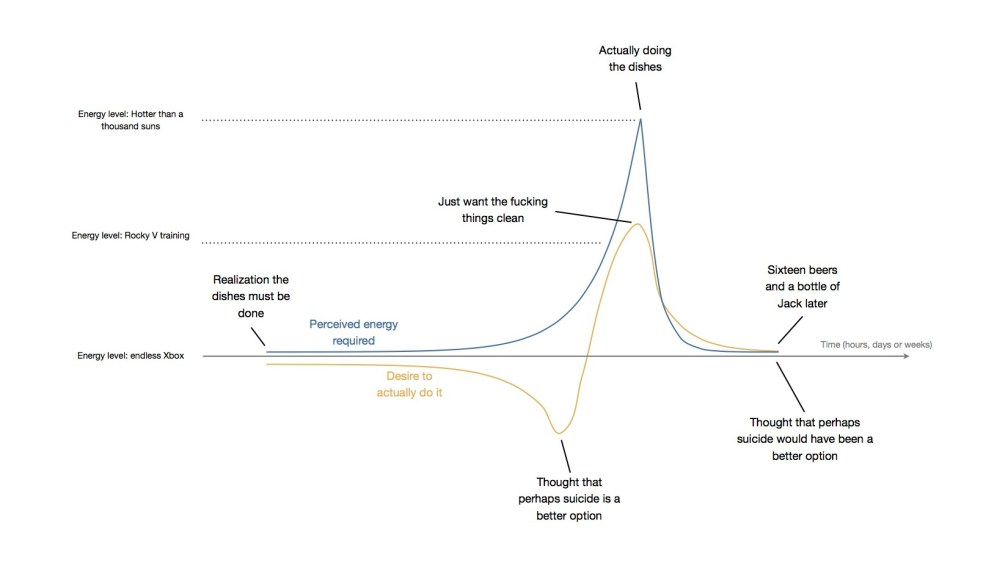
My worst vice here is doing the dishes. Here is a graph of what it takes to do them; hit ‘Like’ if you know what this feels like! Oh, and bonus points if you can spot the Iron Maiden reference.

I’ve timed myself: it has never taken me more than fifteen minutes of my life to do the dishes. Maybe twenty if I include scrubbing the stove down. Yet it is the one thing I dread more than any other in my daily life. Having to chase and swat the hornet in the bedroom doesn’t even come close. Sometimes it gets to the point of a full-blown panic attack, and images of sporks and plastic cups, festering with mould and rising up against me, fill my mind.

And that damned energy barrier is to blame. Look at it: I think there’s a point just before the peak where my head has actually exploded, and the brain bits are dancing on the walls singing the song about pure imagination from Charlie and the Chocolate Factory (please don’t ask why).

Sadly, I don’t have a satisfying conclusion to this post. I still haven’t figured out a way around this, and I still have dirty dishes hanging around in the morning, like the party guests who got too hammered to drive home. They’re a bit of an embarrassment.

I’m reminded of Einstein’s theory of relativity, and the thought that as an object approaches the speed of light, the energy required to do so approaches infinity.

I desperately need a wormhole. Or maybe a house elf.