
Thought of the Week: Vanilla Water

Some time ago, I set up to brew coffee in our filter coffee maker. I put a splash of vanilla in the bottom of the carafe, because that’s what we do, and I set it going. When the carafe began to fill with an extremely pale, yellowish water, I realized I had forgotten a rather important ingredient.

Another time, I thought I’d be clever and set the coffee maker up the night before, so that it would be fresh and waiting to go when we woke up. I filled it up, put the coffee in because I’d learned from my mistake, set the timer, and went to bed. I woke up in the morning to find the kitchen floor flooded with water; I had forgotten to close the lid on the coffee maker.

These are the things I deal with on a daily basis (though I doubt I’m alone). Tonight I couldn’t remember if I had taken my medication this morning, so I took a double dose. The other night I took out the garbage and forgot to leave the door unlocked; I nearly broke my leg trying to climb in through a second-storey window. I’ve also forgotten all the witty things I was going to write in this post.

You see, this topic has come up because I realized the other day that I’d forgotten to post a thought of the week last week (I had to write down that I wanted to write about this in case I forgot). I forget an awful lot of things, both minor and major. I often forget where I left my glasses, or my iPhone (thank goodness for Find My iPhone). Probably the worst thing I ever forgot was Valentine’s Day (I don’t dare forget my wife’s birthday – I have approximately sixteen reminders for this). I’ve even forgotten my son was in the back of the car and drove him to work instead of school.

I read an interesting publication a while back on the nature of forgetfulness. Apparently, walking through doors can affect this greatly. I can’t remember the number of times I’ve gone into a different room and had no idea what I went in there for (I’m trying not to think too hard about that sentence). In the study, they had participants play a simple computer game where they looked at an object in a room, then walked away from the object and were asked to recall what it was. They discovered that significantly fewer participants who walked through a doorway could recall it compared to those who didn’t leave the room, even if they walked a comparable distance away.

Similar studies have shown that memories are often grossly distorted from the actual reality of the event. One example had different subjects taste – or not taste – a piece of chocolate. Some of them were simply given the chocolate; others were told beforehand how wonderful and delicious the chocolate was going to be. Some time later, they were asked to describe the taste; those to whom the taste was described recalled the taste far better – even those who had never tasted it!

These occurrences are so frequent for me that I am becoming increasingly concerned, often to the point of doubting my own thoughts and and considerations. Things I adamantly remember – clearly, vividly, blow by blow – turn out to have never happened. I recall conversations with my wife that never took place, and forget the ones that did.

These two aspects of failing memory – false and absent recall – make me worried for my own sanity. I am already disposed of an ill mind, and these symptoms seem only to reinforce my maladies. Even now, as I have begun to reread my book for editing, I have come across entire passages I don’t recall writing.

So what am I to do? I have tried many memory aids – pieces of string, notes, reminders; often, though, by the time I find pen and paper, I have already forgotten what I intended to write. I don’t remember what the string was for. A date pops up in my calendar, and I can’t remember why. I realize this must seem mundane – perhaps normal, even – but I worry that my memory will continue to degenerate, and I will soon be unable to remember even the simplest of things. Early-onset Alzheimer’s, perhaps?

Tell me – what do you think? Leave your thoughts in the comments; I just hope I remember them.

Thought of the Week: Dinotopia

As a child, I loved to read; perhaps even more then than now. Even at a young age, my obsessive nature was evident: I was incessantly hooked on vast series, reading one after another after another. I believe I read nearly every Hardy Boys book that has ever been written; a guilty pleasure (even now) were Star Trek novels, from all four series (yes, four; I refuse to acknowledge Star Trek: Enterprise as viable Star Trek material).

But sometimes, here and there, I would come across books of a different breed: books that were, in their very essence, magical. Books that engaged my young mind, books that opened my eyes to the realities and fantasies of many other worlds, and many other lives. Some of these I have spoken of  already in these pages; books like Jonathan Livingston Seagull, The Trumpet of the Swan, Goodnight, Mr. Tom, and even a little book called The Whipping Boy. These were tales of inspiration, tales of darkness, of danger and excitement, filled with emotion and sharp characters. They encouraged beautiful visions in my mind, and fueled my imagination.

However, there was one book, one I discovered quite a bit later, that stood out apart from any other tale I had ever read. A book that, to this day, I read with reverence and awe. That book is Dinotopia.

What an utterly beautiful cover.

Dinotopia is a tale of shipwreck, mystery and lost worlds. Arthur Denison, and his young son Will, find themselves cast upon an uncharted island when their ship is brought down during a terrible storm. In their immediate quest for food and survival, they begin to happen upon very odd, strange things: creatures, like giant lizards, of an era long-extinct.

To their further astonishment, they discover that, living in harmony beside these ancient creatures is a great civilization of humans, men and women who are able even to communicate with the beasts.

Arthur, being a scientist, begins in ernest to interact and document all he can on this astonishing and impossible island. His son, however, is much more taken by the folk of Dinotopia, and begins rapidly to become one with the men and women of the lost world.

As time goes on, Will befriends humans and dinosaurs alike, and even becomes one of an elite troop of skybax riders, flying in symbiosis with the free-soaring flighted dinosaurs of the island.

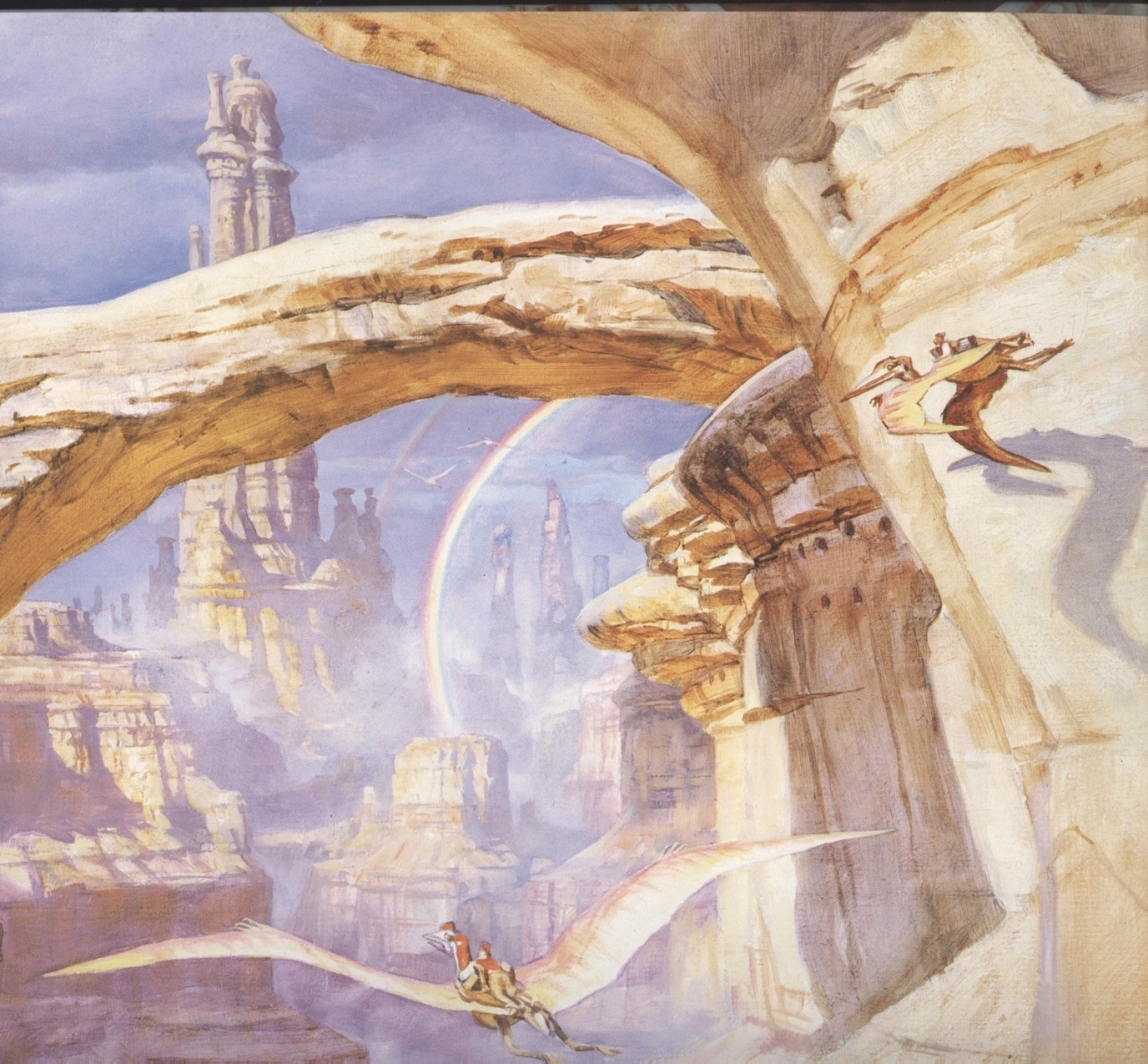
However, whilst the tale itself is indeed wondrous, far more astonishing – breathtaking, even – are the incredibly detailed and vivid illustrations that fill each page of the book, bringing to the utmost life the world of Dinotopia. James Gurney, who both wrote and illustrated the book, is certainly one of the most talented artists of our time. The striking watercolors that fill the book depict the majesty and grandeur of the civilizations of the land in astonishing and graphic detail. From the simple homes of the small villages to the sweeping beauty of the landscapes and the glorious cities that mark the centers of culture and learning, every place of this world is realized, leaving the reader breathless as they read the words that are as beautiful as the art that accompanies them.

Eventually, James went on to create several sequels to the first book, which later became known as A Land Apart from Time. However, none of them manage to quite live up to the splendor of that first, groundbreaking and inimitable style of the first book, Dinotopia.

The Forbidden Mountains.

The soaring heights and fathomless gorges of the Skybax’s domain.

The first sight we have of Waterfall City is by far my favorite illustration of the whole book. I could stare at this painting for hours, so vivid and beautiful.

Thought of the Week: Creepy Photoshop

The importance of cover artwork is gradually being lost, in an age where a song is an intangible entity on a twirling magnetic disk, and books are nothing more than illuminated words on a glass screen. Why would we care about a beautiful painting or sketch, when it is rendered in a two-by-two inch square on a device that rarely leaves our pocket?

Type O Negative – Bloody Kisses (1993)

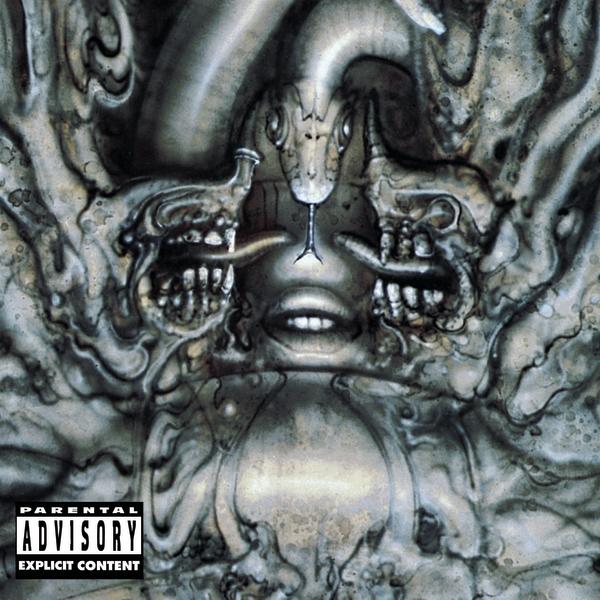
There was a time when you picked the thing you wanted by the way its artwork looked; countless favorite albums of mine came simply by having seen their cover – when I saw Type O Negative‘s cover for Bloody Kisses, I simply knew I had to have it. The same was true for Danzig‘s How the Gods Kill, with its incredible, grotesque and frankly disturbing artwork by none other than H. R. Giger (he of Alien fame).

And the same, once, was true of books. At the risk of upsetting the age-old maxim, a book’s cover has a lot to say for its contents, even if it is nothing more than a gesture. The leather-bound, gold-pressed edition of Oliver Twist on my father’s imposing bookshelf sent the clear message that this was an IMPORTANT book, and was therefore very BORING. When I later discovered a copy with a lovely, friendly picture of the rascally little orphan, I devoured it.

Danzig – How the Gods Kill (1992)

However, if ever there was a loss of cover artwork, it is in the realm of computer software. Long-passed are the days of buying software in a box on a shelf in a big, cold, unfriendly store, driving home, sticking the disc (or floppy, or what-have-you) into the computer, and muddling your way through incomprehensible Read-Me files and instructions before realizing that you only got the Lite version, and what you really needed was the Ultimate Pro Bonus Pack 7 (with X9 Speed-Upgrade) version. Back in the day, some software simply was mandatory, and the rest tried to sell itself on the merits of what the other stuff didn’t have.

Now, we get our computer’s capabilities from a plethora of online sources. I personally download virtually all of my applications now through the Mac App Store; it is clean, friendly, and easy to navigate. However, the artwork has been reduced to its most elemental function: an icon, a hundred pixels to a side, doing its very best to try and give us some vague notion of what the application actually does.

And in this world of instant access, many of the heavyweights of boxed software are finding themselves suddenly challenged by the newcomers. Google Docs and Open Office are taking the place of Microsoft Office in many businesses and homes; photo-editing apps such as Pixelmator and Picasa are making people question why they would spend $700 on Photoshop.

With this overwhelming choice upon consumers, the big names must step up, and convince us that their products are still worth buying. A part of this, naturally, begins with the cover artwork. If you are still going to be selling your stuff in a box, you need to make that box as appealing as possible. It ought to call out that this is a friendly product, that you’re going to feel right at home with it, like a brother or a sister or a friendly neighbor. Something that would inspire you to create new, colorful, vibrant and beautiful works of art.

Something like this?