Thought of the Week: Return to the Fold

Wow. It’s been almost a month since I last wrote a post on here, and it feels like forever. Luckily for you I had some prescheduled posts for you to read, but last week was pretty much a blank, and I apologize for that. I was kind of off my head when I got back from my three-week work training, and it’s taken me a while to reacclimatize to normal life. I’ve been on and off between depression and lethargy (actually I suppose those two kind of go hand in hand, don’t they), and I certainly couldn’t bring myself to do any writing. Even the Daily Photos stopped, and I do have some lovely pictures to share with you all.

However, it’s not all doom and gloom – I’m back, and I’m recommitting to my writing, here and elsewhere. I have some interesting things to say, and some serious hard work in front of me, and the only way I’m going to get through it is by going one day at a time.

The first thing I need to let you all know is that for the foreseeable future all work on The Redemption of Erâth: Exile and A Gothic Symphony is going to stop. The reason for this is that I finally got my manuscript back from the editor, and while there was a lot of positive feedback, there’s also a lot to work on, including some rather major restructuring. I’m going to need to dive deep into the guts of the story and bring out some key characters in a way that I’d not done before, turn a few things on their heads, chop out some other stuff, and give it an overhaul. The good news is that I’ve got a good plan going now, and there are some chapters that are going to work more or less the way they are anyway.

I plan to post a more detailed overview of the comments and feedback from my editor – I’d love to hear what you think of them, especially if you’re already familiar with Brandyé’s story in the lands of Consolation. For now, I’ll leave you with this: The Redemption of Erâth: Consolation is not going to be ready by Christmas (which I had rather hoped it would be), but it will be coming in the new year. This book has been in the works now for over two years, and I want it to be as perfect as it can be. I hope you can bear with me while I work through these final revisions (and they are final – I’m going through the book one more damn time, and that’s it!), and look forward to being able to hold this book in your hands next year.

Lastly, thank you for all your incredible support – all 2,000+ of you. None of this would have happened without the the feedback and positivity I’ve received from so many of you.

Thank you!

Featured image from http://serc.carleton.edu/sp/library/writing_assignments/index.html.

Satis Logo with ©

Thought of the Week: The Role of the Fantasy Sword

When I first began delving into the world of fantasy, a quest that would eventually lead to the world of Erâth, Brandyé Dui-Erâth and his journey into darkness, I came across a number of articles outlining common themes throughout fantasy literature. At first, of course, I thought I had to adhere to these commandments, laid down by the god of fantasy, J.R.R. Tolkien. As time, and the novel, progressed, however, I began to realize the value of originality, and discovered certain aspects that deviated from the tried and true classical form of fantasy. One key element was that I came to realize there were no true ‘heroes’ in my story. The protagonist, Brandyé, is weak, both physically and emotionally, preyed upon by both beasts and darkness. There are no master figures, no Aragorns or Gandalfs to save the day. There are people with kind hearts that nonetheless do cruel things.

The metaphor is (I hope) different as well. Whereas Tolkien’s darkness was (in my mind) a metaphor for the dismal horrors of war, for me it holds a much more personal facet: it is the great, all-consuming and unsurmountable darkness of depression and despair. The world is already covered in darkness; the forces of good have already lost. Our hero has no conviction, and despairs that he can ever do good in his life.

However, there are still many elements that fit neatly the stereotype of high fantasy, such as a dark lord, fictional worlds and languages, a quest to defeat said dark lord, kingdoms great and small, etc. And one of the elements preserved, though I didn’t know it at the time, was the fantasy sword.

Narsil

The Shards of Narsil

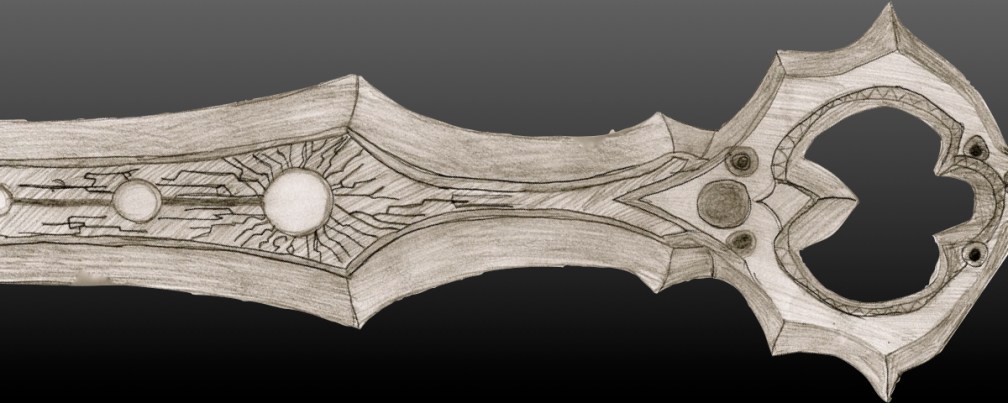
Nearly every high fantasy story I can think of (though I’m not as widely read as I should be) has swords, which is natural for a genre that tends to romanticize the middle ages. But more than that, there is usually at least one sword, if not several, that has a merit beyond its ability to kill. These swords have a history, their forging is legendary, their uses are magical, and in the right hands they are undefeatable. The Lord of the Rings has NarsilElric has StormbringerHarry Potter has the Sword of Griffindor, although I would argue that the wands represent the same functional place as these others. The Redemption of Erâth has Namrâth.

It’s hard to deny that these swords are an integral part of such fantasy, but it became curious to me that it should be so. Certainly swords are necessary if the story is to contain fighting of any kind, and it would be poor fantasy indeed if there were not epic battles involved. But the question remains precisely why it is so important that there be at least one sword with mystical origins and powers.

I have one or two thoughts on the matter, which may or may not be way off the mark. Wikipedia has a fantastic list of famous fantasy swords, and one of the first things I noticed is that, with the exception of J.K. Rowling, every author who has invented such a sword (including myself) is a man. Cue the obvious sexual innuendos. High fantasy rarely has sexual content of any kind, and even romance is often sidelined (the relationship between Aragorn and Arwen in The Lord of the Rings is hardly touched upon in the book, as opposed to Peter Jackson’s film versions). And it’s easy to see how a great, whopping sword could be seen as a phallic symbol. (Interesting, then, that Rowling’s wands are so small!) These swords are themselves almost invariably wielded by men, and represent their great strength and prowess. It’s certainly possible that, consciously or unconsciously, these magical swords represent the manliness of their bearers.

A magical mace?

A magical mace?

Another, more mundane explanation could be that there have to be mystical swords. After all, what fun would it be if the great demon lord was defeated by any old blade kicking around on the battlefield? Great, magical beings require great, magical weapons, and the sword is the natural weapon of choice. (Brandyé, in The Redemption of Erâth, actually carries a crossbow for the majority of the first book.) But why not magical maces, or whips (Indiana Jones, I suppose), or daggers? Perhaps because there is something clean about a sword, that it can effortlessly stab, slice and decapitate with little or no mess. A great spiked mace is a pretty messy weapon, it has to be said, and high fantasy is, along with being romance-less, usually pretty bloodless.

Finally, the thought that comes to me is that the magical sword represents power greater than the wielder can manage; the metaphor of runaway technology leading to the wars in which they are actually used. Elric’s Stormbringer, sucking the souls of any it touches, is exemplary of this: the sword is a curse to its wielder, who becomes ever more bound to it the more he uses it.

Perhaps there is another, socio-psychological answer to this pondering question; if so, I am too blind to see it. Perhaps the fantasy sword just is, no questions asked. But I’d like to turn this over to you: what do you think the purpose of these fantastical swords is?

Featured image taken from http://www.deviantart.com/morelikethis/artists/274055104?view_mode=2.

Satis Logo with ©

Thought of the Week: Snooze

I hate inspiration in the same way I hate money: it’s constantly eluding me. That little beast, dancing just out of reach and taunting me with clues that fail to develop, is one of the most frustrating things in existence.

Of course, I can’t say I never have inspiration; after all, I managed (somehow) to write a book, half of another, and half of a third (does that make two books total?). But for the most part, it’s just not there. Just…not…there…

Or is it?

You see, I read recently a passing comment that inspiration often comes when the mind is allowed to wander, such as those moments between waking and sleeping. It’s a time when your brain starts to meander off course, taking the unbeaten track to places that make little or no sense, yet with the presence of mind still to remember it…maybe. The danger of this approach, clearly, is in actually falling asleep, because then the wanderings turn to dreams, which are inherently unmemorable.

And I can certainly attest to this. Though indistinct, I can clearly recall many, many occasions just before falling asleep (or sometimes, on those rare occasions I get to sleep in, just before waking up) when I start thinking about my writing, or my music, and suddenly something just makes so much sense that I want to jump up and scream and write it all down. Most of the time, however, I just fall asleep.

Occasionally a dream will be vivid enough to remember even after waking, if only for a little while; the seed of a novella I’d like to one day work on came from such a thing. Even the title came from the dream: The Girl Who Killed Herself in Apartment 615. Yes, it’s pretty morbid.

However, there is one source of inspiration that works more often than not, and that’s the daytime snooze. Some people refer to it as power napping, and the great thing about it is that you don’t quite fall asleep; your mind is in a constant state of drift. The realization of what happens at the end of The Redemption of Erâth: Exile (that’s book two) came from such a place. So did the knowledge of what exactly happened to Amy in her formative years in A Gothic Symphony. It’s a wonderful place to be – a world of disconnection where the oddest things suddenly make sense of themselves, and every so often blast their way to the front of your head so that you remember them.

And of course, the very best part of all of this is that – heh heh – I have an excuse to sleep during the day. Of course, the real reason is because it helps to avoid doing anything else, but the secondary benefits are rewarding. Inspiration, that elusive fiend, can’t escape my snoozes.

Ironically, the inspiration for this post came from thinking about how little inspiration I see to have. So that works, too.

Featured image from http://documentaryden.com/the-light-bulb-conspiracy/.

Satis Logo with ©