Thought of the Week: Depression Is…

It’s been quite some time since I’ve turned my hand to poetry, but since I’ve been writing such a voracious amount of prose lately, it felt about the right time. I make no promises for its quality, but maybe it’ll ring true with one or two of you.


~


Depression Is…


Night time vision on a sunlit day

The inability to accept proof of reality

Feeling your stomach churn at the sight of happiness

Knowing you’ll die alone

~

Incapacity

Sleeping all day when there are things to do

Writing furiously and loathing the outcome

Knowing your life is worthless

~

Scars on an arm that you hide from everyone

Wanting to drown in black memory

The past being ever better than the present

Knowing there is nothing yet to come

~

Going to work every day, not knowing why

Coming home to mess, and anger, and disappointment

Wanting to forget everything and everyone

Knowing there is no escape…no hope

~

Featured image from: http://www.midnight-artwork.com/?attachment_id=237.

~

Satis Logo 2014

Thought of the Week: It’s Done

Yesterday, April 27, at about 11:01 PM, I wrote the following words:


And then, as his mind began to collapse inward upon itself, he thought he could see something far, far in the distance. A tall, black figure approached, and as Brandyé gave in to madness and death, it spoke.


Ironically, they don’t seem all that special to me anymore, although perhaps that’s the exhaustion speaking: these words are the last of the book The Redemption of Erâth: Exile.

What do you think for closing words?

This book was a grueling process, having started in January 2013 and surviving a devastating depression during the winter, but it’s now finally, finally done. Or at least, the first draft is (argh!). Whereas The Redemption of Erâth: Consolation was written in a period of about six months, Exile has taken almost a year and a half. Part of this is that it’s longer; with 6,000-word chapters I just couldn’t keep to the commitment of writing a chapter a week as I had done with the first book. The grand total?

  • 25 chapters
  • 476 pages
  • 143,900 words
  • 3 fictional languages
  • several dozen named characters
  • 1 nearly-broken mind

I had a goal of 5,000 words per chapter, and the vast majority eclipse that greatly, with the longest clocking in at 6,863 words. I didn’t intend for it to grow so much – it kind of just happened. It might pose a publishing difficulty; currently my publisher wants The Redemption of Erâth: Consolation to be under 100,000 words; I don’t see how I could possibly cut ⅓ of the entire manuscript for Exile.

In any case, the book is finished for now, and I’m going to be taking a bit of a rest from writing, I think. I will be posting the final chapter momentarily, and if you’d like a brief synopsis, see below.

Thank you all, for your support!


Satis 2014


~


The Redemption of Erâth: Exile

Brandyé finds himself wandering the desolate lands by the black sea, cast out from his home land of Consolation and forbidden to ever return. Haunted by the ghosts of the past, he is at first delighted to discover that there are folk who live out in the wilderness beyond Consolation – until he becomes their slave. For several years he labors under the harsh lordship of the Cosari, finally finding a home with a kinder master.

Before long, the warlike Cosari take Brandyé on a raid of the shore land, where a terrible storm and dreadful events cast him alone upon the shore. Seizing the opportunity, he sets out into the unknown forests – only to find unexpected company, and long-lost friends. Overjoyed to be reunited with his childhood friend, Elven, the two friends set out on a journey through the woods of the Trestaé Mountains, to uncertain destinations.

Along the way they encounter danger and disaster, and are rescued from a fate worse than death by one of the most mysterious forces Brandyé has ever encountered: the Illuèn. A race of Light, they hold a special power over Darkness, a force of Erâth that has been plaguing Brandyé since his childhood. Together with the guidance of one of the ancient race, Elỳn, the two friends set out to discover the kingdom of Erârün: one of the last true kingdoms in the world of Erâth.

They soon find themselves in the ancient and vast city if Vira Weitor, where Brandyé enlists in the army at Elỳn’s behest. This duty takes him to the far northern outskirts of the kingdom, where the Grim Watch patrol their borders and keep the forces of Darkness at bay. During a vicious and unprecedented attack, Brandyé flees with the local villagers, finding his way into the mountains of the Reinkrag, and from their to the mountain-dwelling Hochträe – the last men of light in Erâth. He learns of enlightenment and the denouncement of Darkness, but can he find it in his soul to let go of his past? Unable to rest, he sets forth once more, into the cold and eternal snows of the Reinkrag…

Satis Logo 2014

Thought of the Week: Measuring the Lead (Cosmos Question)

Cosmos_spacetime_odyssey_titlecardLittle Satis, Mrs. Satis and I have quite come to enjoy watching Cosmos on Sunday evenings. Despite its often over-sensationalized tone, the show covers some intriguing topics and presents them in a famously easy-to-understand way. However, as with all simplification, sometimes crucial details are missed or skimped, leaving me at least with a deeper yearning for understanding.

Which is hopefully the point of the show.

Last night’s episode told the tale of Clair Cameron Patterson, who pioneered a now-common method of dating rocks to determine the age of the earth. To be fair, it wasn’t his idea but that of his principal investigator, Harrison Brown; yet Brown allowed Patterson to do the work as a PhD student, and kept him on even when uprooting and moving his lab to California, and when Patterson’s experiments seemed to be failing miserably.

The essence of the episode was in fact to showcase how Patterson inadvertently revealed the extent of lead toxicity in the environment around us, and fought for decades afterward to remove lead from paints, petrols and pipes. Because of this, the hardcore science of the experiments was, if not scaled back, not dived into. And it left me with a burning question, which I’ll get to in a moment.


How on earth could this method of comparison work?


You see, to date the earth (or any piece of rock for that matter), one of the primary methods is to measure the amount of uranium in the sample, and compare it to the amount of lead. Why does this help? Because uranium is an unstable radioactive element, which decays into lead over a very long period of time (the half-life of 238U being almost 4.5 billion years). Because this decay occurs at a constant rate, by comparing the amount of uranium to the amount of lead the age of the rock can be calculated.
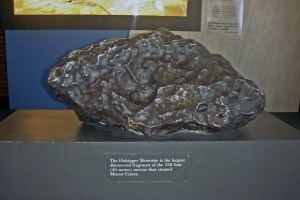
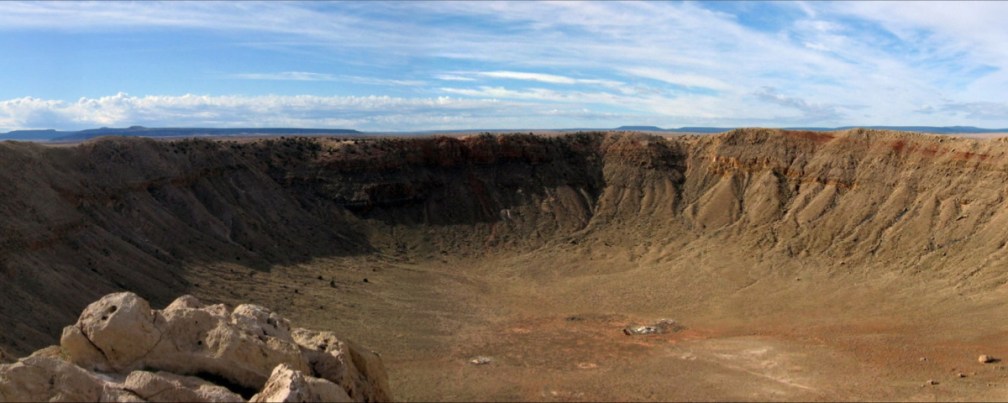
The Holsinger Meteorite, part of what blasted a half mile-wide crater in Arizona.

The Holsinger Meteorite, part of what blasted a half mile-wide crater in Arizona.

From this point, the episode covered the discovery that Patterson’s initial measurements were skewed because of the fact that lead was present in the atmosphere and soil in unnatural quantities, and veered off into the politics of fighting the oil companies who were putting lead in fuel as an “anti-knock” agent. But it left me wondering: how on earth could this method of comparison work?

After all, we can measure the amount of uranium and the amount of lead in a rock as it stands today, but how can we possibly know what proportions existed in that rock three or four billion years ago? After all, lead is as naturally-occuring an element as uranium, so presumably there was lead in primeval igneous rocks as well as uranium. If this was the case, how to tell the difference?

So I had to do a little research, and the answer, as far as I can tell, is this: the key was using zircon crystals. Zircon, it seems, actually rejects lead from its crystalline structure: in other words, zirconium and lead don’t mix. This was presumably known at the time, which meant that the traces of lead that were found in zircon crystals could only be from uranium decay. This implies that when the rock was first formed, there was no lead in it at all. Since the rate of uranium decay is known, then the amount of lead can be directly used to backward-calculate how long it took to form, ergo the age of the rock.

Zirconium crystals, complete with uranium and lead.

Zirconium crystals, complete with uranium and lead.

Now what Patterson did was a little more complex, by comparing different isotopes of lead in a series of meteorite samples, but the principle is the same. The maths involved are a little beyond me at the moment (bringing back that rusty high-school physics!), but as I understand it, it nonetheless depends on the ratio of radiogenic (formed by radioactive decay) and non-radiogenic versions of lead.

What I still don’t understand about this, however, is that presumably meteorite fragments would have been decaying their uranium at the same rate as the earth, and how could we know in an iron meteorite fragment what amount of non-radiogenic lead would have been present 4.5 billion years ago?

Any geophysicists out there that could help me with this one?