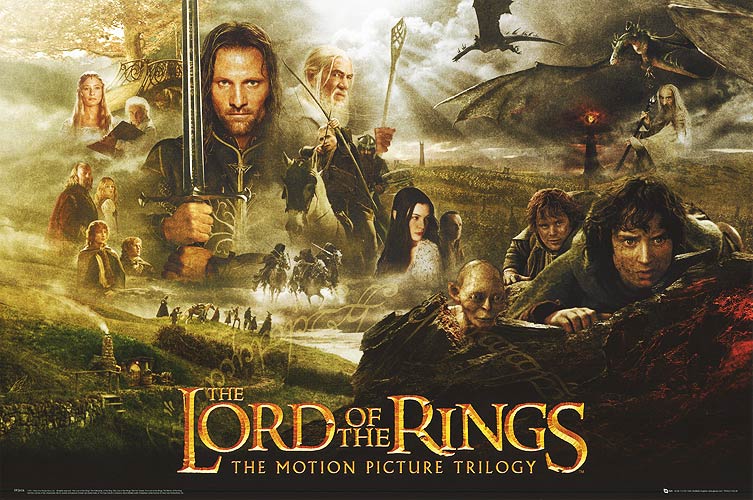
Music I Love: “The Lord of the Rings”, Howard Shore (2001-2003)

In my mind, there is only one lord of film score, and it is John Williams. In terms of prolificacy, variety, emotion and sheer staying power, he is undefeated. So I’m going to talk about the composer that one-upped him.

Howard Shore has been scoring films for quite some time; his first features film was The Brood, back in 1979 (having said that, John Williams started way back in 1958!). He spent the next two decades writing music for many, many notable, famous and oscar-winning films. The FlyThe Silence of the LambsPhiladelphiaCrash and Gangs of New York all bear his haunting melodies. More recently, he has been responsible for Martin Scorcese‘s masterpiece, Hugo, which is one of my favorite films of the past ten years.

But – poor soul – he had never won an Oscar, and I hate to say it, but I can’t remember a melody or tune from any of these movies. Can you? I remember The Silence of the Lambs opening with some eerie piano music, but couldn’t sing the tune back to you at all. In part, of course, these have all been exceptionally serious films, and such movies can rarely sustain a rousing melody. John Williams, with his plethora of forays into fantasy (Jaws, Star Wars, Indiana Jones, Close Encounters of the Third Kind, Superman, E.T. The Extraterrestrial), has had much more freedom in expressing his artistic style.

So if the nature of the film determines the expressiveness of the soundtrack, what would this mean for The Lord of the Rings? Peter Jackson brought a depth to these tales that defied expectation, with sweeping landscapes, battles of epic proportions and an impossible attention to detail; there is more Elvish spoken in the film than appears in all three books. What could Howard possibly write that would not only support this monument, but overshadow the film itself and bridge the gap between the image and the audience?

He delved deep, scoured every mote of his musical training and knowledge, released himself from all constraints: and wrote an opera.

For any of you familiar with the programmatic music of the late 1800s, a movement pioneered by Beethoven sought to tell stories through music. The composer would craft a theme for each part of the tale, and the listener would be expected to follow the story by picking up and recognizing these themes. It was Wagner, however, that created the concept of the leitmotif: a very specific and recognizable melody – a tune, as it were – to represent characters, places and events. These might appear on their own, perhaps at the introduction of a new character; they might appear combined with numerous others, building an entire scene and plot, reinforcing the story told through the opera itself.

Now, the application of this concept to film is hardly new; John Williams achieved this brilliantly in Star Wars, of course. Everyone can recall the opening theme, which is used to represent, most often, Luke Skywalker. But can you also remember the Imperial March? Perhaps the force theme (first heard when Luke is looking out over the twin sunsets of Tatooine)? Each of these memorable motifs recurs throughout the films, brought back not at random, but very deliberately to represent specific elements in the film.

So where did Howard Shore go beyond this? He composed nearly a hundred separate, individual leitmotifs for the film, some of the most recognizable being the Ring (heard over the opening titles), the Shire (heard when we are first introduced to Frodo), the Black Riders (quick, low notes on bassoons), Isengard (heavy, descending thirds in the brass), Mordor (high, chromatic brass), Rohan (wonderful, rustic fiddle) and, most brilliant of all, Gondor: horns, playing in the style of hunter’s horns of days past (heard in the most hair-raising climax, musically, of the entire trilogy, when Gandalf is racing up the seven levels of Minas Tirith, desperately seeking the Lord Denethor).

Howard, however, took his multitudinous leitmotifs, and used them in ingenious and subtle ways, signifying the most important changes and climaxes of the tale. Take, for instance, the theme of the Fellowship – heard in full at that famous scene, used in the trailers, where Gandalf appears over the lip of a rocky hill, as the Fellowship, fresh from Rivendell, set out on their quest. This theme is heard abundantly throughout the first film, often heard in its full orchestration. It is also heard throughout the second and third films as well, but: not in full. The theme of the Fellowship is never heard in its complete, orchestrated version again following the breaking of the Fellowship.

Other instances of this ingenuity are equally noticeable elsewhere; Isengard and Mordor have distinct, but complementary, brass themes. When we are shown scenes involving both Saruman and Sauron, these themes are heard together. The Isengard theme is associated also with the Nazgûl, and these two themes are heard prevalently as the goblin army leaves Minas Morgul under the watch of the Witch King of Angmar.

To me, Howard’s score for The Lord of the Rings represents possibly the finest music ever committed to film, both in its scope, inventiveness and sheer beauty. I feel his heart and his soul poured into this score, and if he never betters it, it will remain his crowning achievement. It is inseparable from the film, and from the tale; I cannot read Tolkien’s passages of Rohan without the theme of the Rohirrim passing through my head.

So watch out, John – you might have the quantity, but here, in this instance, Howard has the quality. I believe I could live the rest of my life and never hear such beauty in a film.
Music I Love: “War Requiem”, Britten (1962)

Benjamin Britten (1913-1976), though a life-long pacifist (he remained a conscientious objector throughout World War II), was nonetheless touched by that war, as were almost all others who lived through that time. Two of his closest friends were killed in combat, and a third, Piers Dunkerley, having survived the storming of the Normandy beaches, killed himself fifteen years later, two months before he was due to be wed. It was with these thoughts, among others, that Britten took to the composing of his War Requiem, which is undoubtedly the crowning achievement of his musical career.

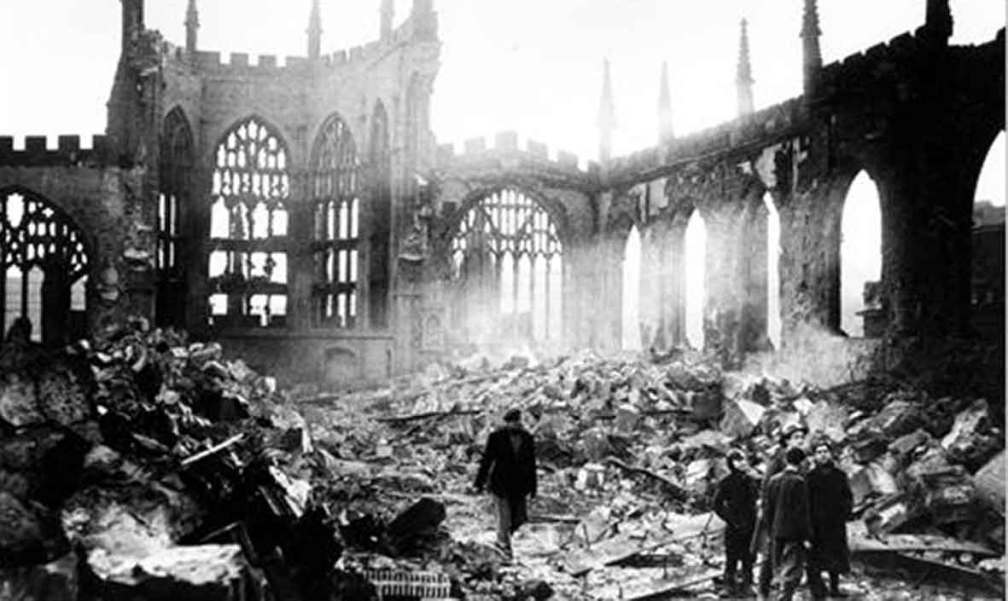
The War Requiem was commissioned for the reconsecration of Coventry Cathedral, a fourteenth-century church destroyed by German bombs in 1940. Given no other brief, Britten was allowed the freedom to tell such a story as he wished through his music, and the result was a monumental, moving and epic ode to the dead and the fallen in war. Britten paired the traditional Latin Mass for the Dead, sung by choir and soprano, with the heart-wrenching poetry of Wilfred Owen, performed by tenor and baritone.

The Requiem begins with the discord of the tritone – the two most musically distant notes in Western music – whispered in by the main orchestra and choir. This is a musical theme that forms the foundation of the entire work, its dissonance and subsequent resolution a parallel for the horror of war and the final peace of death. In the opening Requiem Aeternam, the full orchestra and choir, along with the second orchestra and soloists, and the organ and boys’ choir, are juxtaposed against each other, but never sound together. In fact, the separation of these elements within the Requiem persists until the closing of the whole work, with the entirety of the massive orchestral body coming together for the In Paradisum, before dissolving into a final Requiem Aeternam, and Britten’s own touch – the final words of the Requiem, sung to the same terrible discord as the opening, and resolving only to a perfect chord on the last note, are Requiescant in Pace – Rest in Peace.

Throughout the work, we are taken on a trip of sadness, horror, rage and joy, with the monumental climax of the Libera Me shuddering the very foundations of the church in which it was first performed. Yet by far the most chilling, shivering and touching aspect of the War Requiem is the poetry of Wilfred Owen, interspersed between the major sections of the Requiem and accompanied by the sparseness of a chamber orchestra:

What passing-bells for these who die as cattle?

Only the monstrous anger of the guns.

Only the stuttering rifles’ rapid rattle

Can patter out their hasty orisons.

No mockeries now for them; no prayers nor bells;

Nor any voice of mourning save the choirs, –

The shrill, demented choirs of wailing shells;

And bugles calling for them from sad shires.

What candles may be held to speed them all?

Not in the hands of boys but in their eyes

Shall shine the holy glimmers of goodbyes.

The pallor of girls’ brows shall be their pall;

Their flowers the tenderness of patient minds

And each slow dusk a drawing-down of blinds.

Anthem for Doomed Youth – Wilfred Owen, 1917

Music I Love: “Blackwater Park”, Opeth (2001)

Blackwater Park is the fifth album by Swedish band Opeth, and represents in many ways the pinnacle of their early career. Musically, their style began to vary and diversify greatly after this album, but in many ways, it still represents the perfect place to learn their music, for it forms a bridge – both the culmination of everything they had ever done to that point, and the starting point for every album since.

Opeth began their career as a death metal band in the early 1990’s, releasing their first album, Orchid in 1995. Even here, there was evidence of their trans-genre styles; at a time when death metal was reveling in sonic brutality, Opeth presented a refreshing balance between heavy guitars and beautiful, lullaby-like jazz-inspired acoustic soundscapes. Their second album, Morningrise (1996) pushed further against the genre, including extended sections of jazz improvisation, and finishing with the beautifully sad To Bid You Farewell, a 10-minute ballad with no growls in sight.

While they continued to refine their style over the following two albums (My Arms, Your Hearse and Still Life), it was in 2001, with the release of Blackwater Park, that Opeth genuinely defined their sound. While most bands would have considered this the stopping point, for Opeth it proved merely the jumping-off point – each subsequent album has pushed the boundaries of what defines death metal (and metal in general), with their most recent album, Heritage, shedding all vestiges of their roots, and providing a stunning tribute to the bands of the seventies that had inspired them in the first place.

Blackwater Park opens with a ten-minute track, The Leper Affinity, kicking off the musical journey in a terrifying and exciting manner. Fading in from silence, a massive discord of sound builds to a swell, ever increasing until, with no warning, a shocking and harsh rhythm bursts in, thick chords and fast drumming. Over the top of this, Mikael Åkerfeldt’s guttural and devasting growls push the musical tension forwards until, if possible, the rhythm doubles in speed and moves into the secondary theme. Throughout the exposition, we are treated to a dizzying variety of rapid themes, each building organically from the previous. Then, quite suddenly, the song moves onwards into the development section, taking on the melodies and rhythm of a veritable waltz before, impossibly, giving way to a gorgeous acoustic section, and for the first time we are treated to Åkerfeldt’s stunning singing. Eventually, this leads us further into the development, the heavy guitars kick in again, building to an off-rhythm climax which culminates with a solitary scream leading back into the original opening theme. Just to push the contrast as far as possible, at the tail end of such intensity, the song finishes by petering out into a beautiful, slow jazz piano solo.

This one, single song represents in ten minutes everything there is to know about Opeth. The album progresses on beautifully from there, through a simple and serene ballad in Harvest, a stunning ballad in Dirge for November, and ending finally with the title track, a twelve-minute mammoth which, though starting and ending with heaviness, includes a six-minute acoustic jam right in the middle.

Opeth are an utterly unique band, and their music transcends genres, from metal to jazz to prog rock, and taking into consideration a hefty dose of western classical tradition. Though their subsequent albums have, in musical terms, bested even the mastery of Blackwater Park, this album remains their golden masterpiece – the defining moment in their career when everything that had led to this point was justified, and providing the foundation for everything to come.