There is little more terrifying than the thought of the dead risen; grim skeletons, grinning with their scythes and bearing down upon you, inescapable.
Death was everywhere in the fourteenth century. For a hundred years, France and England had been pitting their men against each other, drenching the earth with blood and filling graves with the mutilated bodies of the wounded. The crops grew poor, and the poor grew hungry; famine and disease were rampant. And most terrifying of all, a death that crept upon the young and old alike, one that grew great boils upon the skin and moved from person to person with frightening swiftness. The plague decimated nearly half of the European population during its time, and the lives of men hung by a thread.
It is against this background that the first records of the Totentanz, the Dance of the Dead, are known. In a cultural landscape dominated by murder, war, adultery and disease, people grew suddenly terrified of god’s wrath, knowing they could be struck down at any moment. In an effort to find reprise from the horrors of life, the vision of one, last moment of joy, even on the way to the end, swept across the lands: the final dance to the grave.
In these times, where salvation was futilely sought in the houses of god, the hymns of mass began to see the introduction of a new plainchant: the Dies Irae. This melody, full of gloom and storm, speaks of the wrath of god, the day of judgement and the ending of the world.
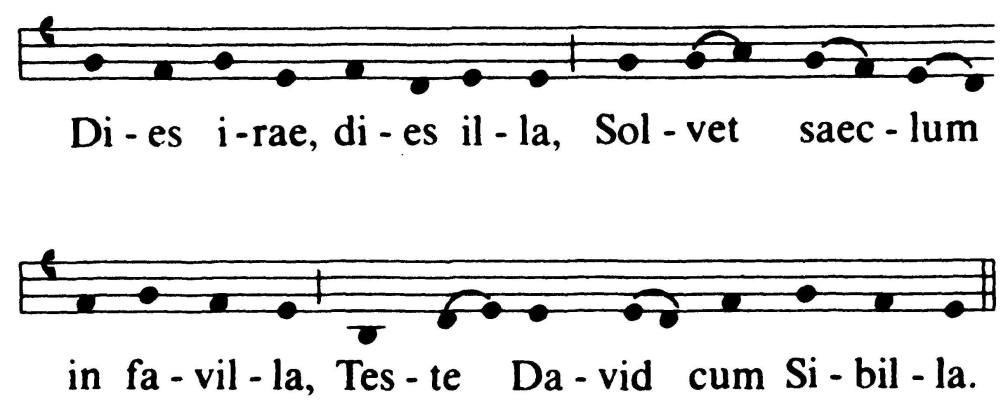
Original Dies Irae plainchant (c. 1260)
These sights and sounds of horrifying death endured, and nearly six hundred years later, were still incorporated into the art of the Romantic era. Franz Liszt (1811 – 1886) was one of these artists: an eccentric, infamous and exceptionally talented pianist and composer. He was the rock star of his day, sought after to perform, dazzling men and women alike with his superhuman pianistic wizardry (Liszt had enormous hands, and to this day some of his scores remain unplayable due to the stretches required).

Part of the original manuscript, in Liszt’s hand, for Totentanz for Piano and Orchestra.
Liszt was also a macabre individual fascinated by death and the medieval; he would often visit asylums, hospitals and even the dungeons of condemned prisoners, fasciated by those on the edge of death. Many of his works show the influence of these thoughts, but perhaps none more so than the dismal, thunderous and terrifying Totentanz for piano and orchestra. A set of variations on the Dies Irae plainchant, it begins with a rumbling, indiscernible piano, across which cuts the lowest instruments the orchestra has to offer, growling the Dies Irae with threatening ferocity. From there, we are swept away on a journey of madness and death, the pianist battling frantically against the inexorable march of the orchestra, flying to great heights and abysmal depths in an attempt to flee. At times, we are taken to one side, shown a moment of compassion, a moment of sadness, or even of humor – but always, we return to the rush and the doom.
Finally, the work builds to a frenetic climax, the pianist and orchestra verily trembling in fright, before plunging, without compromise or reprise, into the depths of the grave.
Liszt’s Totentanz is one of the most technically difficult pieces he ever wrote, and one of the darkest. Only some of his late compositions for piano, such as Nuages Gris, truly suggest a maudlin resignation to the ending of life, while many more of his compositions center around the country tunes of his native Hungary, and the sparkle and showmanship that gained him such fame that he wanted for nothing by his mid-forties.
Nonetheless, Liszt remained obsessed with death until the ending of his own life, in 1886. In his last years he suffered from many illnesses, some of which left him partially paralyzed and unable to play. His preoccupation with death increased with the knowledge that his own was fast approaching, and in July, he died in his bed. He has left us with a legacy of beauty, darkness and despair, and his works remain worthy of awe to this day.



 Satis Writes