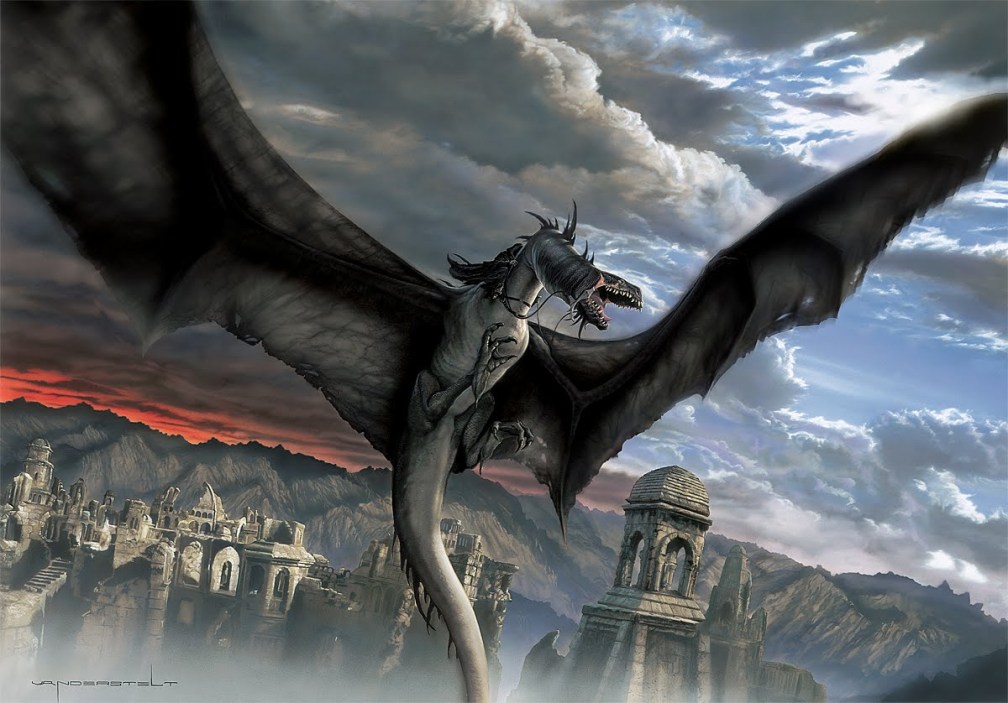
I was talking to a colleague the other day about movies, and he revealed to me that he and his roommate are making a concerted effort to watch The Lord of the Rings trilogy in its entirety for the first time ever. After I got over my initial shock that there still exist people in the world who haven’t seen these magnificent pieces of cinematic history, we started talking about some of the scenes he had seen so far (he hasn’t yet got to The Return of the King), his immediate impression of the characters and ideas within, and how he felt overall about the films.
He loved Gandalf, and how he straight up gets blazed with Bilbo right at the outset of The Fellowship of the Ring (I didn’t have the heart to tell him that Tolkien wouldn’t have meant it to be actual ‘weed’); he also told me how he was ROFLing at the Gandalf the Grey/Gandalf the White scene where he forces Saruman out of Théoden’s head, but that he nonetheless recognized it as an important scene.
One of the things my colleague revealed to me, however, was how it took him some time to get over the clichés of the movies, until he took a moment to recognize that virtually every medieval/fantasy film ever was in actual fact inspired by The Lord of the Rings, and that the clichés are there because it’s really the originator of so many of them. And he was thinking of it from a filmic perspective of the last two decades – never mind the near-century since Tolkien first started writing about Middle-Earth.
His enthusiasm, however, has made me want to revisit these epic films again (I usually watch the trilogy from start to finish at least two or three times a year) with a naive eye, if possible, and try to remember what it was like when I first saw them back in the early 2000s. Whilst some of the CGI has aged better than others (Gollum: yes; Legolas fighting an oliphant: no), and the more I watch them the more critical I become of everything – despite still loving them to death – there is to this day something magnificent, incredibly epic, and almost magical about these three movies that has (so far) transcended time and allows them to remain as one of the most unlikely successes of modern cinema.
But I find myself also – perhaps in anticipation of Amazon’s extended Lord of the Rings TV series – wanting to revisit a trilogy that has not done as well, and that I have certainly not watched as much: The Hobbit films.
Where the scenes that stick out to me in The Lord of the Rings are usually the ones that are epic, magnificent and truly grand, the ones that stand out the most from The Hobbit films are more often the ones that drag it down into an abyss from which even Amazon may struggle to rescue the franchise from: the barrel scene, or Legolas defying gravity, or even the fact that they completely failed to bookend the trilogy properly (it starts with a flashback from which we never actually return). Whilst some of the scenes are simply poorly adapted from the book, some of the more egregious and unforgivable parts include the love triangle between Legolas, Tauriel and Kili – two of which were never even in Tolkien’s original work.
That being said, I have a soft spot for these films – in descending order of softness as the films go on – partially because, like them or not, they’re what we have as a cinematic adaptation of one of the most beloved books in history, but also because I understand the difficulties and pressures that Peter Jackson et al were under to pull off something that even approached the grandiose heights of The Lord of the Rings trilogy: a foreshortened filming schedule, disastrous reshoots, cast and crew that were in despair of being unable to share sets with each other (Ian McKellen in particular was devastated that he was almost entirely alone in green screen for the entirety of the shoot), and a change of director halfway through all contributed to a project that Peter Jackson would later say nearly destroyed him.
Besides, if we can forgive Legolas surfing on piles of Orc corpses in The Two Towers and Aragorn and crew diving through cascades of skulls in The Return of the King, can we really object so strongly to a CGI orc that didn’t need to be in the film, or side plots that were extended beyond need just to fill time? There was plenty of silliness in the original trilogy, and plenty of deviations from the source material, and in some ways I would argue The Hobbit films are actually more faithful to the book: in order to flesh out three lengthy movies, there’s virtually not a single thing in the book that was omitted from the films.
At the end of the day, I still believe we’re fortunate to not only have all of The Hobbit and The Lord of the Rings adapted into high-budget films, but to have them done (in the end) by the same team of writers, producers and directors such that they at least have a consistent feel and tone, and feel very much like part of a single cinematic universe (something Marvel took a page from when creating their own magnificent cinematic universe). I don’t know how necessary Amazon’s billion-dollar TV series will feel when it eventually comes out, but I remain hopeful that it will take heed of these thoughts and make it feel like it fits with the films themselves (the fact that it’s being filmed again in New Zealand is a positive thing in this regard).
I think I may re-approach this set of films in the near future (hey, maybe even tonight!), starting with An Unexpected Journey and going all the way through to The Return of the King. This way I can get a feel for the entire story from start to finish, and still end on the strongest film of the six. I feel The Hobbit films deserve a second chance, at least from me, and I want to experience the good parts (the Misty Mountain song near the beginning of An Unexpected Journey, or the battle of wits between Bilbo and Smaug in The Desolation of Smaug) despite the worse parts, many of which I’ve broached already.
And of course, I feel for Peter Jackson. He’s personally one of my favorite directors, and not just because of his work on The Lord of the Rings; I adored his take on The Lovely Bones, and even the more recent Mortal Engines was a decent film, despite the logical fallacies of the entire concept, which of course is more to do with the original book than anything Peter Jackson did. I just think that his career and reputation were ruined by The Hobbit films, and it really wasn’t his fault; when he took over the helm from Guillermo del Toro, the studio refused to allow him any additional time for rewrites and reshoots, meaning some of it was filmed without even a basic storyboard.
What are your thoughts on the entirely of The Lord of the Rings cinematic universe? Do agree that The Hobbit films ruined it, or do you think that – for what they are – they should still be respected as the best cinematic adaption of Tolkien’s masterpiece that we likely will ever get?

 Satis Writes