 My wife recently came across H.G. Well’s War of the Worlds on TV, which was not the War of the Worlds with Tom Cruise in it, nor the infinitely superior The War of the Worlds from 1953 with Gene Barry. Interestingly (as I discovered) she had never read the original novel, which meant the twists of the tale were quite a pleasant surprise. I will say that I did not watch this adaptation with her, but suffice to say that humans use some kind of virus to destroy the rampaging Martians.
This naturally got me thinking about our beloved prototypical science-fiction authors such as H.G. Wells and Jules Verne, as well as, naturally, contemporary visionaries as well (amongst whom I would cite Gene Roddenberry as being one of the most influential). There is always a great danger in predicting the future, because it can be all too easy to become ensnared by the limitations of our mechanical knowledge, and lose sight of the true predictions: the state of human society, and the concepts that will develop over the following years, decades or centuries.

Jules Verne – the father of science fiction.
Though both Wells and Verne excelled at fantastical story-telling, to me it is undoubtedly Verne who gave the deepest thought to the progress of technology and its impact on the human race. Well’s visions of invading aliens and devolved humans in the far-flung future are engaging and frightening, but there is little reality for them to be based upon, and indeed the more we’ve come to learn of the universe, the more impossible these predictions appear.
The imaginations of Jules Verne continue to ring true through to the very present. This may be to do with the differences in their early lives; as a law student in Paris, Verne had access to some of the best literature and minds of the time, and essentially unlimited potential to nurture his fascination with travel and science. Wells, by contrast, grew up with little money, serving a number of unsatisfactory apprenticeships and teaching jobs, all in order to simply make a living. These themes ultimately reflect in his work, which appear to focus more on human interaction and class.

H.G. Wells – the father of quantum physics.
Verne’s fictional accounts of the future and the impossible have borne out in reality with uncanny accuracy. In 1873 he predicted the ability to travel around the globe at high speed in Around the World in Eighty Days. Fifty years later, it could be done in only three or four; today, in less than one. He famously predicted a self-powered submarine in 1870 with 20,000 Leagues under the Sea; today we have legions of such machines. He even imagined extra-terrestrial outposts such as in Off on a Comet, where a number of people are forced to coexist on a comet that pulled them from Earth as it passed nearby.
It comes as a surprise, then, that between the two authors’ visions of space travel (Verne’s From the Earth to the Moon in 1865 and Wells’ The First Men in the Moon in 1901), it is actually Wells who got it more ‘right’. Verne imagines people shot from a giant cannon; though technically possible, it would result in such phenomenal pressures that the unhappy astronauts would likely be mush by the time they left the Earth’s atmosphere.
Wells, on the other hand, creates a substance called cavorite, which has the interesting ability to repel gravity. At first glance this appears to be utterly impossible of course – far less likely than a moon-cannon – until we start to look into the world of quantum mechanics. Without diving too deep (for fear of losing myself!), I’d like to point out the theoretical graviton. When you boil the universe down to its most fundamental parts and start to observe all the wonderful weirdness that happens, one of the questions that arises is: what actually makes things attracted to each other? So far there is no answer, but one hypothesis is a massless particle called the graviton. If it exists, it would be responsible for the very thing that keeps our feet on the ground.
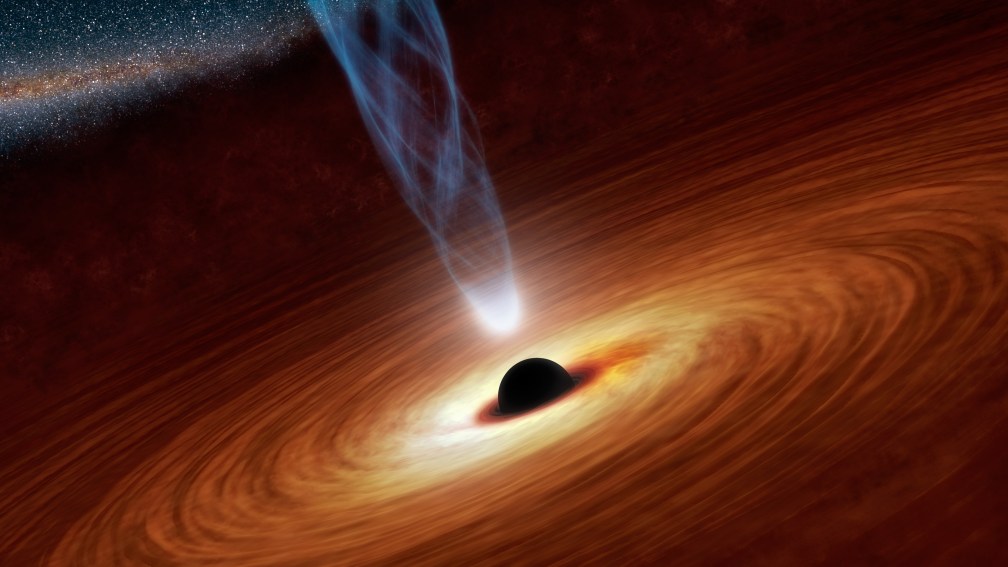
Given that, it then comes to mind that if gravity is the result of a particle, then that particle could be blocked. In fact, it may even have an anti-particle. If you could discover or create a material that could either cancel or block gravitons, you would essentially have created the potential for a free-floating object even in close proximity to extremely massive bodies – not just the earth or the sun, but potentially even black holes! Imagine the implications of that for astrophysics!
So ultimately, though Verne’s predictions have borne out more successfully and accurately, Wells holds the trump card for inventing quantum mechanics twenty years before anyone began doing any serious theoretical work in the field! Einstein, eat your heart out.

Wouldn’t it be cool to be able to sit here – and not get sucked in?




 Satis Writes