Thought of the Week: Forget Einstein, H.G. Wells was the Father of Quantum Physics

MenmoonfrontMy wife recently came across H.G. Well’s War of the Worlds on TV, which was not the War of the Worlds with Tom Cruise in it, nor the infinitely superior The War of the Worlds from 1953 with Gene Barry. Interestingly (as I discovered) she had never read the original novel, which meant the twists of the tale were quite a pleasant surprise. I will say that I did not watch this adaptation with her, but suffice to say that humans use some kind of virus to destroy the rampaging Martians.

This naturally got me thinking about our beloved prototypical science-fiction authors such as H.G. Wells and Jules Verne, as well as, naturally, contemporary visionaries as well (amongst whom I would cite Gene Roddenberry as being one of the most influential). There is always a great danger in predicting the future, because it can be all too easy to become ensnared by the limitations of our mechanical knowledge, and lose sight of the true predictions: the state of human society, and the concepts that will develop over the following years, decades or centuries.

Jules Verne – the father of science fiction.

Jules Verne – the father of science fiction.

Though both Wells and Verne excelled at fantastical story-telling, to me it is undoubtedly Verne who gave the deepest thought to the progress of technology and its impact on the human race. Well’s visions of invading aliens and devolved humans in the far-flung future are engaging and frightening, but there is little reality for them to be based upon, and indeed the more we’ve come to learn of the universe, the more impossible these predictions appear.

The imaginations of Jules Verne continue to ring true through to the very present. This may be to do with the differences in their early lives; as a law student in Paris, Verne had access to some of the best literature and minds of the time, and essentially unlimited potential to nurture his fascination with travel and science. Wells, by contrast, grew up with little money, serving a number of unsatisfactory apprenticeships and teaching jobs, all in order to simply make a living. These themes ultimately reflect in his work, which appear to focus more on human interaction and class.

H.G. Wells – the father of quantum physics.

H.G. Wells – the father of quantum physics.

Verne’s fictional accounts of the future and the impossible have borne out in reality with uncanny accuracy. In 1873 he predicted the ability to travel around the globe at high speed in Around the World in Eighty Days. Fifty years later, it could be done in only three or four; today, in less than one. He famously predicted a self-powered submarine in 1870 with 20,000 Leagues under the Sea; today we have legions of such machines. He even imagined extra-terrestrial outposts such as in Off on a Comet, where a number of people are forced to coexist on a comet that pulled them from Earth as it passed nearby.

It comes as a surprise, then, that between the two authors’ visions of space travel (Verne’s From the Earth to the Moon in 1865 and Wells’ The First Men in the Moon in 1901), it is actually Wells who got it more ‘right’. Verne imagines people shot from a giant cannon; though technically possible, it would result in such phenomenal pressures that the unhappy astronauts would likely be mush by the time they left the Earth’s atmosphere.

Wells, on the other hand, creates a substance called cavorite, which has the interesting ability to repel gravity. At first glance this appears to be utterly impossible of course – far less likely than a moon-cannon – until we start to look into the world of quantum mechanics. Without diving too deep (for fear of losing myself!), I’d like to point out the theoretical graviton. When you boil the universe down to its most fundamental parts and start to observe all the wonderful weirdness that happens, one of the questions that arises is: what actually makes things attracted to each other? So far there is no answer, but one hypothesis is a massless particle called the graviton. If it exists, it would be responsible for the very thing that keeps our feet on the ground.

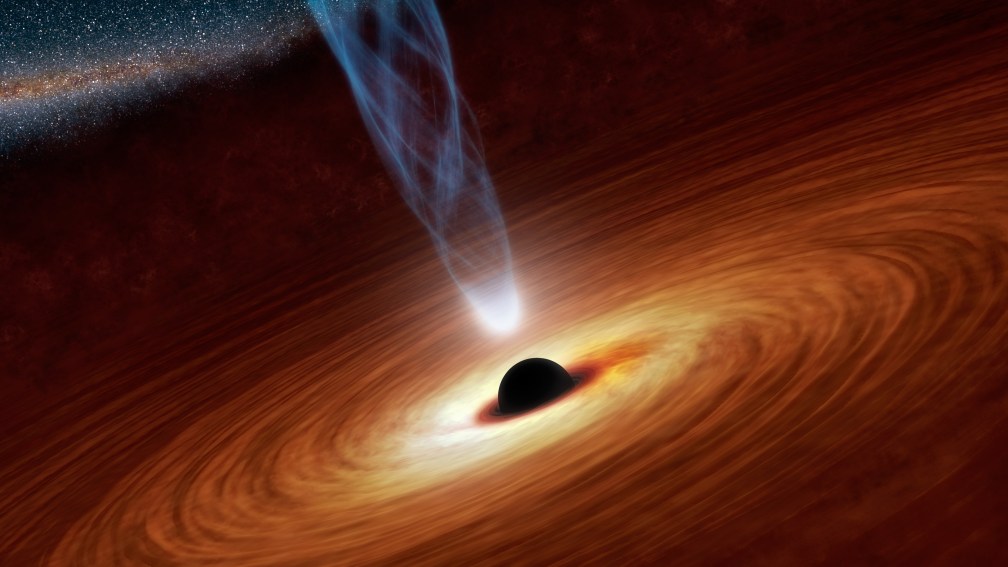
Given that, it then comes to mind that if gravity is the result of a particle, then that particle could be blocked. In fact, it may even have an anti-particle. If you could discover or create a material that could either cancel or block gravitons, you would essentially have created the potential for a free-floating object even in close proximity to extremely massive bodies – not just the earth or the sun, but potentially even black holes! Imagine the implications of that for astrophysics!

So ultimately, though Verne’s predictions have borne out more successfully and accurately, Wells holds the trump card for inventing quantum mechanics twenty years before anyone began doing any serious theoretical work in the field! Einstein, eat your heart out.

Wouldn't it be cool to be able to sit here – and not get sucked in?

Wouldn’t it be cool to be able to sit here – and not get sucked in?

Satis Logo with ©

Movie Night: Explorers

Year: 1985

Director: Joe Dante

Production Company: Paramount Pictures

Leads: Ethan Hawke, River Phoenix
explorers_01This one was very much chosen by the title and synopsis. I’d never heard of it before – which doesn’t mean anything – and Little Satis certainly seemed taken by the plot. For me, I was drawn in by the thought of watching a little Ethan and River.

The plot requires a fairly serious suspension of disbelief, but the good news is that it makes this abundantly clear from the very outset. Little Ben Crandall has a dream of a state-of-the-art 80s 3D circuit board, and describes it to his friend Wolfgang, who happens to be a computer geek from a family of lab-coat-in-the-kitchen-wearing scientists. When Wolfgang builds the circuit, it turns out to create a sphere of pure energy (yes – bear with me on this one) that can be directed simply by typing 3D coordinates into a computer program.

Testing it one day on a hill, Ben manages to inadvertently trap Wolfgang inside the sphere, where he discovers that it’s both airtight, and completely excused from all Newtonian physics (no acceleration, no deceleration, no gravity, etc.). Of course, this leads to the idea of building a kid-sized spaceship to sit inside the sphere, so they can go into space.

It’s there that they discover the dreams weren’t an accident – they were sent to Ben by aliens. Aliens who turn out to be…

Well, I wouldn’t want to spoil it for anyone who hasn’t seen it.

Plot aside, there were some genuinely (and surprisingly) powerful moments in the movie. Without delving too deep, we are shown a well-portrayed view of 14-year-old life. There are the geeks, cool kids and bullies, the junior-high crushes, and a deliberate range of backgrounds and upbringings. The opening of the film is particularly well-executed in introducing the characters and their natures; we see Wolfgang stumbling down a morning street with a laughably over-sized stack of school books in his arms (navel-high trousers, face-frame glasses and all), who is naturally stopped by bullies. Arriving on his bike moments after his books are tossed into a neighbor’s front lawn, Ben nonchalantly lets Wolfgang put his books in his basket, and walks the bike to school with him. Then, moments after establishing Ben as the cool kid, we see Ben himself beat up for saying the wrong thing at the wrong time. And that’s when the real cool kid – Darren – steps in and saves the day (Darren rides a scooter, so we know for sure he’s cool).

Darren poses an interesting character in himself; though Jason Presson isn’t on the same level as Ethan and River, he does a fine job as a quiet introvert from a broken home, eventually pulled from his shell by the excitement and enthusiasm of his friends. The three have a wonderful dynamic presence with each other, each possessing their own quirks and manners. When they first take their spaceship for a test flight (and decimate a drive-in theater), Wolfgang wants to run test after test; Ben isn’t sure what to think, and Darren, of all people, is jumping to go again.

In the end, there is nothing profound about this movie; it’s not exactly a coming-of-age movie, a children’s movie, or even a comedy. It’s a unique little gem that doesn’t take itself too seriously, has no problem completely fudging reality in favor of plot, and pits three excellent actors together in a very convincing portrayal of teen friendship.

★ ★ ★ ★ ☆

The Devil’s Details: Tears in Space

Hello!

Welcome to a new series here on Satis: The Devil’s Details. This may or may not actually survive more than a few posts, but we’ll see where it goes. The idea came to me because I am very observant, but the wrong way.

My wife will know exactly what I mean.

Details catch my attention. It isn’t a conscious thing; it might be a fascinating speck of dust on my desk, or a fellow in the background of a news report wearing an oddly-shaped fedora. In the sense that as long as my eyes are open I’m seeing some thing at any given moment, I’m not particularly looking at things other people aren’t; rather, what tends to happen is that my brain takes some odd part of the scene and runs away with it.

As it happens, this usually leads to me not observing much else. This is the ‘wrong’ of the way: I never really notice the things I’m meant to notice (crumbs on the kitchen counter, wrinkles in the drying clothes, traffic lights that have turned to red), and get carried away by things that, on the grand scheme of things, probably don’t matter all that much.

The thing is, I don’t really mind. Of course, I’d like to be able to notice the important things in life as well, but perhaps the little things are just as significant. Examples: the funny inconsistencies in people’s handwriting because their hand gets tired as they write; imagining a long and detailed life of the groundhog dead by the side of the road; the single off-beat ride cymbal in a song, and wondering if it was meant to be there or not. I watch bugs on walks through the woods, and marvel at the tenuous balance of a fallen twig, caught in the branches of another tree.

These sort of things often keep my mind occupied. Most people call this ‘distracted’; I sometimes wonder if they’re the ones who are distracted, though, at missing these weird and fun little things.

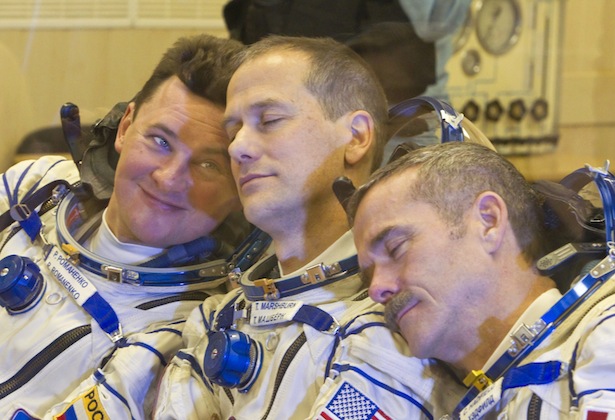
International Space Station crew members Russian cosmonaut Romanenko, U.S. astronaut Marshburn and Canadian astronaut Hadfield joke as they talk with relatives after putting on their space suits at the Baikonur cosmodromeEarlier this week an article from The Atlantic caught my attention. Apparently (and kind of obviously, when you stop to think about it), you can’t really cry in space. Even if your ducts produce excess tears, with no gravity there kind of isn’t anywhere for them to go. So they just sit there. On your eye. And hurt.

What a funny thing to think about. It reminds me of watching movies and realizing no one ever goes to the bathroom. It isn’t the kind of thing that crosses your mind. Now, of course, I know exactly what to include if I ever write a science fiction novel.

In fact, these are the kinds of details I try to include in my own writing if I can; it’s the little touches that make something that little bit more special.

So here’s to weird, odd and special details. I can’t promise that this will be funny, engaging, or even mildly interesting. Kind of like the details themselves.