Tales of Despair: The Color and the Key of Despair

What mood do you see?

There are certain things that ring so of despair that they are instantly recognizable. In life there are such things — death, sadness, old men crying. In art also, there exists an equal dogma of darkness (even the term darkness serves as such an example). The darker of colors — black, blue, crimson — these are colors of despair. They are the colors of things that are frightening — the black of night, the unfathomable depths of the ocean, the terrifying heat of flame, and the letting of blood.

These colors form a great part of our perception of misery and sadness. Winston Churchill famously referred to depression as his “black dog”. Yet even the shading of these colors is significant; when we describe someone as being “blue”, we rarely imagine the pale, soothing blue of a spring sky. Bright red is a color of excitement and joy; deeper tones convey heat and flame and blood.

I think this man might be useful to me – if my black dog returns. He seems quite away from me now – it is such a relief. All the colours come back into the picture.

— Winston Churchill, 1911

And these tones are carried through into music. Ignoring synesthesia, it isn’t uncommon to think of a song or piece as carrying a particular color. These visual representations of key vary from person to person; if you were to ask any two musicians, you would likely get two completely different descriptions.
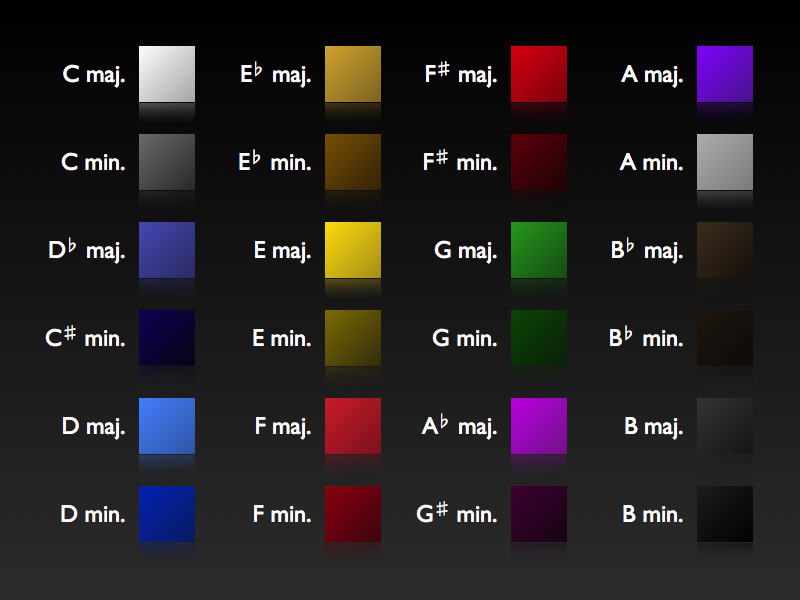
My personal key-color relationships. Even ignoring the colors, notice that the minor keys are universally darker than the major ones.

Having said that, there are certain keys that, almost universally represent sadness, anger and despair. As a starting point, these keys are naturally minor. The bright, exuberant major keys — the clean, purity of C major or the homeliness and warmth of E-flat major — rarely suggest any aspect of darkness. The inherent sad quality of the minor key, however, is inextricable.

The falling of tears.

Part of this is in the psychological impact of the falling semitone; to turn major into minor, the third key of the scale falls by one semitone. The very nature of falling and descent is linked to death (going underground) and sadness (the falling of tears). One of the most heart-wrenching progressions is the fall from the sixth note of a minor scale to the fifth (especially if the root note remains in the bass). A wonderful example of this is the opening of Sotto Vento by Ludovico Einaudi.

However, quite apart from this inherent quality of the minor keys, there is a particular key (or closely related keys) that has throughout the history of western music been used to express the deepest pathos and despair. Countless works have been based on this key, and they are without exception some of the most beautiful, and tragic, pieces of music ever written.

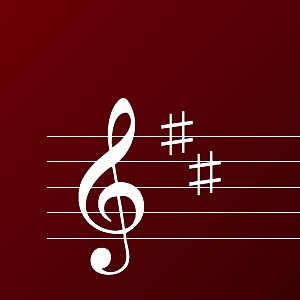
I speak, of course, of B minor (the key that, for me, is represented by the deepest black). There is likely a reason for this; C major, the standard and most oft used key, is above this by one semitone. The shift, the fall from this key of happiness, represents a profound shift from light to dark.

Violin part from the first edition of Beethoven’s fifth symphony.

What’s interesting, however, is that this history of this key is not so straightforward. Though from the 1800s onwards B minor because a de facto standard for sadness, it was prior to this rarely used. Instead, the tonally slightly higher key of C minor was used instead. Mozart wrote a beautiful mass in C minor (despite rarely using minor keys in general); one of his best piano concertos is the twenty-fourth in C minor. Later, Beethoven used this key for one of the most famous and furious of compositions: the raging fifth symphony in C minor. He was attracted to this key several times further: his eighth piano sonata, the Pathétique; the third piano concerto (clearly and heavily influenced by Mozart’s own piano concerto in the same key), and the thirty-second piano sonata (one of the last pieces he ever wrote).

The tragedy of Swan Lake.

Yet something happened in the early nineteenth century that changed this, and suddenly the key of despair dropped a semitone. We began to see works such as Schubert‘s eighth symphony, Chopin‘s third piano sonata, Liszt’s only piano sonata and the wonderful Totentanz, and Brahms’ chamber works (one of the most delicate and beautiful, the first piano trio in B, is in fact half in B minor). And then there was Tchaikovsky. B minor was an epic favorite of this troubled composer, being the home key of his first piano concerto, the beautiful Swan Lake, the furious passages of the Romeo and Juliet Fantasy Overture, and of course the intensely tragic and heartbreaking sixth symphony, the Pathétique.

Though at first it might appear that there are therefore two keys of darkness, and that the choice of key is down to the individual perception of the composer, it turns out not to be so simple. In the eighteenth and nineteenth centuries, there was no set tonal standard, meaning that different countries, and indeed different orchestras, would have their own definitions of standard concert tonality. In most cases, of course, the tonalities were similar – often differing by one semitone.

And to this day, as western tonalities became standardized (a practice that was only formalized in the 1950s), the key of B minor has assumed reign as the common standard for darkness, and despair.

Tales of Despair: The Dancing Dead

Dance of Death, by Michael Wolgemut

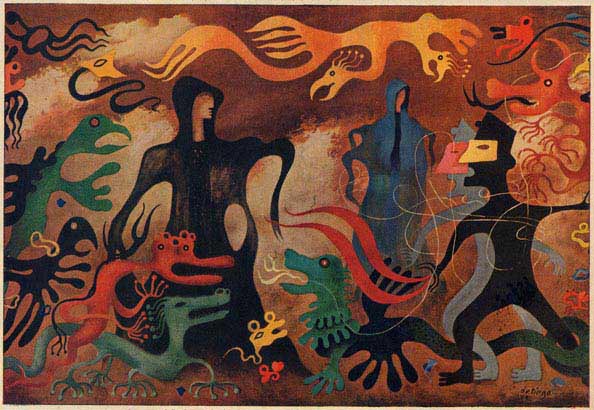
There is little more terrifying than the thought of the dead risen; grim skeletons, grinning with their scythes and bearing down upon you, inescapable.

Death was everywhere in the fourteenth century. For a hundred years, France and England had been pitting their men against each other, drenching the earth with blood and filling graves with the mutilated bodies of the wounded. The crops grew poor, and the poor grew hungry; famine and disease were rampant. And most terrifying of all, a death that crept upon the young and old alike, one that grew great boils upon the skin and moved from person to person with frightening swiftness. The plague decimated nearly half of the European population during its time, and the lives of men hung by a thread.

It is against this background that the first records of the Totentanz, the Dance of the Dead, are known. In a cultural landscape dominated by murder, war, adultery and disease, people grew suddenly terrified of god’s wrath, knowing they could be struck down at any moment. In an effort to find reprise from the horrors of life, the vision of one, last moment of joy, even on the way to the end, swept across the lands: the final dance to the grave.

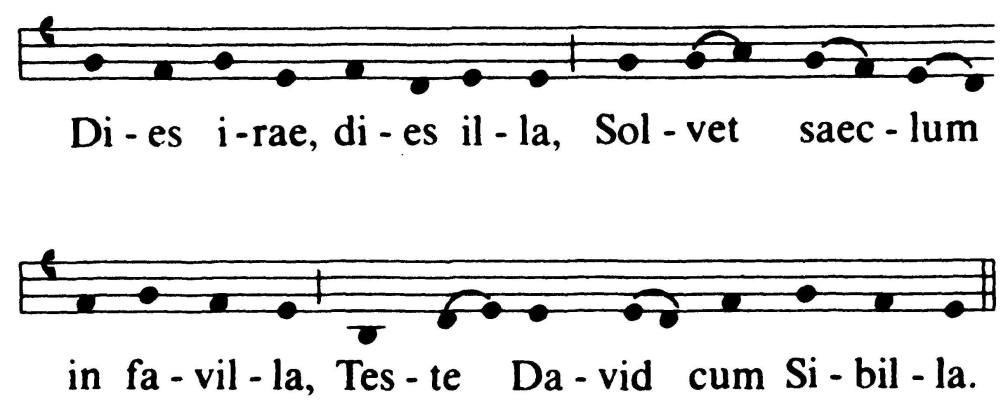
In these times, where salvation was futilely sought in the houses of god, the hymns of mass began to see the introduction of a new plainchant: the Dies Irae. This melody, full of gloom and storm, speaks of the wrath of god, the day of judgement and the ending of the world.

Original Dies Irae plainchant (c. 1260)

These sights and sounds of horrifying death endured, and nearly six hundred years later, were still incorporated into the art of the Romantic era. Franz Liszt (1811 – 1886) was one of these artists: an eccentric, infamous and exceptionally talented pianist and composer. He was the rock star of his day, sought after to perform, dazzling men and women alike with his superhuman pianistic wizardry (Liszt had enormous hands, and to this day some of his scores remain unplayable due to the stretches required).

Part of the original manuscript, in Liszt’s hand, for Totentanz for Piano and Orchestra.

Liszt was also a macabre individual fascinated by death and the medieval; he would often visit asylums, hospitals and even the dungeons of condemned prisoners, fasciated by those on the edge of death. Many of his works show the influence of these thoughts, but perhaps none more so than the dismal, thunderous and terrifying Totentanz for piano and orchestra. A set of variations on the Dies Irae plainchant, it begins with a rumbling, indiscernible piano, across which cuts the lowest instruments the orchestra has to offer, growling the Dies Irae with threatening ferocity. From there, we are swept away on a journey of madness and death, the pianist battling frantically against the inexorable march of the orchestra, flying to great heights and abysmal depths in an attempt to flee. At times, we are taken to one side, shown a moment of compassion, a moment of sadness, or even of humor – but always, we return to the rush and the doom.

Finally, the work builds to a frenetic climax, the pianist and orchestra verily trembling in fright, before plunging, without compromise or reprise, into the depths of the grave.

Liszt’s Totentanz is one of the most technically difficult pieces he ever wrote, and one of the darkest. Only some of his late compositions for piano, such as Nuages Gris, truly suggest a maudlin resignation to the ending of life, while many more of his compositions center around the country tunes of his native Hungary, and the sparkle and showmanship that gained him such fame that he wanted for nothing by his mid-forties.

Nonetheless, Liszt remained obsessed with death until the ending of his own life, in 1886. In his last years he suffered from many illnesses, some of which left him partially paralyzed and unable to play. His preoccupation with death increased with the knowledge that his own was fast approaching, and in July, he died in his bed. He has left us with a legacy of beauty, darkness and despair, and his works remain worthy of awe to this day.

Tales of Despair: The Fantastic Descent into Hell

Perhaps disheartened by the difficulty of writing an actual opera, in 1804 Ludwig van Beethoven (1770 – 1827) had the bright idea to tell a musical story without the words, and so was born the programmatic symphony. His sixth orchestral masterpiece, the “Pastoral” symphony, was one of the first great musical creations to not just paint a scene or don a mood, but tell, from start to finish, a coherent and structured tale, through wordless music alone.

And it was a phenomenal achievement; through five intertwined movements, we are taken through the experience of the composer as he travels to an idyllic countryside, breathes in the beauty and serenity of the pastures and streams, and revels in the joyous dancing of the country folk. In a dark turn, we are overcome by a terrifying and violent storm, threatening to ravage the countryside, until finally it passes, and we rejoice with the shepherds. The story is, admittedly, rather naïve, but Beethoven was one of the great advocates of Goethe‘s humanism at the time, desperate for the belief that man was a better creature, and could aspire to beauty and greatness.

As the world moved forward into the romantic era, the youthful idealism became tainted with the dark reality of industrialism, war and poverty. Stories continued to be told, but they became ever darker. Composers and pianists, the rock starts of the nineteenth century, became corrupted by their popularity. Hector Berlioz (1803 – 1869), the infamous French composer, wrote many of his greatest works under the heavy influence of opium. In fact, perhaps his greatest tribute to Beethoven – a twisted retelling of his tale of beauty and serenity – is the Symphonie Fantastique, in which that very drug is the catalyst for a descent into murder and madness.

Being a child of the romantic era, Berlioz was infused with the passion and impetuosity of many of those of his generation, and he found himself infatuated with several women in his life. One of these, an Irish actress called Harriet, caught his fierce attention in Romeo and Juliet, and she became the inspiration for what is today perhaps his most enduring work.

Berlioz’s Symphonie Fantastique is, as was Beethoven’s Pastoral Symphony, a song with a tale to tell. Our young musician, in a dream of passion, discovers a woman who embodies his every ideal, and cannot rid her from his mind. He is delirious, love-struck, despairing and joyful, and sees her in his mind every waking moment. These thoughts consume him even as he passes through life – at a ball, a festive, joyous occasion, he cannot see the lights or the music. Wandering in the fields, by the brook and past the shepherds, he cannot but brood on his terrible loneliness. He wishes – hopes – that he may soon not be alone, but thoughts of betrayal of evil creep through his mind.

And then, the story takes a dark turn, and does not return. Convinced his love has forsaken him, he poisons himself with opium, and as he lays dying, he is plagued with the terrifying dream that he has murdered his only beloved. Powerless from the drug, he watches helplessly as he is captured, and led to the gallows. The crowd looks on, he cries out in despair – and, as the guillotine’s blade descends, he sees her in the crowd – alive.

And it does not end there. Dead, he finds himself transported to hell, lost in the midst of a witches’ Sabbath. Shadows, demons, sorcerers dance sickeningly around him, taunting and teasing him in his own death. And then – horror upon horror – he sees that she is a part of the diabolical gathering, that she is dancing to his death with the witches. As the bells of his death sound, the terrible creatures conspire to mock god, dancing over the ancient music of his wrath, and all is lost to perpetual darkness.

Inspired by the beautiful Harriet, Berlioz went on nonetheless to become engaged to a Camille, instead. When she spurned him, he raced to Paris, seeking to murder her, her mother and her fiancé. Eventually, when this plan failed, he returned to Harriet – and there, he discovered the painful truth behind infatuation. The two wed for a mere two years.

Berlioz would go on to produce one of the most famous renditions of the legend of Faust, who sold his soul to the devil. He separated from Harriet, and though he continued to provide for her for the rest of her life, she died not long after from severe alcohol abuse. His mistress, whom he eventually married, died eight years later. A girl for whom he had affection, only twenty-one years old, died also, and Berlioz was left with nothing but his grief.

At the age of only sixty, he began, in his despair, to wish for death, and not long after, he was stricken with violent abdominal pains. The pains soon grew and spread, and in the end, consumed him. On his death bed, he spoke these final words:

Enfin, on va jouer ma musique.