This one is by request this week, from TamrahJo, who wanted to know how to not kill aloe plants. I should preface this by saying there are many, many varieties of aloe, and I am familiar with precisely one:

Our aloe plants; we never quite new what species they were, but the closet I could find was the African Aloe.
The key thing to understand about aloes is that they’re like rabbits (or Catholics): they love making babies. As long as you take care of the original aloe, as it grows you’ll find smaller aloes sprouting all around it. These can be separated easily (the roots go deep) and replanted on their own, and will soon grow and make babies of their own.
Realize that aloes are distantly related to cactuses , and store a surprising amount of fluid in their stems. The stems are actually the wide, flat leaf-like part of the plant, as technically only the spines qualify as leaves. If one breaks it will release a large amount of viscous, clear sap that is often used to soothe burns (I won’t go into why this works, because I don’t actually know).
What this means is that they don’t need a lot of water. Plant them in a pot that has ample drainage, and water them only when the soil starts to dry. Mind you, if you let the soil dry too much it will crack, and not retain the water at all. Water them until the water just leaks out of the bottom, and then stop (make sure you have a plate or base to catch the water). I’ve over-watered countless aloes, and ended up with a lot of water to mop up.
If you get this right, you’ll find your aloe starts to grow fast. It’ll grow in all seasons if you keep it indoors, though faster in Spring and Summer. Keep a close eye on it for babies, and be willing to repot it regularly. Because of its affinity for dry climates, its roots are long, tangled and numerous. If the roots fill the pot it’ll start to wither, so repotting it into larger pot allows its roots to spread.
The babies actually come from these roots; when the spread far enough from the original plant they start to branch off, and some will begin to grow upward toward the soil again (photophillic, I think my high-school biology teacher once said?). Once the baby reaches a moderate size, gently dig it out and replant it in an appropriately-sized pot with fresh potting soil.
And have lots of pots on hand.
If you follow these steps, you might – if you’re very lucky, and it turns out I actually know what I’m talking about – get an aloe forest something like this:
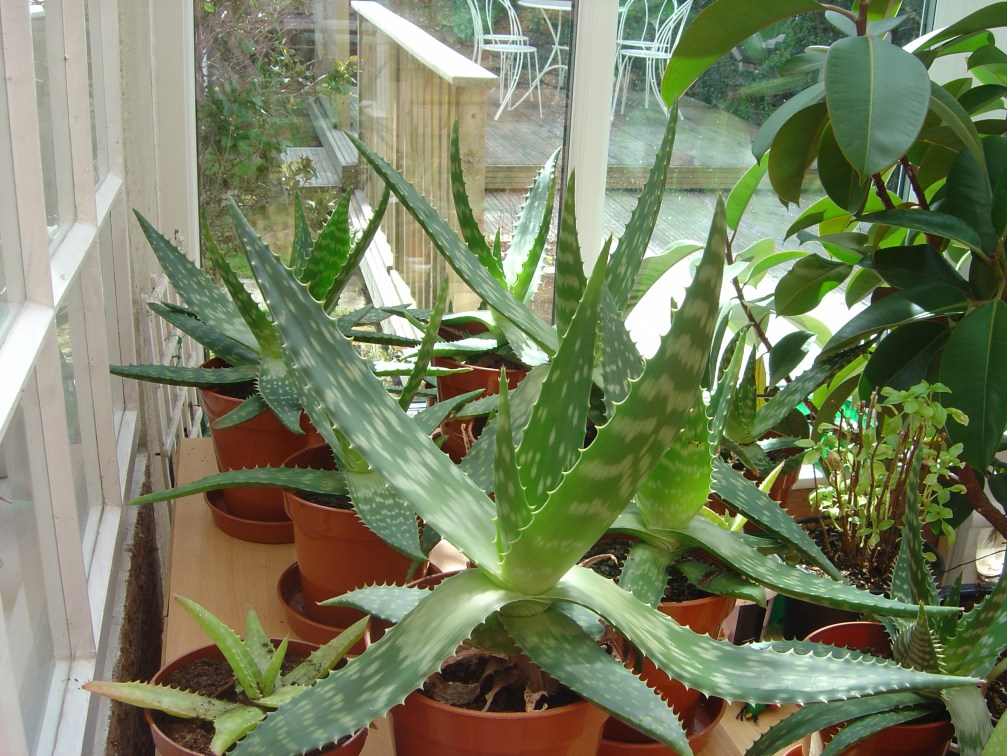
Our aloe forest.
And if you’re really, really lucky, they might flower, like this:
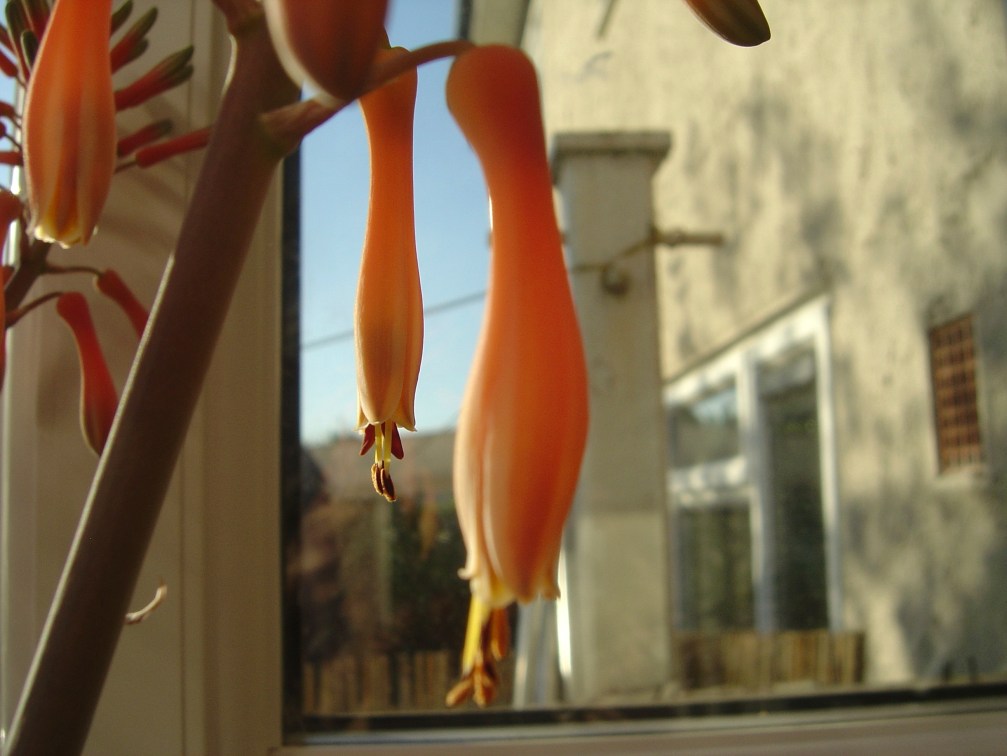
The droop of an aloe flower.
And there you have it. Two disclaimers: I am not a plant expert, and every single thing you’ve just read comes from Mrs. Satis, not me.
Good luck!
~
Oh, one other disclaimer: I have nothing against Catholics. Just saying.

 Satis Writes