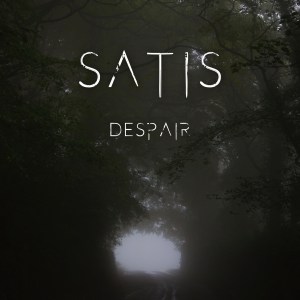
Despair (2023), by Satis

In the past, I’ve used the category “Music I Love” to discuss music that has been particularly important to me over the course of my life. Anything from Mozart to Metallica, I’ve often mentioned the significance of their emotional response in me, or how it meant something at a particular time of my life.

This time, however, I’m changing it up slightly. While this post is intended to highlight music that is indeed very important to me, this time the music I’m discussing is … my own!

It may not have been made entirely clear to everyone over the course of my blogging tenure, but my background and education is in music, not writing – specifically composition. And in recent years, I’ve taken the time to reinvest in that old, forgotten passion, and write some new music.

Back in 2019-2020, I began thinking that I would like to write an album that blended the best of classical orchestration with the gritty heaviness of metal music (my two musical loves). As I began to experiment with different ideas, I realized that I could write something of a heavy metal symphony; nothing so pretentious as Deep Purple’s Concerto for Group and Orchestra, yet more focused and structured around the orchestra itself than something like Nightwish, whose music – whilst evocative and generally excellent – tends to be “orchestrated” metal. I was looking to write music that could only exist with both contrasting elements; remove one, and the other isn’t sufficient to carry the music alone.

And so was born Despair; a five-track, hour-long album of metal and orchestra, exploring themes of darkness and misery through music. It took a long time – over a year – to complete the first draft, and a year further to fine-tune the sounds, hone the orchestration, and get it to a standard where I felt it was publishable.

And whilst the follow-up, an album soon-to-be-released called Shade Under Trees of Longing, has (in my opinion) a far superior production, I am nonetheless proud to announce that Despair is now live and available to stream through all your favorite platforms: Apple Music, Spotify, iTunes, and more!

The Diminishing Returns of Practicing

They say it takes 10,000 hours of practice to master something – chess, neurosurgery, piano, what-have-you. If you practiced your field three hours a day, that would equal roughly ten years. If, like me, you practice closer to 10 minutes a day, you might never actually master anything in your lifetime.

The thought occurred to me the other day as I was playing some Beethoven, and wondering why it seems so freaking difficult. I’ve been playing piano since I was eight, so by rights I should have crossed the line into mastery by now, but I most certainly have not. I achieved Grade 8 piano (a measure of skill in England, the highest grade for students there) at around age seventeen, and I would argue I’ve not improved much since then. I struggle to play simple pieces accurately, and I struggle to play difficult pieces entirely.

Now in fairness, I haven’t had access to an actual piano for the past 12 years since moving from England (a problem that I’m hoping to remedy this summer as we convert our garage into a music studio), and I’ve only had a fully-weighted, full-size digital keyboard for about six months or so. To that extent, it really means there’s been a huge gap in time in my ability to actually practice playing piano, and one could argue that I’ve probably regressed significantly in my performance ability.

Another component is my inability to recognize that I’m no longer as good as I used to be, and that it will take some time to get back to that place – never mind get better. I’m diving right back in to Mozart and Beethoven’s difficult piano sonatas, when I should probably be trying to learn a few newer, but easier, pieces.

Nonetheless, I can’t help feeling overwhelmed by this idea that there’s only so far practice is going to get me. I’m never going to be Alfred Brendel, or Glenn Gould, no matter how much time and effort I put into practicing. I feel like a hack, with a better understanding of technique than an ability to put it into practice. And ultimately, I feel like the returns of intense practice are diminishing, to the point where there really just isn’t much point; hours and hours of practice are going to result in smaller and smaller improvements in my skill, until the point comes where I simply will not get any better.

I fear I may already be there.

I don’t think this means I’ll stop playing piano altogether, because at the end of the day I enjoy the art itself, even if it’s just for myself. But whereas once I used to believe that I could play anything if I put enough time and effort into it, now I feel like there’s a hard limit to what I’ll ever be able to achieve. It’s not like this is my profession, or my academic career; I literally just play for fun. But maybe there’s a point where I have to recognize that certain pieces will forever be out of my reach.

Oh well.

For those of you who do a thing that requires practice – whether it’s a musical instrument, or a sport, or a job – what’s your perspective on practice? Do you think you can become the best in the world if you only practiced enough, or is there a point where you’ll be the best you can be, and no amount of further practice will significantly improve you beyond that?

Album Review: Anno 1696 by Insomnium

Those of you who’ve been following me for a while will be well aware of my love for all things heavy metal, and one of my favorite bands is Finland’s Insomnium – a long-standing staple of the melodic death metal their homeland is known for.

Insomnium have been releasing top-tier melodeath for over twenty years, starting with their debut LP In the Halls of Awaiting back in 2002. They rapidly struck a formula of balancing brutal riffs with melancholic, haunting melodies and harmonies, and have rarely deviated ever since. In fact, if there is a complaint to be lodged against Insomnium, is that each album doesn’t really feel like much of an evolution for the band. They tend to open every album with a intro track that blends seamlessly into an upbeat pop single, followed by a series of more forgettable, if more challenging, longer songs.

They changed this up in 2016 with the album Winter’s Gate, which took the form of a seven-part sequence of songs that actually form one massive 40-minute track. To date, this represents their most adventurous and progressive attempt, but they returned to their tried-and-true formula with 2019’s Heart Like a Grave (which actually contains, beyond the intro and pop single Valediction, some of their best and most accessible music to date).

So where does that leave their most recent release, Anno 1696 – a concept album based on a short story by bassist and vocalist Niilo Sevänen? Like Winter’s Gate, it eschews the standard album structure that Insomnium have used since 2002 in favor of eight slabs of equal-quality melodic death metal (although the opener, 1696, has the feel of an intro track, despite being over six minutes long). Two songs – White Christ and Godforsaken – mark the first open collaboration with vocalists outside of the band, with the first featuring Rotting Christ’s vocalist Sakis Tolis, and the second bringing a haunting melodic performance from Finnish folk singer Johanna Kurkela (also known from her collaborations with fellow Finns Sonata Arctica).

Each track is, as has always been the case with Insomnium, exceptionally well-produced and composed, and with the longest track clocking in at around eight and a half minutes, none of them outstay their welcome (in the past, some of their longer songs have felt a little overbearing). Blast beats are balanced with more tempered drumming, acoustic guitars blend well with heavy riffs, and melody – as to be expected – is paramount to each song. As the album progresses, odd time signatures and longer acoustic passages are a welcome break from the standard 4/4 heaviness that often drags this sort of music down.

However, for all of this, no one track feels terribly memorable, and whilst each is certainly distinct from the other, the album feels missing that one standout hit that Insomnium have been able to produce in the past. At 51 minutes, it’s also one of their shortest albums (only Winter’s Gate, the one-song album, and Across the Dark are shorter), and feels like it could have afforded an additional 4- or 5-minute track that really “pops”.

With that said, what is here is atmospheric, well-written, and fits the bill of a concept album about a witch perfectly. There’s no argument that Insomnium are at the top of their game musically, and the album’s structure does form a welcome break from the standard format that they’ve typically restricted themselves to. Although it can’t be said that it contains their best individual song to date, taken as a whole it is still one of their best albums, and for fans of melodic death metal is well-worth a good few listens to really appreciate the depth that it has to offer.

If you’re new to Insomnium, or want to explore melodic death metal for the first time, you’d be better off starting with Heart Like a Grave, or 2014’s Shadows of the Dying Sun, but if you’re familiar with the band already, then dive right in and enjoy another solid effort by Finland’s premier melodeath act.

4/5 stars