The Devil’s Details: Surgical Drapes

It turns out you learn a lot when someone you know undergoes surgery. Along with the general nausea, blurred vision and pain of recovery, we discovered long red marks on Mrs. Satis’ abdomen. We had absolutely no idea what caused it until we went to see the doctor for our first follow-up consultation. He pondered for a moment, and then declared with quite the “ah-ha” that it was a delayed reaction to the surgical drapes.

54_hartmann_basis_set_ambu_481x355_z1

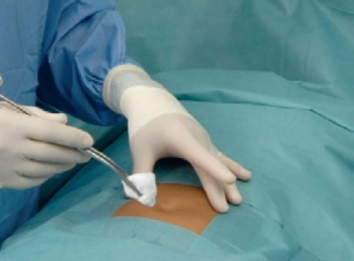
Did you know they drape the patient’s body entirely during surgery apart from the head and the surgical site (called the “operating field”, according to Wikipedia)? It makes sense when I think back on it – whenever you see surgery on TV there’re gowns and cloths and drapes all over the place. The specific reason for this, however, wasn’t apparent to me until now. During open surgery when the patient is under general anesthetic, the anesthesiologist remains in the operating room throughout the procedure. Another one of those things that makes sense when you think about it. The patient is hooked up to IVs and ventilators and all sorts of stuff, and the anesthesiologist is there to make sure the patient remains unconscious throughout.

The drapes separate the surgeon’s working area from the anesthesiologist’s (and anything else). You see, I’d always assumed that operating rooms were kept pretty sterile as it was, but it turns out not sterile enough: the drapes help to minimize the possibility of contamination during surgery.

It feels obvious, but kind of crazy at the same time; it’s just a further reminder that you are being deliberately wounded – cut wide open – and that you are just as prone to infection during surgery as anywhere else.

~

Featured image from http://healthland.time.com/2010/02/22/which-prostate-surgery-is-best-depends-on-the-surgeon/.

Satis Logo with ©

Thought of the Week: The Minutiae of Mortality

Someone close to me underwent a surgical procedure the other day to have her gall bladder removed. She’d been having abdominal pain for years, but after a sudden, severe and inexplicable attack she decided to have a scan. They discovered two gallstones, each over 2cm across, lodged in her gall bladder, and evidence that a third had lodged itself in the bile duct at one point (hence the attack). Worlds of fun.

This is about the most pleasant picture of gallstones I could find.

This is about the most pleasant picture of gallstones I could find.

It turns out the gall bladder, not unlike the appendix, is not a critical system in human anatomy. Its purpose is to store and concentrate bile, releasing it in a wave when needed to digest fatty foods. Without it, the liver still produces bile, and the bile still enters the intestine; it just doesn’t do it in one big go. You might need to watch your fatty foods, but you ought to be watching them anyway.

Also not unlike the appendix, it can become inflamed if blocked, and may need to be surgically removed. In the appendix it’s often calcified fecal matter than can cause this obstruction; in the gall bladder, it’s gallstones. In her case, they were cholesterol stones, formed from crystallization of the natural cholesterol that aids in the production of bile. It’s curious because this has nothing to do with “high cholesterol”, or the deposit of fatty acids in blood vessels. Cholesterol is naturally present in the liver and gall bladder, and the concentration of bile might actually serve to cause the formation of stones in the first place.

In any case, it was pretty quickly decided that the gall bladder needed to be removed, and within a matter of weeks she found herself at the hospital, signing waivers and waiting to have her abdomen cut open. It was to be a laparoscopic procedure, which means two small incisions instead of one: one for a tiny camera, and one for the actual surgical instruments. (In this case there were actually four holes, because they were repairing a hernia as well.) There was just a small chance that complications might arise, leading to full open abdominal surgery, but it was unlikely.

~

…the vein might have collapsed…because I suddenly noticed the saline solution wasn’t dripping.

~

The thing is, even “minor” surgery isn’t minor. Someone is taking a very sharp knife and cutting open your body, and then stitching it back together with needle and thread. There’s blood pouring out, flowing out and dripping into the body. There are any number of variables that could lead to horrible consequences; a slight slip of the hand and a major artery is severed, and you bleed to death in the operating room without ever knowing what happened. And that’s really the terrifying thing, and the thing that was terrifying her: once you’re in there, you’re out of control. Despite all promises and reassurances, there’s no knowing that when they put you to sleep (because that’s what they’re doing – there’s no choice about it), you’ll ever wake up again.

Hope you're not squeamish around needles.

Hope you’re not squeamish around needles.

And so I was there for her, of course, trying to be brave and strong (and failing, I’ll admit). This person is not stupid, and false reassurances don’t help. You can’t just say, “It’ll be all right,” when you know as well as they that there’s a chance – even if it’s less than 1% – that it won’t. And the thing is, I was fine going into it, thinking about the surgery and imagining the procedure (they wouldn’t let me watch, of course). I was fine watching the IV needle go in, as the nurse moved the needle around under the skin, lifting it and lowering it to get it into the right vein. I was fine as I watched her sign the paper that gave her life to a complete stranger.

There was just one point where I stuck.

In preparation for the surgery, she had had to have a blood sample drawn, and it was the same vein the nurse was using now for the IV drip. And I think the vein might have collapsed or something, because I suddenly noticed the saline solution wasn’t dripping. Then I noticed that blood was slowly flowing back up the tube. For her, it was pain; for me, it somehow symbolized everything that could possibly go wrong wrapped up in one neat, little needle. My mind suddenly filled with collapsing lungs, ruptured arteries and severed internal organs…I was light-headed, hyperventilating and dizzy. I was freaking out.

In the end it was nothing; the nurse came over, flushed the system, and the IV began flowing normally again. A few minutes later she was gone into the OR, and I was left waiting for the next three hours, wondering if more IV drips had stopped or not. None did, of course; the surgery went fine, and she’s now (painfully) recovering. But it’s funny how so small a thing can be what triggers the severe import of a situation to you. It was like that when she gave birth to our child; the whole thing was hideously unreal, but that one trickle of blood as they rolled her off the gurney…that was what hammered it home that they had just cut a living being out of her.

I love you, sweetie; you were really brave.

pixar_brave_2012-wide

Featured image from http://www.scquest.org/in-the-face-of-fear-the-promise/.

Satis Logo with ©

Thought of the Week: Finding Optimism

Optimism IconFor those of you who know (and those who don’t), I am not entirely mentally stable. From depression to violent outbursts and outright nervous breakdowns, I’m honestly pretty messed up.

The good news is that, for some time now, I’ve making inroads into coping with these issues better. I’m loathe to say I’m getting better, because I don’t believe there’s any such thing; I am me, warty neurons and all. My behaviors at times are erratic and unpleasant, and I acknowledge that I can make life extremely difficult, if not downright miserable, for those I care most about. But coping – that, I feel I’m doing better with.

pictureAnd there are a few reasons why.I’ve now been regularly going to therapy since February, and as embarrassing as it is to admit, she does help me achieve some insight into myself. It’s ironic, because the techniques she uses are precisely those I use with people at work on an everyday basis, but even though I recognize it, it still helps.

For example, she helped me consider the possibility that a lot of the strain between Mrs. Satis and I might result from a mutual jealousy of the things each of us excel at (she’s really good at making sure everything gets done; I’m really good at not doing anything). She’s reassured me with my mild hypochondria that I have every mental illness under the sun (I don’t have Aspergers, though I might share some traits; I’m not bipolar, though I often have mood swings). We’ve talked about how I often feel emotionless, and helped trace it back to when I did last feel an intensity that I personally could define as “emotion”.

I’ve also been exercising (sort of). My UP band has been phenomenal in helping with this, by tracking my steps, my meals and my sleep. I’ve begun going for a 20-30 minute walk every lunch time, and using our elliptical (finally!) on my days off. I’ve reduced the amount of calories I consume, and consequently have dropped 15 pounds in the past month or so. I’ve started making sure I try to go to bed earlier, increasing my average of 5½ hours to closer to 7 hours. It’s all helping.

My weight since April. I'm over 6' tall, so don't worry - 200 lbs isn't actually that heavy!

My weight since April. I’m over 6′ tall, so don’t worry – 200 lbs isn’t actually that heavy!

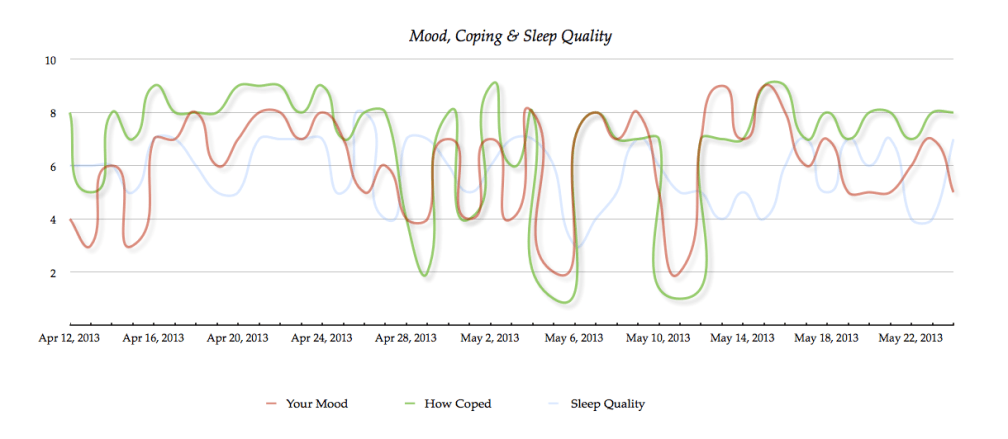
And one of my favorite things I’ve discovered is an app called Optimism. It’s an incredibly flexible mood tracking app, allowing me to chart anything from my general mood and ability to cope to how guilty I feel and the number of cups of coffee I’ve had. I’ve been using it for about two months now, and the results have been…interesting, to say the least. One of the neat things is that I can record notes with each day, which helps me go back and see when I felt a particular way and the possible reasons why. Here’s what it looks like:

Screen Shot 2013-05-26 at 10.04.15 PM

Interesting, no? Look at the few weeks of wild mood swings around the start of May. Looking back, this correlates to stress at work and a number of severe fights with Mrs. Satis. Now what would be really interesting would be to have a think about what external triggers might have caused these swings, and the possibilities are endless (and perhaps all true), from changes in weather to hormonal cycles.

It’s an ongoing process, but I feel a lot better about it than I did three or four months ago. I don’t know if it’s been external changes or the very nature of tracking my mood that’s helped, but either way I’m going to continue, because each day I feel better able to cope with myself and the world.