Thought of the Week: Oh, To Be a Dragon

I kind of have a thing for dragons.

You know what I mean. For as long as I can remember, these fantastic creatures have mesmerized me, awed me, and pulled me in with their frightful allure. There is a thrill in imagining the pounding of great wings overhead, of the shadow of that colossal beast as it passes over your head, of the dangerous intent in its eye as it bores its gaze into you.

Sculpture of a Chinese dragon

The history of dragons is long, and convoluted. Wikipedia has an excellent entry on them, but in a basic summary, dragons appear to have arisen in myth and folklore out of the common and widespread fear of lizards in general, and snakes in particular. Eastern and western dragons are substantially different, not only in their appearance, but in their demeanor, mythology and meaning as well. Snakelike in form, Chinese dragons are wise, long-lived, powerful and majestic. They are intelligent beyond men, and some legends hold that dragons first taught men to speak. Western dragons, with their legs and wings, are typically more brutal, representing a force of maliciousness and destruction, raining fire and poison from their throats.

I marvel at all of these, but it is admittedly the more western dragons that hold my attention (no doubt due to my upbringing). It’s likely that this was borne from my fascination as a child with dinosaurs (isn’t every young boy?); though I knew there were no longer dinosaurs, the idea that there could be, somewhere in the world, some living vestige of those incredible creatures fueled my imagination. I remember having a near obsession at one point over the Loch Ness Monster; I remember an odd movie with Ted Danson, of all people, as a scientist trying to prove the existence of the fabled creature. I loved that movie.
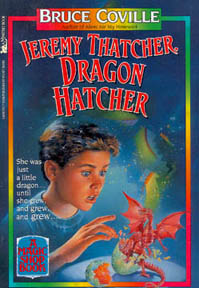
Jeremy Thatcher, Dragon Hatcher – Bruce Coville (1991)

Dinotopia, which I have already written about, bore the marvel of living dinosaurs to me, and the Skybax riders, soaring majestically on the backs of great, winged beasts, made me intensely jealous that I didn’t live on a remote, unknown island filled with saurians.

There have been numerous books and films over the years that have sustained my love of the creatures; I remember a lovely book from my childhood called Jeremy Thatcher, Dragon Hatcher. In it, the titular character comes across a mysterious object in a mysterious shop – a shop that disappears almost as soon as he steps out of it, carrying with him what he will soon discover to be a real, living dragon egg. He tends to the egg, hatches it, and begins to rear the wonderful creature as a pet. Soon, though, he discovered that the dragon – and he – have a much greater destiny, with the fate of the entire race of dragons in their hands.

Draco, from DragonHeart

Another favorite is DragonHeart, with Dennis Quaid and Sean Connery as Draco (yes – it’s a terribly imaginative name). A delightfully witty and dramatic adventure, it tells the tale of a prince, wounded in battle, who is healed by the generosity of a dragon – the creature passes to him half of his heart, so that he might live. Yet as he grows, the boy becomes ever more bitter, and his teacher – his mentor since childhood – finds himself banished from the kingdom for disagreeing with him. A dragon slayer by nature, he eventually comes across Draco (voiced so wonderfully by Sean Connery), and the two form an uneasy partnership, determined to end the prince’s tyranny once and for all.
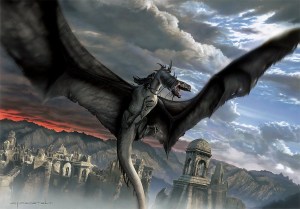
Rendition of a Nazgûl as they appear in Peter Jackson’s The Lord of the Rings films.

There are many others – Reign of Fire, Mulan, Harry Potter, The Hobbit (and The Lord of the Rings, if you count the Nazgûl),Beowulf, and even Shrek all have dragons or dragon-like characters; some benevolent, some evil, and some simply depicted as wild creatures, bent on destruction. However, the most recent addition to the wonderful canon of dragon tales is a movie Little Satis and I watched only recently: How to Train Your Dragon. I will admit, I was worried about this movie; I have no great affection for DreamWorks, as I generally find their animation substandard compared to Pixar’s, and their stories far less compelling than Disney’s. I am glad to say this time, however, I was happily mistaken.

How to Train Your Dragon is a surprisingly heartfelt and touching tale of a young viking who, though desperate to participate in the great dragon hunts of his village, is perpetually shunned for his mild demeanor and physical weakness. Desperate to gain their approval, he in secret designs a complex dragon-killing machine – and manages to bring down a Night Fury, one of the most feared dragons in the land. When he goes to find the creature, however, he discovers not a terrifying, vicious beast, but a frightened and badly wounded animal, just as hurt and alone as he is.

Toothless, from How to Train Your Dragon

In its fall, the dragon’s tail suffers an irreparable injury, leaving it unable to fly. Overcome with guilt, the boy begins the process of constructing a prosthetic tail wing – and in doing so, learns there is far more to the race of dragons than anyone had previously thought. Through the dragon’s healing, their bond strengthens, and the two will eventually lead the fight in an epic battle whose outcome will determine the fate of the vikings – and the dragons themselves.

For those of you who have been following The Redemption of Erâth, you’ll have certainly noticed that dragons have an important role to play in this world as well. Sadly, I have yet to come across a live dragon, so this is the closest I can get to seeing, touching, and breathing in the scent of one of these beautiful beasts.

What I wouldn’t give to ride on the back of one of these great winged furies.

Movie Night: Swiss Family Robinson

Welcome to Movie Night: a chance to sit back, relax, and take in a new piece of cinematic wonder with Little Satis and I. This will (hopefully) be a once-weekly post about the movies we watch together, snuggled up in the dark with a cup of tea and a pack of M&Ms. Enjoy!


Year: 1960

Production Company: Walt Disney

Leads: John Mills, Dorothy McGuire

Little stands out in my memory from my childhood as well as Disney’s 1960 version of Swiss Family Robinson. Along with such swashbuckling epics such as Treasure Island and Robinson Crusoe, its simple yet delightful tale of a (Swiss) family shipwrecked on a deserted island mesmerized me, and I lived and breathed the storms, the jungles, the fear and the smoke of the pirates’ attack. What young boy didn’t want to live in a treehouse with a monkey and an elephant?

This was something of a spectacle when it was released almost fifty-two years ago. A rare feat for Disney, it was filmed in epic widescreen, which allowed the luscious scenery of Trinidad and Tobago to sprawl across the screen. The opening scene, serving as a striking backdrop for the credits, shows a nineteenth-centry sailing vessel being battered to pieces in a savage storm. I marvel at this scene today; long before the age of terrible CGI sea storms, this looks, even now, stunningly realistic. The waves seem too large and detailed to be a miniature set, yet they clearly couldn’t have filmed it in an actual storm. My best bet is they made phenomenal use of the historic sets of Pinewood Studios.

Accompanying this dramatic opening is William Alwyn‘s beautiful, romantic-inspired score – strings, piccolos, timpani and haunting brass a musical match to the storm that could rival Wagner. Throughout the film, this score keeps pace, and though it occasionally descends into cartoonish cues, it provides a depth and drama to an otherwise amusing family adventure.

There are, of course, numerous instances that date the film, most notably the almost embarrassingly stereotyping of both women and races. There are only two females in the film – Mother Robinson and Roberta – and both are portrayed throughout as helpless and defenseless. I held a little hope when Roberta shows some skill at shooting, but she never ends up actually shooting any pirates – another terrible typecast. I’m pretty sure the oriental-ish pirates weren’t actually speaking any kind of language at all. Oh, for the sixties.

And of course, looking back on it now, how did I miss that the ‘Swiss’ family were all English and American? And why on earth did no one ever grow a beard? And for that matter, how did they build all that cool stuff? It’s sort of like someone had a sonic screwdriver to hand.

Either way, it’s a charming and lighthearted romp of an adventure, and Little Satis and I very much enjoyed it.

★ ★ ★ ★ ☆

Tales of Despair: Paranorman

Spoiler Alert: If you haven’t seen Paranorman yet, read no further!

I know what you’re thinking: isn’t Paranorman that stop-motion kids’ movie that came out earlier this summer? You know, the one with funny-looking zombies and plenty of goofs?

Yes, it is…sort of.

I took Little Satis to see it the other day – a kind of day-before-school treat – assuming it would be a good bit of fun. Something like Corpse Bride, I thought, or The Nightmare Before Christmas (goulish animation seems to be the exclusive realm of Tim Burton). I wasn’t expecting to find a movie that was surprisingly dark, genuinely scary, and ultimately heartbreaking.

Norman talks to dead people, and unsurprisingly, most people – including his parents – think he’s a freak. The only person who listens to him is the fat kid, who shares his torment.

The town he lives in, Blithe, is renown for the trial and execution of an evil witch some three hundred years ago. Soon, strange goings-on begin, and Norman is confronted by a crazy man claiming to be his uncle, telling him he must read from a book at the witch’s grave before sundown, or the dead will rise. Needless to say, the old man dies, Norman doesn’t make it in time, and a host of zombies – the seven folk who had sentenced the witch to death – rise from their graves: cursed by her to wander forever, undead. Norman, the fat kid and his unwilling older sister are now faced with delivering the town now not only from the hordes of zombies, but from the evil of the witch herself.

The darkness in this movie, however, comes not from the ghostly story or ghoulish characters, but rather from Norman himself; the creators of Paranorman made the (brave) decision to create a main character – in a children’s movie, no less – who is drowned in misery and depression. Norman passes through his life numb, bearing the torment of those around him, and never considering that there could be any other way of life. The thought of tossing a stick for a dog to fetch – the concept of fun – is entirely lost on him.

And of course, it could be no other way, for the ending of the story was as emotional as it was surprising. Gradually, we learn that the seven undead executors, far from being evil, are merely seeking rest – relief from the torment of living dead for over three hundred years. And when Norman hunts desperately to discover where the witch’s grave could be, he discovered a terrible, tragic truth: the demonic witch, scourge of the town and held as evil for three hundred years, was only an eleven-year old girl. For nothing more than appearing to control fire, she was hunted, trialled, and executed.

I was blinking back tears by the end of a movie I had expected to be thoughtless entertainment (after all, it wasn’t Pixar). But the misery, the tragedy of so young a girl, ripped from her parents by ignorant, fearful men and put horribly to death…it was so unexpected, and so sad, that my heart went out to her. In my throat was caught my heart when the girl’s ghost, finally spent of her rage, collapses to her knees and utters…

I want my mommy.

This was no children’s movie, despite what its producers would have us believe. It was something special – something that speaks to the bullied, the tormented and the abused in all of us. I am glad I saw it – and glad Little Satis did to, despite it all. The world is a dark place sometimes, and our children need to learn this: it will make them appreciate the light all the more.