Thought of the Week: What Should I Read?

All right, confession time: for a writer, I’m very poorly-read. I haven’t actually sat down to read a book in years.

I have my excuses: work, raising a child, working on my own books, depression, etc. etc. etc. The point is that, if I really wanted to, I’d have read. And I feel kind of embarrassed, and ashamed about that. What kind of writer doesn’t read?

I suspect that if I did genuinely have more time I would read, but when every free moment is spent trying to write, I just can’t get around to reading.

However…I’d like that to change. I’ve been away at this work training thing for two weeks by the time you read this, and I will have already chosen a book to read (this is a shame, because I would have very much liked your opinions). I may not even get around to reading that, but I thought I’d share with you the list of books I’ve bought over the past few years and simply never got around to reading.

The Lake, The River & the Other Lake – Steve Amick (2005)

The resort town of Weneshkeen, nestled along Michigan’s Gold Coast, has become a complex melting pot: townies and old timers mix with ritzy summer folk, migrant cherry pickers, wily river guides, and a few Ojibwe Indians. As the summer blooms, these lives mingle in surprising ways – a lifelong resident and Vietnam Vet pursues the take-no-guff deputy sheriff, while plotting revenge against the jet-skiers polluting his beloved lake; a summer kid from downstate stumbles into a romance with the sexiest rich girl in town; the town’s retired reverend discovers the Internet and a new friend in his computer tutor.

Little Wolf Slayer – Donald E. Cooke (1952)

Ship of Magic – Robin Hobb (1999)

Bingtown is a hub of exotic trade and home to a merchant nobility famed for its liveships-rare vessels carved from wizardwood, which ripens magically into sentient awareness. The fortunes of one of Bingtown’s oldest families rest on the newly awakened liveship Vivacia.

For Althea Vestrit, the ship is her rightful legacy unjustly denied her – a legacy she will risk anything to reclaim. For Althea’s young nephew Wintrow, wrenched from his religious studies and forced to serve aboard ship, Vivacia is a life sentence.

But the fate of the Vestrit family – and the ship – may ultimately lie in the hands of an outsider. The ruthless pirate Kennit seeks a way to seize power over all the denizens of the Pirate Isles…and the first step of his plan requires him to capture his own liveship and bend it to his will…

Steve Jobs – Walter Isaacson (2011)

The Charnel Prince – Greg Keyes (2004)

When the legendary Briar King awoke from his slumber, a season of darkness and horror fell upon the Kingdom of Crotheny. Now countless breeds of unspeakable monsters roam the countryside. An epidemic of madness has transformed peaceful villagers from the wildlands into savage, flesh-eating fiends. In Eslen, King William has been murdered, Queen Muriele is stalked by treachery on every side, and their last surviving daughter, Anne, has fled the assassins bent on destroying her family.

Close on the heels of the runaway princess, young knight Neil MeqVren, the queen’s one trusted ally, is sworn to rescue Anne from her murderous pursuers. Anne herself undertakes a perilous journey toward the sanctuary of her distant paramour’s arms, but along the way lie the sinister agents and hidden snares of a sprawling conspiracy that few might hope to evade.

At the same time, spies in the service of Praifec Hespero, the powerful Churchman, embark upon a mission to destroy the Briar King in the heart of his domain. And the power-hungry Church, spurred on by the mystical events, has launched an inquisition whose repercussions threaten even the queen. As the noose of intrigue tightens across the land, personal fates and a kingdom’s destiny alike will be decided in a conflict between virtue and malevolence, might and magic.

Full Dark, No Stars – Stephen King (2010)

The Song Spinner – Pauline Le Bel (1994)

Step into the land of Pindrop where Hush Laws keep everyone quiet. Very quiet. The melancholy ruler, Frilo, has decreed that even birds are not allowed to sing. Meet young Aurora who hears beautiful music in her head. While she does her whispering lessons like other good children and wears her Hush Cloth, she dreams of a day when everyone will may joyful sound again. Into this silent land, comes the mysterious Zantalalia. Banished to the Water World because she refused to stop singing, she has secretly returned in time for the Sunwatch holiday with a precious gift for Aurora. Now it will take all the courage Aurora can muster to get past the dreaded Captain Nizzle of the Noise Police and convince Frilo to lift the shroud of silence.

The Dragonriders of Pern – Anne McCaffrey (1988)

Wildwood – Colin Meloy (2011)

Prue McKeel’s life is ordinary. That is, until her brother is abducted by a murder of crows and taken to the Impassable Wilderness, a dense tangled forest on the edge of Portland. No one’s ever gone in – or at least returned to tell of it.

So begins an adventure that will take Prue and her friend Curtis deep into the Impassable Wilderness. There they uncover a secret world in the midst of violent upheaval – a world full of warring creatures, peaceable mystics, and powerful figures with the darkest intention. And what begins as as rescue mission becomes something much greater as the two friends find themselves entwined in a struggle for the very freedom of this wilderness. A wilderness the locals call Wildwood.

Trinity Fields – Bradford Morrow (1995)

The Pact – Walter J. Roers (2000)

In the summer of 1948, young Mike Dougherty and Ricky Stedman become firm friends and begin a series of adventures in their working-class Minneapolis neighborhood. Their pleasurable pastimes are overshadowed, however, by harsh family realities that the boys are slow to reveal to each other.

Shatner Rules – William Shatner (2011)

Featured image from http://tomorrowsreflection.com/forget-the-books/.

Satis Logo with ©

The Redemption of Erâth: Midwinter Pause

So I hope you’ve been enjoying Brandyé’s journey into the world of Erâth over the past few months. Throughout the last fifteen chapters we’ve seen Brandyé be captured by, and eventually live alongside, the seafaring Cosari. He reunited with his childhood friend Elven and learned of terrible happenings in his home country, and set out to discover the world with him. Along the way they met a mysterious race of beings called the Illuèn, who appear to know much of the world past, and something of what is to come.

I am just as excited to know where this is going as you are, but the time has come for a pause in the telling of this tale. My current focus during the autumn is going to be A Gothic Symphony, a work that I’ve been continuing for many years. I would like to finally see that near to completion, and this is the year to do it. Alongside this I will be working toward the (finally!) publication of the first book, Consolation. I can’t wait to get it back from the editor, and I’m becoming very anxious to send it off so that I can finally see it in print. If I can get it out before the holidays, that would be fantastic.

So what does this mean? Things will be quiet on the …Erâth front for a while. Expect updates when I get the manuscript back; I will certainly be letting you know how things are going toward publication! However, there will be no new chapters at least until the new year, at which point I hope to have the first book published and most of A Gothic Symphony finished.

It’s been a wonderful journey so far, and I hope you’ll forgive this temporary absence. I can absolutely promise you that Brandyé’s journey is not over; there are still five-and-a-half books left to write!

Take care, enjoy yourselves, and if you’re interested feel free to dive back into the world of Erâth from the beginning: all the chapters are here.

I look forward to seeing you in the new year!

~

Satis 2013

Thought of the Week: The Role of the Fantasy Sword

When I first began delving into the world of fantasy, a quest that would eventually lead to the world of Erâth, Brandyé Dui-Erâth and his journey into darkness, I came across a number of articles outlining common themes throughout fantasy literature. At first, of course, I thought I had to adhere to these commandments, laid down by the god of fantasy, J.R.R. Tolkien. As time, and the novel, progressed, however, I began to realize the value of originality, and discovered certain aspects that deviated from the tried and true classical form of fantasy. One key element was that I came to realize there were no true ‘heroes’ in my story. The protagonist, Brandyé, is weak, both physically and emotionally, preyed upon by both beasts and darkness. There are no master figures, no Aragorns or Gandalfs to save the day. There are people with kind hearts that nonetheless do cruel things.

The metaphor is (I hope) different as well. Whereas Tolkien’s darkness was (in my mind) a metaphor for the dismal horrors of war, for me it holds a much more personal facet: it is the great, all-consuming and unsurmountable darkness of depression and despair. The world is already covered in darkness; the forces of good have already lost. Our hero has no conviction, and despairs that he can ever do good in his life.

However, there are still many elements that fit neatly the stereotype of high fantasy, such as a dark lord, fictional worlds and languages, a quest to defeat said dark lord, kingdoms great and small, etc. And one of the elements preserved, though I didn’t know it at the time, was the fantasy sword.

Narsil

The Shards of Narsil

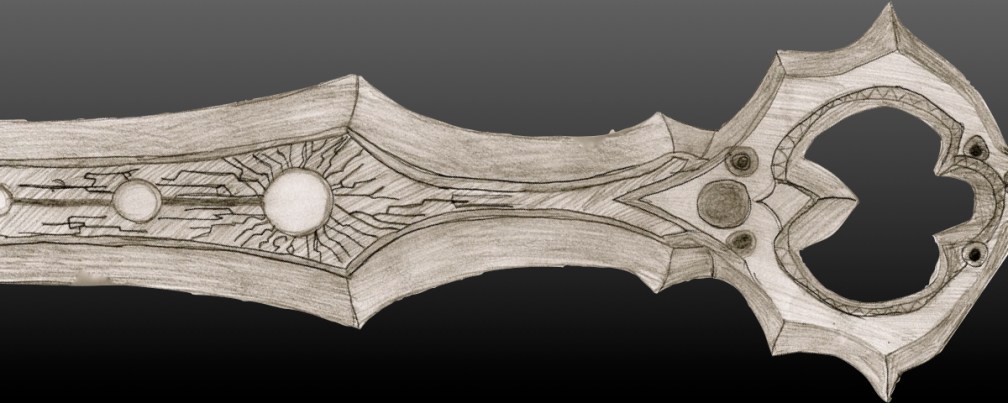
Nearly every high fantasy story I can think of (though I’m not as widely read as I should be) has swords, which is natural for a genre that tends to romanticize the middle ages. But more than that, there is usually at least one sword, if not several, that has a merit beyond its ability to kill. These swords have a history, their forging is legendary, their uses are magical, and in the right hands they are undefeatable. The Lord of the Rings has NarsilElric has StormbringerHarry Potter has the Sword of Griffindor, although I would argue that the wands represent the same functional place as these others. The Redemption of Erâth has Namrâth.

It’s hard to deny that these swords are an integral part of such fantasy, but it became curious to me that it should be so. Certainly swords are necessary if the story is to contain fighting of any kind, and it would be poor fantasy indeed if there were not epic battles involved. But the question remains precisely why it is so important that there be at least one sword with mystical origins and powers.

I have one or two thoughts on the matter, which may or may not be way off the mark. Wikipedia has a fantastic list of famous fantasy swords, and one of the first things I noticed is that, with the exception of J.K. Rowling, every author who has invented such a sword (including myself) is a man. Cue the obvious sexual innuendos. High fantasy rarely has sexual content of any kind, and even romance is often sidelined (the relationship between Aragorn and Arwen in The Lord of the Rings is hardly touched upon in the book, as opposed to Peter Jackson’s film versions). And it’s easy to see how a great, whopping sword could be seen as a phallic symbol. (Interesting, then, that Rowling’s wands are so small!) These swords are themselves almost invariably wielded by men, and represent their great strength and prowess. It’s certainly possible that, consciously or unconsciously, these magical swords represent the manliness of their bearers.

A magical mace?

A magical mace?

Another, more mundane explanation could be that there have to be mystical swords. After all, what fun would it be if the great demon lord was defeated by any old blade kicking around on the battlefield? Great, magical beings require great, magical weapons, and the sword is the natural weapon of choice. (Brandyé, in The Redemption of Erâth, actually carries a crossbow for the majority of the first book.) But why not magical maces, or whips (Indiana Jones, I suppose), or daggers? Perhaps because there is something clean about a sword, that it can effortlessly stab, slice and decapitate with little or no mess. A great spiked mace is a pretty messy weapon, it has to be said, and high fantasy is, along with being romance-less, usually pretty bloodless.

Finally, the thought that comes to me is that the magical sword represents power greater than the wielder can manage; the metaphor of runaway technology leading to the wars in which they are actually used. Elric’s Stormbringer, sucking the souls of any it touches, is exemplary of this: the sword is a curse to its wielder, who becomes ever more bound to it the more he uses it.

Perhaps there is another, socio-psychological answer to this pondering question; if so, I am too blind to see it. Perhaps the fantasy sword just is, no questions asked. But I’d like to turn this over to you: what do you think the purpose of these fantastical swords is?

Featured image taken from http://www.deviantart.com/morelikethis/artists/274055104?view_mode=2.

Satis Logo with ©