Tales of Despair: The Music that Ended his Life

All great composers have died in despair, whether they saw fame in their lives or not. They have died deaf, they have died blind, they have died young and old, rich and poor. In times past their music lay forgotten, and they themselves were left behind, pop artists of the past, ever replaceable.

This man died some long time ago, and his was a tragedy beyond most. He passed, throughout his life, from jubilant exaltedness to raging despair, writing a phenomenal number of works, doubting himself at every one. As he grew older he grew beyond his time and his world, and the music that he wrote for himself – for he rarely had the grace to write other than at others’ commissions – was unpleasing to his listeners. His most successful works during his life were stupefying inanity, poor jokes written for great men of little intellect.

Paraded as a child, he spent little time at any one home, and the racing of his travels fostered a miserable wanderlust in him, an inability to settle for the rest of his life. Drawn away from his mother for great periods, he became hypochondriacal, eventually taking to self-medicating with antimony. He was only twenty-two when his mother died, and was thrown into grief from which he never recovered; he was by now so poor that they didn’t even have the money to call a doctor, something that would haunt him for the rest of his short life.

For nearly a decade, he moved from job to job, never able to settle or to find an income that would support he and his family, which now included his wife and their children. Even in his familial life he was not free from grief and despair; the couple watched in hopeless horror as their first child lived for only two months. They produced a healthy boy not long after, but his future siblings lived, all but one, not more than six months. While it is one type of horror for a child to die after birth, as did their daughter, Anna, it is of a deeper grief entirely to raise a child for six months, watch them grow, sit, smile and laugh – and then have that child taken from you just as you thought the worst was past. Their final child together, Franz, lived to adulthood, but he would never know – he would only know this boy for four months.

His father died when he was thirty-one, and he was suddenly the head of his family and of his home, and was without a job, without money and without hope. Sometimes he would produce a work that was taken with success; this would be followed by great periods of utter poverty. Near the end of his life he grew increasingly ill, suffering from malnutrition, poisonous medication and anxiety, and he grew paranoid of all those around him. When he was asked to write a piece commemorating the death of a wife of a person he had never met, he labored over the score in his illness and grew ever worse.

His wife, seeing his despair, begged him to cease writing such dreadful music, and for a time he ceased, and as his despair lifted, so did his health. It was not to last, however – whether from over-enthusiasm at the prospect of regaining a little of his health, or a fractured mind bent on his destruction, we shall never know, but in his final months he turned back to the writing of this requiem – and died before he could complete it.

It was eventually completed by one of his students, and performed at a benefit concert for his widow. He would never know, buried in a common grave, but he was to rise in renown within a very short period, and even those works of his that were spurned became famous. His wife would remarry, though he heart remained always with him; she and her second husband, whom she would also outlive, worked together to write his biography. It would have been of comfort to him, certainly, to know that his wife and children were not to die in the terrible circumstances he had left them in, and that both of his sons would receive one of the best musical educations of the time.

He would have been equally proud, no doubt, could he have known that the unthanked labour of his short life would one day rank among the most celebrated music in the world, performed, heard and loved to this day. It is unquestioned, still, that his Requiem remained his crowning achievement.

Wolfgang Amadeus Mozart (1756 – 1791)

Tales of Despair: Perversity

The grunts of his sister and her clients ring loud through the thin partition. Emile hates her as he hates all women; women have only ever spurned him.

Later, her lover beats him, and then invites him to eat with them. Irma will not stop him, though she tends to her brother when he is gone.

Bebert does not like him, and is satisfied when Emile squirms. In the end he will stab Emile in front of his sister. Again, she will not stop him.

Emile will buy a gun, and will desire Bebert’s death; it isn’t his that comes.

Such are just some of the scenes that bring to life Francis Carco‘s (1886-1958) frankly stomach-churning painting of 1920s Parisian slums, Perversity (French: Perversité). The story is bleak and desperate, centered around three loathsome characters and filled with little hope. Emile is a clerk, unable to function without the reassurance of strict routine. Irma is a prostitute, working from her bedroom in the tiny, two-room apartment she shares with her brother. Bebert is the bully of the tale, lording ownership over Irma and taking great delight in the torment and abuse of Emile.

What is particularly unsettling about Perversity is Carco’s unflinching dedication to the deeply disturbing faults he has built into his characters, and he allows them no redemption. Emile and Irma are pushed to edge of human decency, and repeatedly make decisions that seem against the very grain of morality, yet each time we are left with the knowing that there was, of course, no other way it could have been. One of the most discomfiting scenes occurs half-way through the story, when Bebert walks in to find Emile and Irma talking together. As Emile shrinks away from him, his sister points out that he is afraid of Bebert. Rather than allowing his characters to escape  with a mere argument, Carco builds a tension so great that it is only finally released when Bebert brings out a pocket knife and stabs Emile repeatedly, smiling all the while and insisting that such ‘pricks’ don’t hurt at all, and he shouldn’t act as such a baby. When he is finally finished and allows Irma to bathe him in salt, she comes to him and tells him that Emile is bleeding profusely. His callous response is that such a thing is “quite natural, I assure you. It’s rather the contrary that would astonish me.”

I have read no other book that so encapsulates the despair and hurt of inescapable depression, and forces it on the reader without sympathy. This is a terribly uncomfortable read, and I found myself unable to continue at certain points, often for weeks at a time. Ultimately, it was a rewarding experience, for it is a tale that draws you in and does not let go. The uniqueness of this story is that it is not tension, fear or suspense that hooks its teeth into you, but rather the grim, hopeless lives of these three people who have no reason to live, yet push on regardless in spite of the filth and the pain.

Perversity is available in print and for Kindle on Amazon. Read it at your peril.

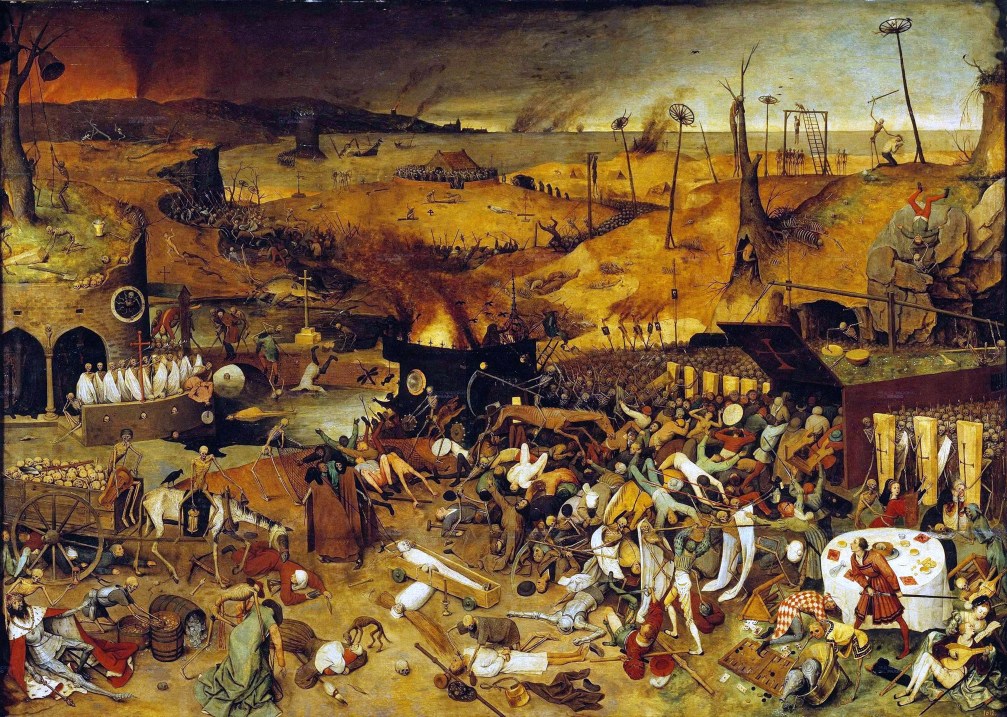
Tales of Despair: The Triumph of Death

I am no student of art, and I know little of the medium and its history. However, I came across this painting some years ago, and even to my untrained eye it is exceptional for its time.

Pieter Bruegel (1525 – 1569) was a Flemish painter at the height of the Renaissance, when secular art began to be accepted in European culture, and people suddenly started painting people and fish, and not just god. Bruegel in particular has become renown for his paintings of everyday life, depicting peasants, hunters and even beggars, working hard to capture the scenes all around him (a kind of 16th-century George Bellows). In many of his works, however, he allowed fantasy to creep into the scenes, such as Landscape with the Fall of Icarus.

Detail showing a king, all his riches powerless to slow the advance of time, and the coming of his death.

Still, none of his paintings (including Dull Gret) come nearly as close to the dark and twisted nature of The Triumph of Death. This is a massive work – the original is some five feet across – and it portrays hundreds of figures, fallen upon by an army of death. There is too much here to even begin to go into, so complex is the entire painting, but there are some points within it that genuinely stand out to me.

Overall, it seems painting seems to emphasize death as the lord of all – kings and peasants as one fall victim to its clutches. In one corner, a great king, cape in ruins, cannot prevent a grinning skeleton from pillaging his gold. As a reminder of his despair, a second skeleton holds up an hourglass, driving home the fact that he will not long last in this world.

Detail showing a man and woman playing music, unaware of death mocking them behind; a moment of black humor in an otherwise bleak work.

The detail of the agony and despair in this painting is astonishing, and excruciating; every inch of canvas is covered by death. Even where there are people yet alive, death is yet hounding them. In one small detail, a man, stripped and naked, seeks refuge from the horror by hiding under the roots of a tree. It is, of course, futile – a spear protrudes from his back. In another, a man fleeing desperately, is set upon by the starved hounds of hell, while a skeleton looks on nonchalantly, waiting as they take down their prey. In particular, though, I am drawn to a small detail that shows two people – perhaps the only people in the entire painting – who seem unaware, or unaffected, by the death and torture around them. The man is playing a lute; the woman is singing from a songbook with him. The man looks worried, as though he perhaps should be thinking about something other than their music, but the woman rests a reassuring hand on his shoulder, and carries a calming expression, as though music is untouchable by death. In an inspired moment of irony, Bruegel adds a skeleton, hiding behind them, accompanying them both on the fiddle.

Church – and god – are no escape for the coming of death.

Though the Renaissance was, of course, a time of artistic awakening, religion was nonetheless and inescapable and fundamental part of culture, and every person’s life. Prayer, and the hope of an afterlife, was often the only consolation for peasants who slaved for a lord, starved, and grew ill with terrible disease. For Bruegel, however, even the church is unable to give deliverance from death; in what may have been nearly heretical at the time, he depicts the skeleton army invading the house of god, desecrating its windows, drowning people in its river, and mockingly calling the ring of silver trumpets. To the right, a very large portion of the canvas is given to showing the skeletons herding people in droves into a cross-embossed box, while their armies await on either side, holding shields bearing crucifixes. It is as though Bruegel was verily denouncing religion itself as false hope of life.

The scene is a grim twist on the artist’s nature and style. Whilst many of his works depict ordinary scenes of peasant life, here he takes a scene from almost every class imaginable, and treats them to the same horror and finality. The princes and the poor, the pious and the sinners, all succumb alike. In the distance, the fires of hell glow bright, while skeletons ring a great funeral bell. Ships burn on the horizon, and the earth is barren of all growth. The only life that seems to persist are the crows, likened as always to companions of death.

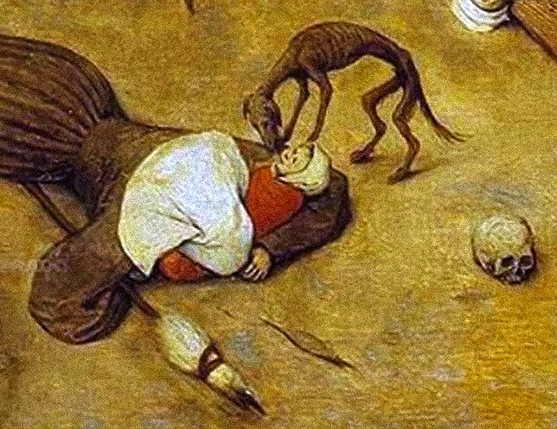
In Bruegel’s eye, death spares no one, and nothing. By the river, a large whale or dolphin lies butchered, and in the distance, skeletons hack at the few remaining trees. However, the true depth of the artist’s horror, and the epitome of death’s cruelty, is in a small detail at the bottom of the painting. Prostrate, a mother lies dying, her bundled infant dead in her arms. The true ghastliness of this scene, though, and the terrible truth of death, is the skeletal hound of hell, feasting on the dead child’s flesh.