Thought of the Week: Get Inside Their Head

A couple of things this week have got me thinking about the concept of empathy, and what it takes to actually think along someone else’s lines. This is something of a two-pronged thought, for the idea of being able to put yourself in someone else’s place is dreadfully important, both in fictional writing and in real life.

I owe the inspiration for this post to The Random Fangirl for her excellent post on bullying. Apart from the naturally troubling nature of such a subject, there was something she said at the end that really got me thinking:

And I didn’t understand. And I still don’t understand. Didn’t these people have parents who taught them better? Couldn’t they see the pain they were causing? Didn’t they care?

Now, empathizing with bullies – particularly those who abuse, harm and kill – may not sound very tactful. But bear in mind – empathy is not sympathy. I couldn’t help but wonder if I could understand, if I could out myself in the place of a person who could willingly cause such harm.

The initial reaction to this is to rationalize. Something must have happened to them in their youth. They must have terrible home lives. Perhaps they genuinely are psychopathic, and unable to understand the feelings of others.

The trouble is, this is the very antithesis of empathy – there is no emotion here. It is incredibly difficult and painful to force yourself to feel what another person feels – all the more so when you find their actions abhorrent. Think for the moment about the phrase “in one’s shoes”; the implication is of switching places, literally standing where the other person is.

Imagine you witness a terrible beating; a person is punching, kicking, tearing and clawing at another – or perhaps you – and will not stop, despite all the screams, the tears, the pleas and the blood. Now, imagine you are the person delivering the abuse. Don’t make yourself stop – continue beating that poor person within an inch of their life.

Why are you doing this? What terrible events could possibly have led you to enact such violence upon another person? What would possess you to continue kicking them in the teeth even as you look upon the blood and the tears and the fear?

And here is the crux – the crossing point into genuine empathy. Answer those questions, genuinely and from the heart. Don’t stop until you uncover the reasons why you would do such a terrible thing. It won’t be easy – you’ll almost certainly be outraged, and unwilling to acknowledge that you could ever be capable of such injustice, because it is so far from the core of your being.

But what makes you different from that terrible person? We are all of the same ilk at birth. For me, the only reason I have to descend with such viciousness upon someone is pure, blinding hate. Then I am given to ask – what could cause such hate, especially if this person hasn’t wronged me? Perhaps I am convinced they have – I see something within them that I am desperately jealous of. Perhaps I am terrified of them, and see no other option – like killing a wasp so it won’t sting me. Then a new question follows this – why am I jealous?

This line of thought will lead you to a great many questions, each one burying down into a new depth of your own soul, into places you didn’t even know existed, or worse, wouldn’t accept. This has taught me that I would most certainly be capable of such despicable actions – in just the right scenario and given the right set of circumstances that led to it. It will be torture to acknowledge these terrible parts of you, but if you can face it, if you can admit to your own failings and insecurities, you might find yourself suddenly able to understand behaviors that you, yourself could never dream of doing.

And this very same line of thought applies to creating the characters in your story. No matter how brilliant and inventive your plot, the entire story hinges on the believability of your characters. Unfortunately, this is probably the hardest part of writing. Hands up who is 100% confident of the quality of your dialogue. What’s that? Only a few? I’m right there with you. Why is it so hard to write convincing dialogue?

For me, part of the reason for this is the instinct to write dialogue out as though I was speaking it myself. All of it. Imagine watching a movie where every character spoke in the same way! Come to think of it, this does happen in film – think of someone like Johnny Depp. For all his brilliance as an actor, a huge number of his films rely on him being Johnny Depp, whether he allows it to run rampant (Pirates of the Carribbean) or tones it down (Charlie and the Chocolate Factory).

It becomes all too easy when coming up with a storyline for the characters to become the vehicle to carry the plot to its end. The difficulty here is that it can lead to shallow characters, who speak only to further the plot, and act as needed, not as they must.

So I would encourage you to do the same soul-searching for your characters as you would for other, real people. Imagine yourself stabbing someone in the back, or having to decide between saving your by friend or your lover. Forget the plot you intended – it might not work! Follow your character, see what they get up to, and above all, imagine yourself in their place, and then ask yourself: why would I have done this? Your characters – and your readers – will thank you.

Your friends just might, as well.

Tales of Despair: Werewolves in Suburbia

This is a tale of depression, misanthropy and suicide. Of coming of age, and of dying. It speaks of the banality of modern society, and the terrible havoc of a demon from long ago.

In a basement, two sisters live. In the dim light, they dream of their escape, by flight or by death. In the waking world, they are disliked by all; in the dungeon of their home, their dislike is only for themselves, and for life. Though their parents live above them, they have little contact with them, and the disconnect between their lives is total.

And then, the eldest sister is mauled by the beast. They know not what the beast is, nor its provenance, but the girl’s transformation becomes slowly unmistakable. The physical is preceded by the mental and the emotional, and she turns upon her own sister, ostracizing her in favor of encounters that satisfy her newfound and ravenous sexuality, and her equally ravenous and terrible appetite.

Refusing to leave her sister to her fate, the younger girl pursues her, even as she starts down an irreversible path of death and destruction, beginning with the devouring of pets, and leading to the murder of a local girl. In a rare lucid state, the elder sister helps her sister bury the dead girl, but the realization comes to the younger one’s mind that her sister is not the person she once knew: she would eat the dead girl, given the chance.

Desperate to redeem her sister, her only soulmate, the younger sister discovers a possible cure – but it is too late. Despite barring her in their shared bathroom, her transformation has become too great, and she escapes, leading her to their school. Frantic, the younger sister follows her, encounters her as she seduces a boy, the only one who believes the truth of her transformation. In pain and torment, they subdue her, and drag her to their home, where the last dregs of their cure remains. But it is too late – her transformation is complete. Now a beast herself, the boy is murdered before her eyes, yet her devotion to her sister, terror through she now is, is resolute: she will cure her, or release her from her pain.

And in the end, of course, the cure is forsaken, and the girl, weeping, is left with no choice, and plunges the knife deep into her sister’s heart, listening to the beast’s slow and ragged breathing until, finally, it ceases.

Go watch Ginger Snaps.

Tales of Despair: Standing on the Edge, and Daring to Jump

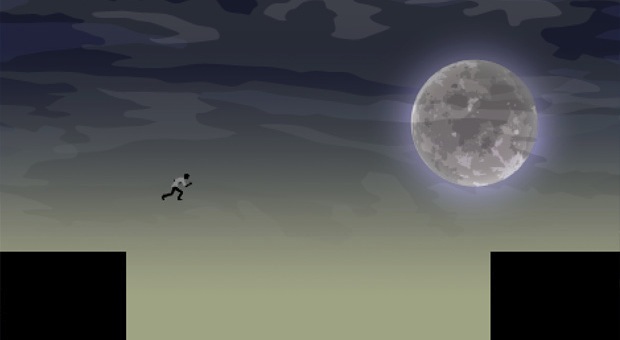
There is a game I played on my iPhone. It’s called One Single Life and I didn’t play it again. The game’s concept is very simple: you run, you jump, and you land on the next building. There is just one catch: if you die, you die. You do not get a second chance. This is one of the most thrilling games I have ever played; the knowledge that my quarter-inch avatar is about to leap quite possibly to his tiny death sends tremors to my fingers. My heart beats fast, and my palms are as dry as dust. I am terrified.

I know this sensation well, and it is the pause before the leap. In my youth, I spent a great deal of my time rock climbing, mostly at indoor rock gyms since the weather was usually bad. Some of the long routes were scary; one curved wholly over the ceiling of the gym, some sixty or seventy feet off the ground. Still, there was always a sense of safety, of a second life: the floor was cushioned, you were roped in, your climbing buddy had you.

But there was a time when a friend and I went walking in the Swiss Alps. I say walking, but we were young and foolish, and couldn’t resist the temptation to race each other up small cliffs here or there, quite proud of our budding climbing skills. This naturally delayed us, and we found ourselves quite late in the day still on a glacier, not even close to where we needed to be, and so decided quite wisely to take a shortcut over a low peak to the north. The peak had looked innocent enough on the map, but when we arrived at its base, we realized we were faced with a hundred-foot cliff face that was not quite vertical…and of course we just had to climb it. After all, it would surely be faster than going around.

I won’t speak of the abandoned Swiss military base at the top of this mountain – that is for another time – but it was halfway up this ridiculously foolish ascent that I first truly realized that I could die. Despite my confidence, the rock was loose, and in grasping for a handhold, the stone simply came free in my hand. For a single, endless moment, I wheeled slowly, sickeningly away from the cliff, releasing the rock and knowing it might hit my friend below me, and all the while grasping in utter desperation at the cliff with the two remaining fingers that attached me to it. Somehow – I have no memory of it to this day – I did not release my grip from the wall. I believe I was in tears when we finally arrived at the top.

The free fall in the stomach, the dryness of hands, the hypersensitivity to every touch and sound, are the hallmarks of standing on the edge of death. Sadly, my experience in the Alps was not the only time this sensation came over me. Countless times since then, I have found myself on that edge, often with a blade to my wrist. I have lived with people who have stood on that edge with me, and we would stare into the darkness together. The sensation, as the steel bites into your skin, or the rope rubs roughly on your neck, is not of pain, or of comfort, or even of anguish: it is the dusty, gliding feeling of standing right on that edge, toes over the abyss, and deciding to leap.

In the end, I never leapt. Some I know did, but were caught, and survived. Some leapt and we never saw them again. I could never overcome the sensation, the thrill of death that had saved me that day in the Alps, and fell back from the edge each time. I was crushed, dismayed, guilty and furious, and all this would collapse into the deadness that I was doomed to live for yet another day; but I was nonetheless alive.

This was all some time ago, and though I still see the edge each day, I keep my distance. I wouldn’t want to fall off by mistake. I can’t convincingly say that the fear of the leap has taught me anything, but I am glad of it, for had I jumped I would not know my wife, and I would not know our son, and the world would have been a darker place.

Still, I wonder at the thoughts of those others, at the moment they chose to make the leap. I imagine it was release – the final decision they would ever need to make was done, and there was no need to look back.