Thought of the Week: The Energy Barrier

One of the things that used to afflict me terribly in my days of depression was the utter inability to find the energy to actually do anything. The very thought of even the simplest of tasks – getting up out of bed, or brushing my teeth, was more than I could bear.

As my depression mutated, evolved, and turned into a variety of other, yet-undefined mental disturbances, this has stayed with me. It isn’t always the case, of course – hell, I wrote a damn book; something got me going with it! But there are things I simply can’t stand doing, and when faced with them, I build up a mental resistance to even the thought of it, and it becomes impossible to get it done.

Do you have any idea how dry our grass is right now? And the sprinkler is sitting by the back steps, right next to the hose!

Gargh.

I remember, many years ago, my father explaining something to me. It was a rare instance of empathy, a point where, inexplicably, he actually said something that made sense to me. Maybe it was a fluke.

He said that, in the process of thinking about activity, there is a mental energy barrier. The nutshell version is that it requires far more energy to convince yourself to do something than it actually takes to do it. And it’s true; four days of dread, of procrastination and excuses…and in the end, the garbage was taken out in about thirty-six seconds.

All right, I didn’t actually time it. It might have been longer – after all, I had to take it all the way from the kitchen through the back door (in the kitchen) to the garage (next to the kitchen).

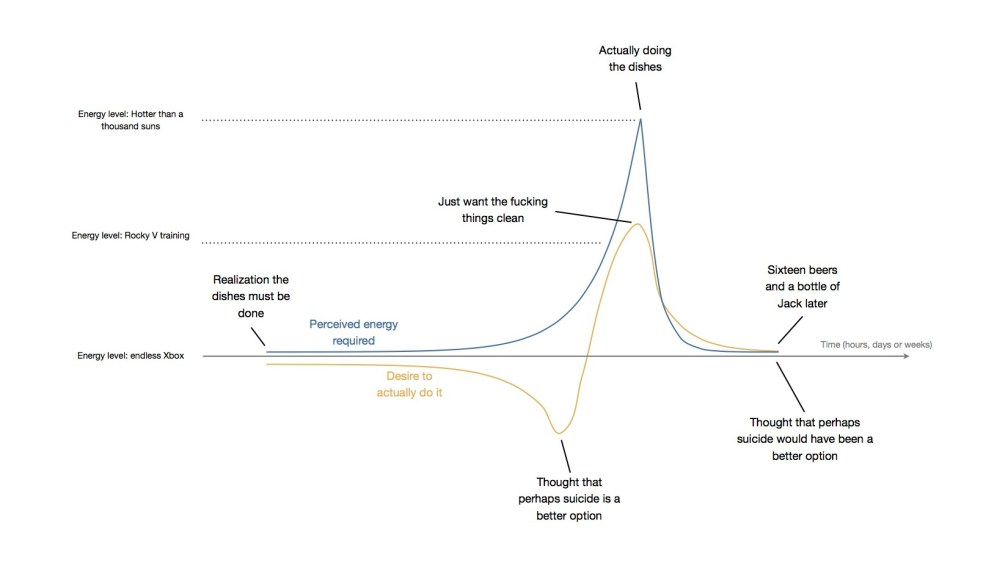
My worst vice here is doing the dishes. Here is a graph of what it takes to do them; hit ‘Like’ if you know what this feels like! Oh, and bonus points if you can spot the Iron Maiden reference.

I’ve timed myself: it has never taken me more than fifteen minutes of my life to do the dishes. Maybe twenty if I include scrubbing the stove down. Yet it is the one thing I dread more than any other in my daily life. Having to chase and swat the hornet in the bedroom doesn’t even come close. Sometimes it gets to the point of a full-blown panic attack, and images of sporks and plastic cups, festering with mould and rising up against me, fill my mind.

And that damned energy barrier is to blame. Look at it: I think there’s a point just before the peak where my head has actually exploded, and the brain bits are dancing on the walls singing the song about pure imagination from Charlie and the Chocolate Factory (please don’t ask why).

Sadly, I don’t have a satisfying conclusion to this post. I still haven’t figured out a way around this, and I still have dirty dishes hanging around in the morning, like the party guests who got too hammered to drive home. They’re a bit of an embarrassment.

I’m reminded of Einstein’s theory of relativity, and the thought that as an object approaches the speed of light, the energy required to do so approaches infinity.

I desperately need a wormhole. Or maybe a house elf.

Music I Love: “Crimson”, Sentenced (2000)

Sentenced are a genre-defining band in many ways; hailing from Finland, their career has been marked by music of an intense, dark and depressing nature. Beginning as a melodic death metal band, their seminal album Down (1996) saw a departure from the guttural vocals, leaning towards a more melodic style, both vocally and musically. This was followed by Frozen in 1998, which furthered the new melodic style of the band. However, it was two years later, in January 2000, that Senteced pulled it all together, and released (to my mind) the most perfect album of their career: Crimson.

Sentenced’s themes universally revolve around depression, loss and death, though there are – every so often – rays of bitter hope that shine through. One of my favorite songs, Brief Is the Light, from their 2002 album The Cold White Light, contains the words:

Hear these words I say;

Make the most out of your day

For brief is the light on our way

On this momentary trail

Hear these words, awake:

Make the most out of your day

For brief is the time that we’re allowed to stay

However, there is little of this hope on Crimson, an album dominated by self-loathing, guilt and despair. At the time of its release, I was in a very dark place in my life, and every word on this album spoke to me, intimately. From the opening track, Bleed in my Arms, we hear of the destruction of love, for nothing but the knowledge that it is the only thing to do, the only just self-punishment. The second track, Home in Despair, is perhaps one of the most immediately identifiable songs to anyone who has suffered depression:

Again the sky has fallen down on me

Once more a world has crumbled down and over me

 [break]

And yet in some twisted way

I enjoy my misery

And in some strange way

I have grown together with my agony

 [break]

I feel home in despair for I dwell in grief

And I feel home when the air’s too thick to breathe

And I feel home anywhere human lives are going down the drain

 [break]

For as long as I remember life has been hard

I guess they have “misery” written somewhere in my stars

[break] 

For I have mourned for so damn long…

That I’ve forgotten what it was for

Everything has gone so wrong

That I really couldn’t think of anything more

[break]

I feel home in despair for I dwell in grief

And I feel home when the air’s too thick to breathe

And I feel home anywhere the light of the day is drowned in heavy rain

 [break]

Yet I know the worst is still to come

A further departure from their traditional style, the album opens to a slow-paced tempo, and in fact doesn’t pick up at all until Broken, five tracks in. The mood of the entire album, from start to finish, is morose, doomed, and dark. Halfway through, we have the anthemic Killing Me, Killing You, perhaps the best known song from the album. In some ways, this song of a torturous relationship is, if anything, the high point of the album, followed by an unstoppable descent into the black, all the way until the final, dying My Slowing Heart.

This is an incredibly strong album of frailty and despair, and its words speak a powerful message of depression. One of the most memorable, and heart-wrenching lines comes from Fragile, three songs in:

Sometimes it feels it would be easier to fall

Than to flutter in the air with these wings so weak and torn

Sentenced disbanded deliberately in 2005; a sort of pre-announced musical suicide. There could be no better end for a band so lost in despair.

Tales of Despair: Falling Through the Roof

October 2nd, 1988.

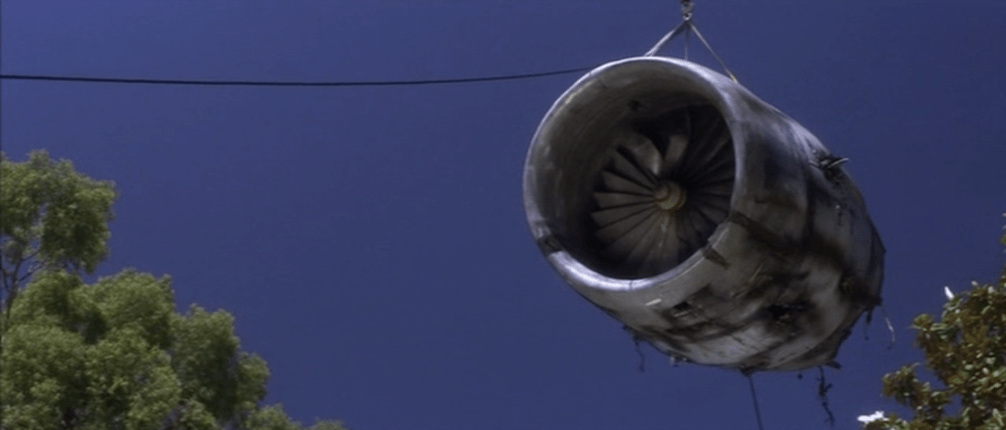
An airplane engine falls through the roof of a teenage boy’s home, and should have killed him: should have, had he not been lured out of the house by an enormous rabbit.

Sound familiar? Then you’ve probably seen Donnie Darko. It is a masterpiece of dark cinema, a mind-bending trip into the world of insanity, and it does so in the most realistic of ways: by making the insanity appear sane. For ultimately, this is what we think, isn’t it, those of us whose grip on reality is tenuous? It’s the world that’s gone mad.

The rabbit plagues Donnie; the rabbit tells Donnie the world is going to end in twenty eight days, six hours, forty-two minutes and twelve seconds. And oh, Jake Gyllenhaal does such a good job of believing it, never doubting it, and descending into the madness that comes with the freedom of knowing it’s all going to end. Yet all the while, we remain rooted firmly in the real world. School goes on; work goes on; life goes on. The rabbit is an illusion; the rabbit is real.

Certainly, the world doesn’t seem like it’s going to end. Nor does it for any of us, of course. Almost certainly, when the end does come, it will be abrupt, it will be instant, and we won’t know any different. But Donnie…oh, Donnie knows.

And it is despair that comes with this. The knowledge that any thing, any action, is meaningless. He burns down the principal’s house, and it is meaningless. A vile secret is unearthed because of it, and it, too is meaningless. He falls in love…and it is meaningless.

The story behind this film unravels the very nature of what is real and what isn’t, and in a very Descartian way dissects the meaning of armageddon. For if we end, the world ends, and there is no way of knowing otherwise. It is an end of life, an end of existence, and most importantly, and end of self.

And in the face of this ending, the destruction of self, Donnie is given a choice, and the choice is this: to let the world end…or to let the world end.

Few people will be given the chance to learn of their death before it comes. Fewer still will make the choice to roll over in bed, and let the engine fall through the roof.